
Choose the load-bearing contact before choosing the gripper. A core grip is a useful starting point when the package surface must remain untouched, but only if the actual tube can carry the package through the planned turn. An outer grip needs an acceptable contact area on the winding. A supporting tool needs room to enter, carry and withdraw at the receiving position. The right choice can therefore change between picking a package up and putting it down.
What the turn changes
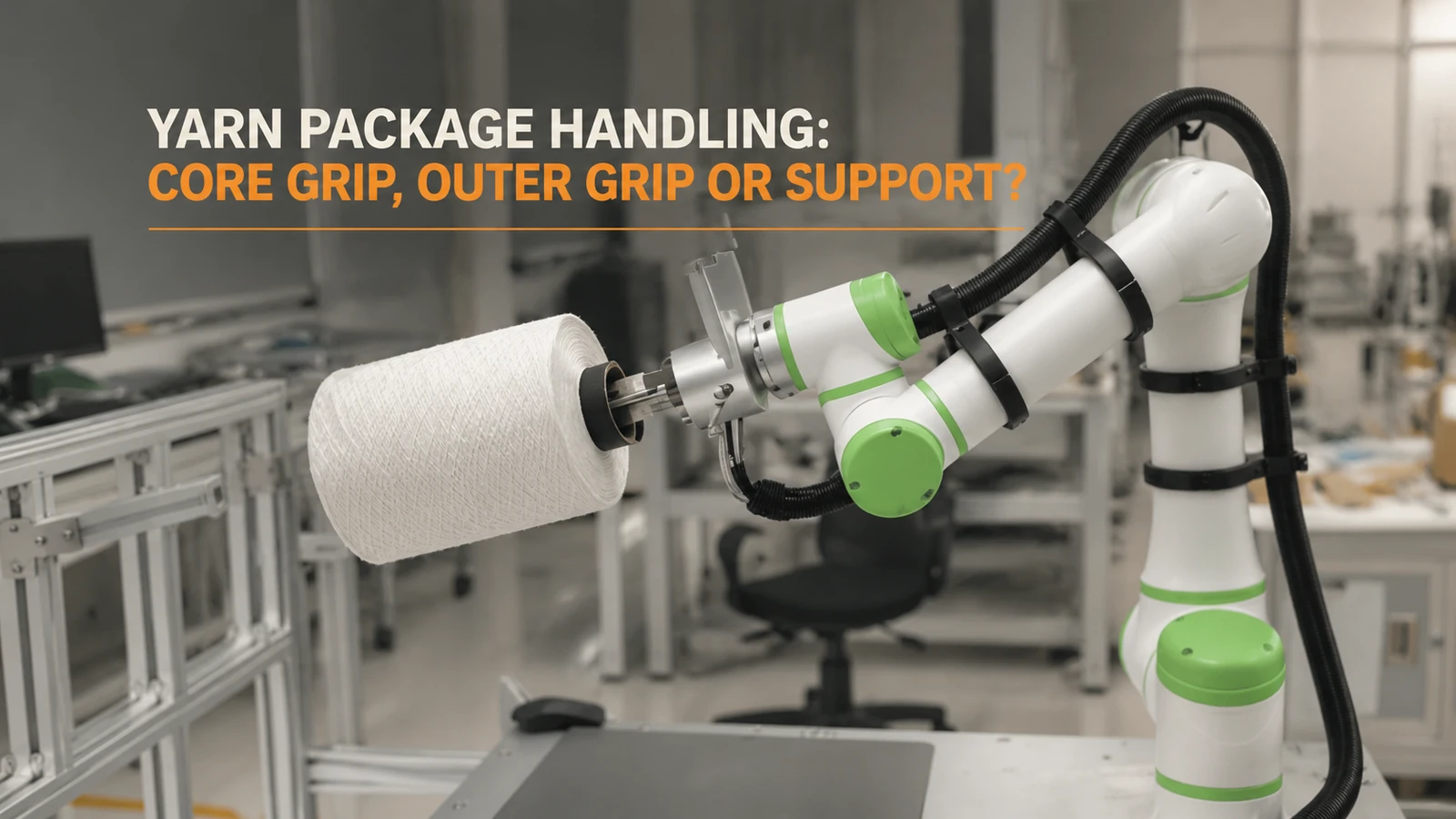
In this handling demonstration, a robot engages a white yarn package at the core opening, raises it, turns it towards a horizontal orientation and returns it upright to the table. The useful detail is the change of orientation: a successful vertical lift is only one part of the task.
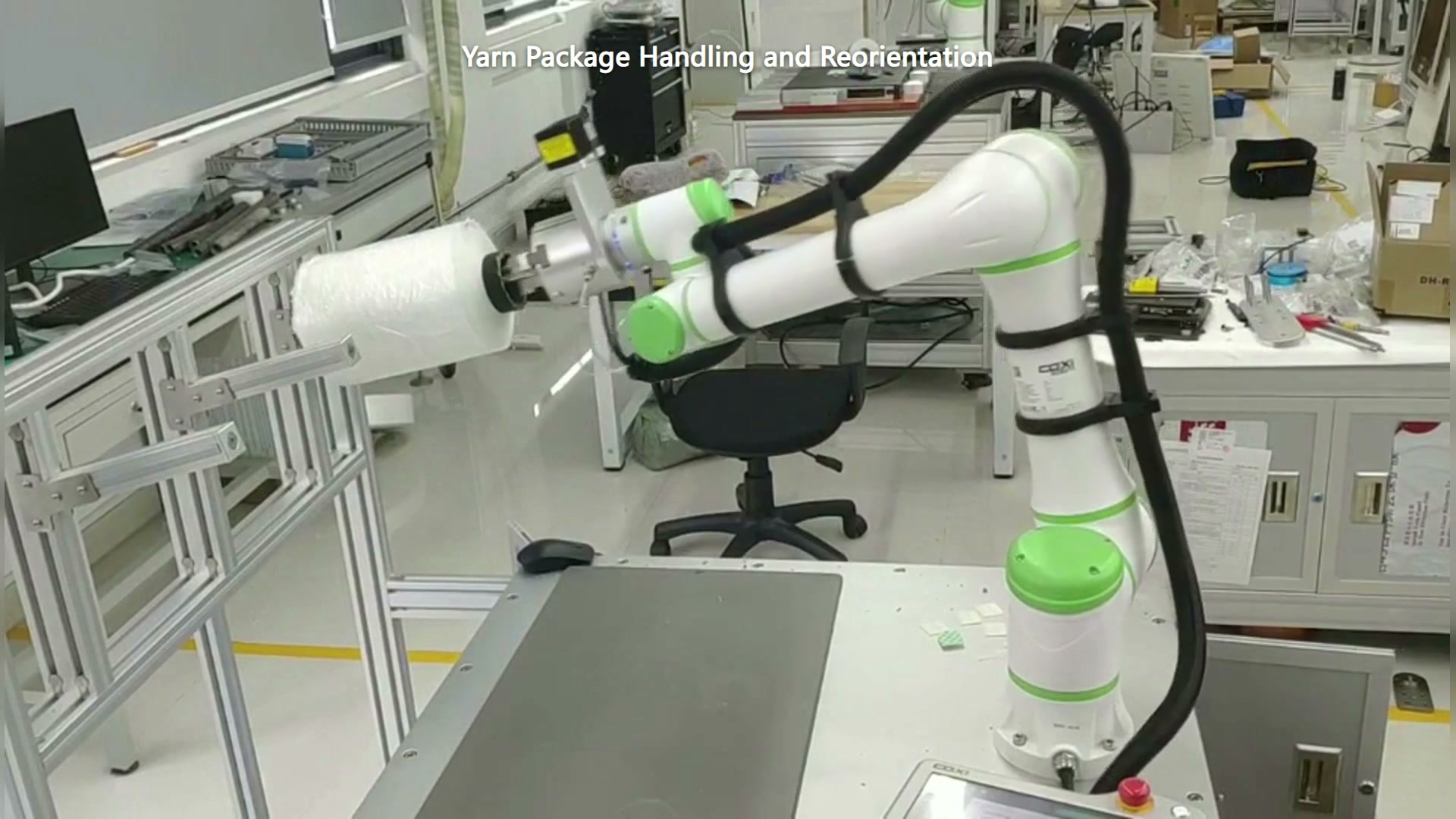
00:04 — The robot holds the yarn package towards a horizontal orientation.
For a proposed core grip, ask how the load is supported after that turn. Core material, wall condition, bore shape and available engagement length are relevant together; an accessible hole alone establishes none of them. A tube that has been dented or used repeatedly may behave differently from a new sample. Test the actual package and core condition rather than approving a tool from nominal bore diameter.
Manufacturer roll-handling guidance offers several internal-contact profiles and explicitly calls for trials where the core and contact profile do not match reliably. That is a useful lesson for yarn handling, although a paper-roll mandrel specification is not a yarn-package rating. The chosen contact must be qualified for the intended package, motion and release.
Compare the routes by what they touch
| Рута | A reason to consider it | A condition that can rule it out |
|---|---|---|
| Grip inside the core | Keeps the tool away from the wound yarn surface | The real core cannot tolerate the contact, or the bore is needed by the receiving spindle before the tool can release |
| Grip around the package | Leaves the core available for a receiving shaft | The winding cannot tolerate the contact without marking, displacement or loosening |
| Support from below or through the axis | Provides a different load path when a clamping interface is unsuitable | The support cannot enter or withdraw at the required destination, or the turn needs retention the proposed tool does not provide |
These are route choices, not interchangeable attachments. An outer grip should be tested against the winding condition that is hardest to handle, not just against the neatest full package. A support may work at an open table yet be impossible to remove inside a closely spaced rack. Where an internal tool occupies the same space as the destination shaft, changing the handoff arrangement may matter more than increasing gripping force.
Prove the handoff with the package you expect to receive
Bring the proposed tool, package and receiving geometry into the same trial. Include the expected weight range and the real variation in tube condition, package diameter and winding firmness. If both full and empty tubes must be handled, make them separate trial conditions: the contact geometry and acceptable handling damage may differ.
Run the planned lift, turn, placement and withdrawal. Look for relative movement between tool and core, core damage, yarn displacement and disturbance as the tool leaves. Define acceptable results with the next process: a package that remains in the gripper but arrives with displaced yarn is not an acceptable transfer. An upright placement also needs a stable resting position before release.
Record what changed when a trial failed. Sliding during the turn points to a different problem from a tool that cannot withdraw after placement. The first requires investigation of the load interface and motion; the second may require a new receiving arrangement or another grip route. Treating both as “needs more grip” can preserve the wrong design.
For an initial discussion with ЕВСТ, share core dimensions and condition, full and empty package photographs, the weight range and a sketch of both pickup and receiving positions. Those details allow the grip route and the trial to be discussed together, before a convenient pickup becomes an awkward handoff.