
Од Уреднички тим EVST-а · Last updated: November 11, 2026
Lights-out machining means CNC machines keep cutting with nobody attending them. A robot-tended cell often runs this way during the day while the operator works elsewhere; nights and weekends are simply the hardest case, because nobody can respond quickly when the cell stops. How long a cell can run alone is set by whichever limit runs out first: blanks on hand, tool life, chip and coolant capacity, or the loader itself.
Lights-out manufacturing is the same idea applied to a whole factory. This guide covers what a job needs before it runs alone, how to estimate run time, what usually stops a cell, how loading methods compare and how to roll out in stages.
Кључни одводи
- A loader alone does not make unattended machining work. Tool monitoring, chip control, remote alarms and a safety review for the unattended case matter as much.
- There is no standard number of hours. Run time is the shortest of four limits, worked out for each part and cycle.
- Most stops we see in commissioned cells come from a blank placed wrongly in the tray or magazine, or from a mistake by a person, not from the robot itself.
- Decide in advance what state the cell stops in, who gets the alarm and what is checked before restart.
Lights-Out Machining Starts Before the Loader: Five Conditions a Job Must Meet
A job is ready to run unattended only when it already runs on a staffed shift without anyone stepping in. That means five things are in place: a proven process, monitored tools, controlled chips, in-process measurement and workholding that needs no hand. If a job needs a nudge every few hours while an operator is there, it will need the same nudge when nobody is, and the cell will simply stop and wait.
The job is proven on a staffed shift
Run the same program, fixture and material lot for an agreed number of consecutive good parts, set with your quality team, before the job runs unattended. Track scrap and every intervention. A job that still needs frequent help is not a candidate yet; fix the cause first, usually a tool, a fixture or chips.
Tool life management and broken-tool detection
With nobody there to hear a tool chatter, the control has to know when a tool is worn or broken before it does damage. The usual building blocks are tool-life counters that call up a sister tool, broken-tool detection with a touch probe or laser, and spindle load monitoring that stops the cycle when load leaves its normal band. Set tool-life limits more conservatively for unattended runs.
In-process probing and offset control
In-process probing measures a feature during the cycle, so the control can correct an offset or reject a part on its own. Keep automatic correction inside a fixed window; outside it, the cell should stop and raise an alarm, and failed parts go to a reject position.
Чипови и расхладна течност
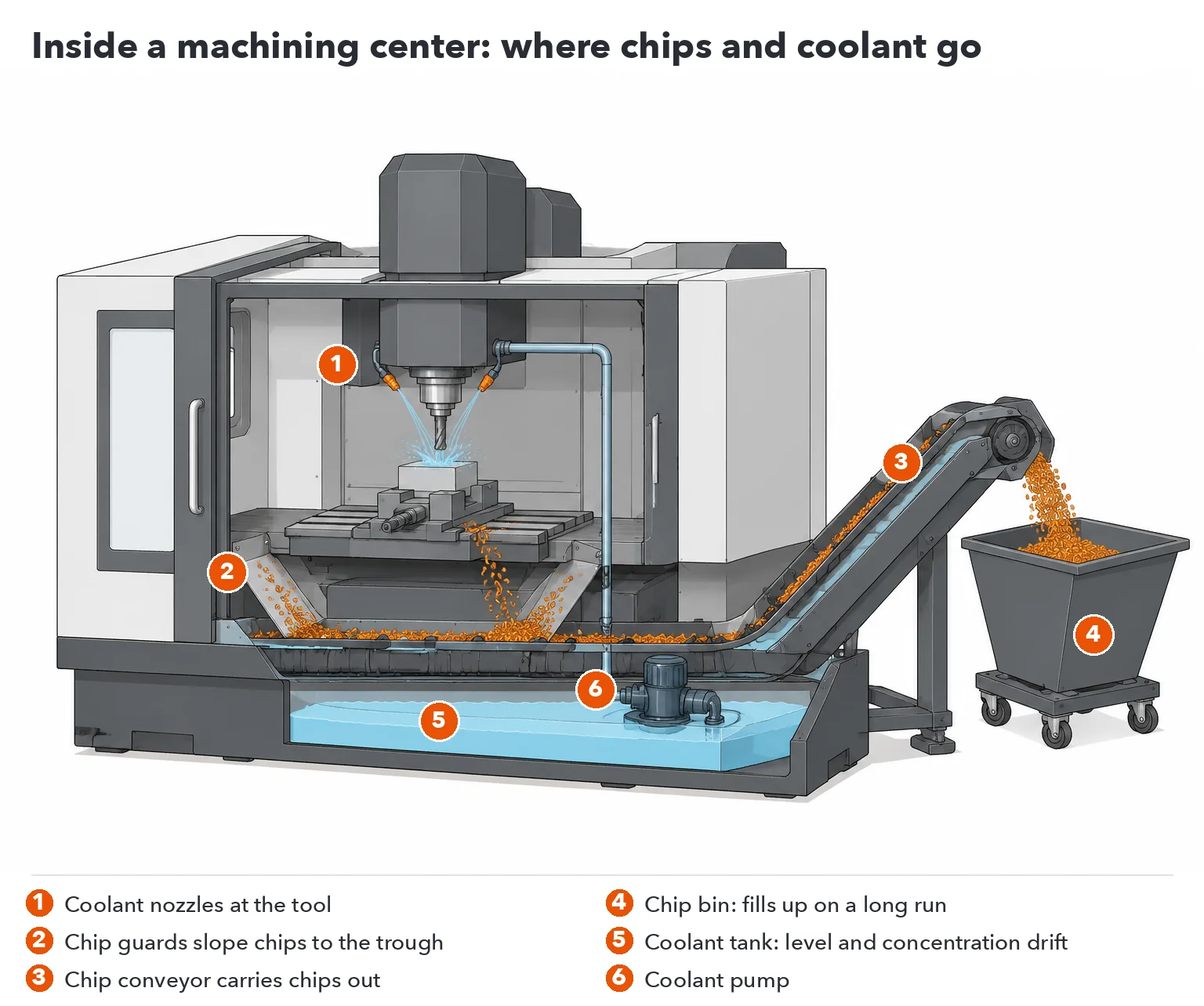
A chip bin that lasts a staffed shift can fill during a long unattended run, stringy chips can wrap a tool or part, and coolant level and concentration drift over many hours. Check each machine’s chip path, bin capacity and coolant top-up on a real unattended run.
Workholding that does not need a hand
Automatic vises, chucks and fixtures with clamp-confirmation signals tell the control that a part is really held before it cuts. Low air pressure, a part not seated on its locating pins or a clamp that has not closed should each stop the cycle. These signals also catch the most common cause of stops, covered below: a blank that was out of position to begin with.
Safety and Compliance for Unattended CNC Operation
Unattended running needs its own safety review, because every safeguard that relies on a person noticing a problem or pressing an emergency stop has to be replaced by one that acts on its own. The topics below do not replace the standards, your machine builders’ instructions or your insurer’s requirements.
Machine guarding and door interlocks
According to OSHA’s general requirements for all machines, КСНУМКС ЦФР КСНУМКС, “one or more methods of machine guarding shall be provided to protect the operator and other employees in the machine area.” In an unattended cell that usually means interlocked machine doors, fixed guards that cannot be left open, and a defined handshake between machine and loader: the robot enters only when the machine signals that the door is open and the spindle has stopped, and the machine starts only when the robot signals it is clear. For a lathe, see chuck, door and part interlocks on a robot-tended lathe door signals and the loading window.
Robot and mobile robot safety standards
The ISO 10218 series was revised in 2025: ISO 10218-1:2025 covers the industrial robot itself, and ISO 10218-2:2025 covers robot applications and robot cells. In the United States, A3 published ANSI/A3 R15.06-2025 as the national adoption of both parts. The 2025 series took in most of the collaborative guidance from ISO/TS 15066:2016. Industrial mobile robots have a separate U.S. series, ANSI/A3 R15.08, whose three parts cover the mobile robot, its integration into systems and the user. A mobile manipulator draws on both families.
In practice, an industrial arm is guarded to ISO 10218, and a collaborative arm without a fence runs only after a risk assessment of the complete application: gripper, part and fixture, not the arm alone. That assessment is usually written with an operator nearby; the unattended case asks which state the robot stops in and what happens at the next start. For the cell-level standard, see ISO 10218-2:2025 explained.
Fire detection and suppression inside the machine
Fire is the risk shops take most seriously once no one is watching. Oil-based coolants and fine chips of some metals, including magnesium and titanium, can ignite, and a fire a person would catch in seconds can burn for hours in an empty building. Many shops add automatic detection and suppression inside the machine enclosure, plus smoke or heat detection in the building. If you cut combustible metals, the U.S. reference is NFPA 484, the Standard for Combustible Metals; confirm with your fire authority which edition applies.
What changes when nobody is there to press the E-stop
The risk assessment has to be redone for the unattended case, because “an operator will notice” no longer holds. For each foreseeable fault, it should name the safe state the machine and robot stop in. The cell should stop safely and wait, never recover on its own into a state nobody has assessed. Insurers and EHS teams often set their own conditions for unattended running, such as fire detection and on-call cover, so bring the plan to both before equipment is bought.
How Long Can a CNC Run Unattended?
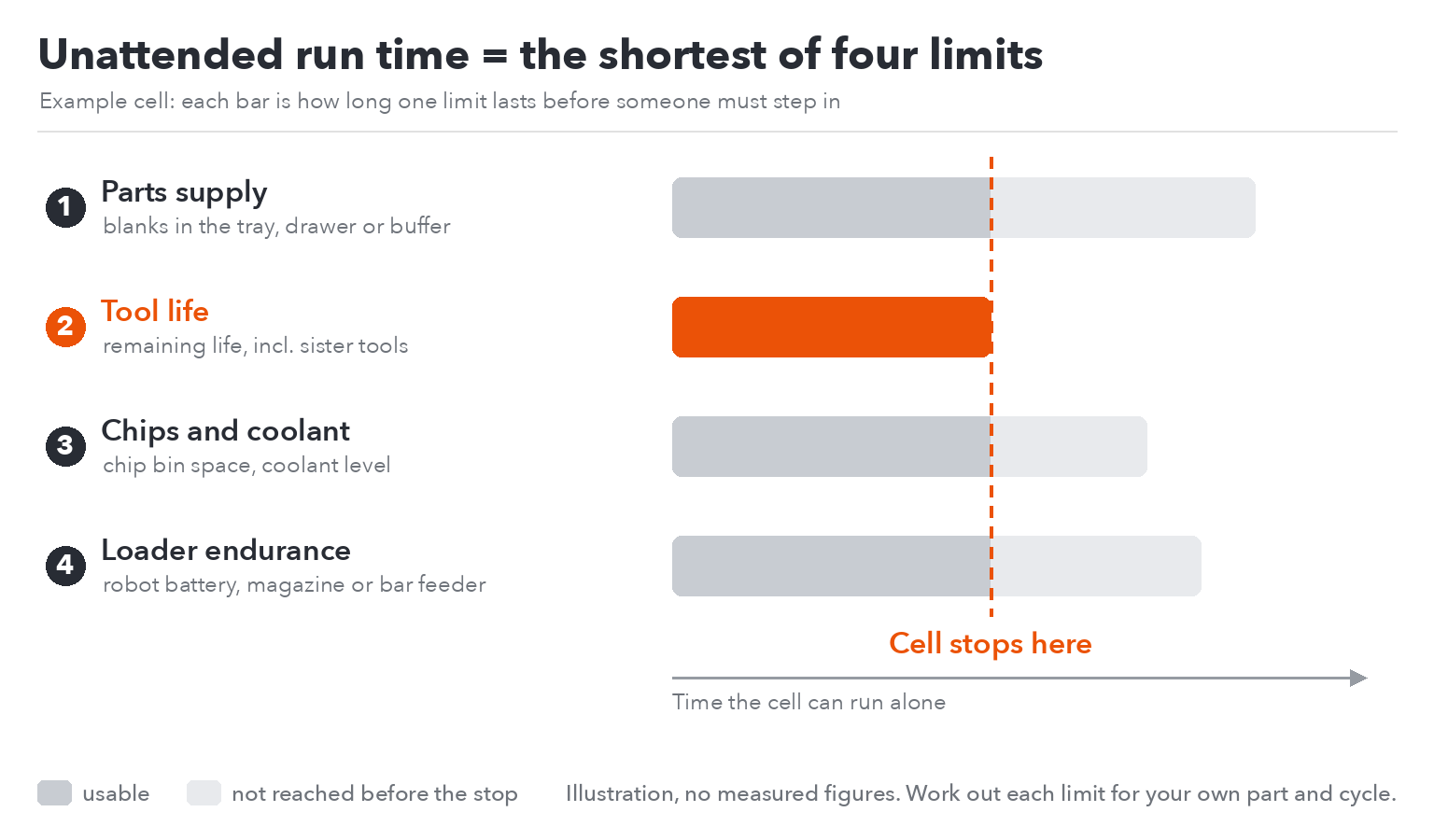
A CNC cell can run unattended only as long as its shortest limit allows, so run time is the smallest of four numbers: parts supply, remaining tool life, chip and coolant capacity, and loader endurance. There is no standard figure: in the cells we have commissioned it comes down to the part and its cycle time, so we do not quote a general number of hours. Work out each limit for your own job and take the smallest.
Unattended run time = the smallest of:
- Parts supply: the blanks held in the magazine, tray, pallet pool or bar feeder, multiplied by the cycle time per part.
- Век трајања алата: the cutting time left before the first tool in the program needs changing, counting sister tools the control can call up.
- Chips and coolant: the time until the chip bin, conveyor or coolant needs attention.
- Loader endurance: how long the loading device can keep working. For a mobile robot this includes battery and charging time.
Run time is also not the same as the time you are allowed to leave a cell alone. An example on this site uses a buffer of 12 parts at 4.5 minutes each, which lasts 54 minutes; if the process needs a check every 6 parts, permitted unattended time drops to 27 minutes. See how long a lathe-tending buffer runs before refill.
For a mobile robot, the fourth limit is the battery. EVST’s published specification for its mobile manipulator gives a battery rated for about 6 hours of operation and a full charge, from 5% to 100%, of up to 2 hours at the automatic dock; battery capacity can be configured per project. Charging has to be scheduled like any other task (see battery and charging on the product page). Actual runtime depends on the site, the parts and the cycle.
What Usually Stops an Unattended Cell (It Is Rarely the Robot)
In the cells we have commissioned, most unplanned stops have little to do with the robot itself. They come from two places: a blank that was not placed correctly in the tray or magazine, and a mistake made by a person while loading, changing over or resetting the cell.
Blanks that are not in position
A blank that sits tilted in its pocket, off its locator or the wrong way round gets picked at the wrong position. The gripper may fail to close on it, or the part reaches the chuck or fixture and does not seat. With clamp confirmation and part-present checks, the cell stops and raises an alarm, which is the outcome you want. Without them, the machine may cut a part that is not held properly. Common fixes:
- Trays, magazines and pallets with pockets or pins that accept a blank in one position only.
- A presence or orientation check before each pick, with sensors in the tray or on the gripper, or a camera where blanks vary. For an example, see vision and code-reading checks that stop a mis-loaded blank.
- A quick look at every tray when it is filled, before the cell is left alone.
Mistakes during loading, changeover and reset
The other usual cause is a person: the wrong program or offset after a changeover, a tray filled with blanks from another job, a mode switch left in the wrong position, or a fault cleared and restarted without finding out why it happened. Each one tends to show up later, when nobody is watching. Shops usually handle these with:
- One written procedure for loading and changeover that everyone follows the same way.
- A short handover checklist before the cell is left to run: program, offsets, blank type and count, chip bin, coolant level, alarms clear.
- Access levels on the machine control and robot program, so only trained people can change programs, offsets or safety settings.
Six Ways to Keep Machines Loaded Without an Operator (and What Limits Each One)
For lights-out machining, each loading method answers “what runs out first when nobody is there?” differently, and the choice mostly comes down to machine type, layout and cycle length.
| Метод | What mainly limits an unattended run | Прикладан за | Није погодно за |
|---|---|---|---|
| Улагач шипки | Bar length and the number of bars loaded; chips | Токарење шипки | Chucked or irregular blanks |
| Pallet changer or pallet pool | Number of pallets × cycle time; finished parts still need somewhere to go | Machining centers with a steady job mix | Machines without a pallet system |
| Fixed cobot or robot cell | Parts staged in the cell; the robot waits while its machine cuts | One machine, or two adjacent machines, on a stable job | Machines spread across the floor |
| Robot on a seventh-axis rail, or gantry loader | Parts staged along the line; reaches only the machines on its rail or under its gantry | A row of adjacent machines on steady jobs; gantries for high-volume, short-cycle lines | Scattered machines |
| Кобот на колицима | Changes machines only when a person moves it, so while nobody is around it stays on one machine | A few machines with batch work and someone free to move the cart | Unattended running across several machines |
| Мобилни манипулатор | Parts carried on board; battery and charging time; travel time | Machines standing apart whose cycles leave time to serve each in turn | Short-cycle rows; floors outside the site limits; doors that cannot be automated |
Fixed cells, rails, gantries and carts
A fixed cell beside one machine, or two adjacent ones, is calibrated once and never travels; its limit is the parts staged in the cell. See machine tending cells and systems for our cell options. For a row of machines, a robot on a linear rail serves them in turn without re-docking, and the rail sets which machines it can reach; see reach and cable limits of a robot on a linear rail. A gantry loader suits high-volume parts on a dedicated line; see gantry robot applications. A cobot on a cart changes machines only when someone rolls it over and re-docks it, so once the operator leaves it stays on one machine.
Мобилни манипулатор
A mobile manipulator fits when machines stand apart and each needs a robot only for a short part exchange. On an unattended run it is limited by the parts it carries, the battery and charging time, and the floor and Wi-Fi along its route. The machines also need automatic doors (or a retrofit) and an I/O link; a robot cannot tend a manual-door machine unattended. See is a mobile manipulator the right fit, and for the tray, opening and docking interfaces, planning mobile CNC tending.
For a side-by-side of five loading options on layout, positioning and site needs, see the comparison table on the product page.
When the Cell Stops: Alarms, Response and Restart
An unattended cell is judged by what it does when something fails, because nobody is there to improvise. The points below are general good practice, not figures measured in our own cells or a promised response time; set the details with your EHS team and insurer.
- Stop in a defined safe state. A dropped part, a part that will not clamp, a machine alarm or a missing door signal should each leave the machine and robot stopped until someone has checked.
- Send the alarm to a named person. Many machine controls share status and alarm data over open interfaces such as MTConnect or OPC UA, so a monitoring system can message whoever is on call. Name a backup too.
- Agree the response in advance. Decide how fast someone should respond, which faults can wait for the next staffed period, and whether anyone may clear a fault remotely. This matters most at nights and weekends, when response is slowest.
- Check before the first reset. Read the alarm log and look at the tray and the part in the fixture first, since that is where most stops start, then inspect the tool. Do not restart before you know why it stopped.
- Lock out before entering. If someone has to reach into the machine or the robot’s working area, apply lockout/tagout; ОСХА 29 ЦФР 1910.147 covers servicing where an unexpected start-up could injure workers.
Automatic fault recovery differs from cell to cell, so confirm what your own equipment does with its maker.
Roll It Out in Stages: From Short Gaps to a Full Weekend
The safest way to start lights-out machining is to lengthen the time a cell runs alone one step at a time, adding the monitoring each step needs.
- Staffed runs. Run the job under observation and log every intervention and every stop with its cause. Fix the causes.
- Short unattended gaps, someone on site. Leave the cell alone over breaks or while the operator works elsewhere, with a person nearby who can respond.
- First long unattended run, most stable job only. For most shops this is the first night, with remote alarms live and a named person on call.
- More jobs, then the weekend. Add jobs as each proves itself. A weekend is far longer than a night, so the safety and fire review has to cover it.
For the step before this, one person watching several machines, see роботско опслуживање CNC машина, which covers running several machines with one operator.
Common Questions About Lights-Out Machining
What is the difference between lights-out machining and lights-out manufacturing?
Lights-out machining is CNC machines running with no operator attending them, whether for an hour or a whole weekend. Lights-out manufacturing is the broader idea of a whole factory running without people. Most shops start with machining, on a few stable jobs.
How many hours can a CNC machine run unattended?
There is no standard figure; it depends on the part and its cycle time. Work out parts supply, tool life, chips and coolant, and the loading equipment in hours, and take the smallest. A large buffer does not help if tool life, or the time the process may run without a check, ends sooner.
What most often stops an unattended CNC cell?
In our experience commissioning these cells, most stops come from a blank placed wrongly in the tray or magazine, or from a mistake during loading, changeover or reset, rather than from the robot. Trays that accept a blank one way only, a presence check before each pick, a handover checklist and access levels on programs prevent most of them.
Can a cobot run lights-out, or does someone need to be nearby?
It can, once the complete application, including gripper, part and fixture, has been risk-assessed for the unattended case and the machine has the doors, signals and monitoring it needs. A collaborative arm without a fence is not cleared for this by default.
Can one mobile robot keep several CNC machines running unattended, and how is charging handled?
Yes, when the machines’ cycles leave time for the robot to serve each in turn and the floor and Wi-Fi meet the site limits; see one robot serving several machines. Charging is part of the schedule: EVST’s mobile manipulator is rated for about 6 hours and charges from 5% to 100% in up to 2 hours (product FAQ).
Is lights-out machining cheaper than hiring a night-shift operator?
The two do different work, so a single cost line is the wrong comparison. An operator can change over jobs, adjust offsets and deal with alarms; a cell repeats loading exactly but stops when something unexpected happens. Compare whether the extra spindle hours can become orders, which tasks still need judgment, what a stop with nobody there costs, and what safety, monitoring and training the cell needs. Payback depends on each shop, so we give no figure.
Should we start lights-out with overnight runs or weekends?
Neither. Start with short unattended gaps on your most stable job while someone is on site, then one long run such as a night, with remote alarms live and a named person on call. Move to weekends only after several uneventful long runs and a safety and fire review that covers the longer period.
Следећи корак
To check whether a mobile manipulator fits your floor and machines, контактирајте EVST with your part and machine details and we will review the application. Pricing depends on the configuration and is confirmed by our sales team for each project.
Повезано читање: Mobile manipulator for CNC loading · Planning mobile CNC tending · Један робот опслужује неколико машина · Lathe buffer run time · Unattended powertrain blank tending
Аутор: Уреднички тим EVST-а (EVS TECH CO., LTD, Chengdu) · Уредничка политика · Политика исправки · Услови коришћења
Метод: Based on EVST product documentation, EVST’s own commissioning experience on what stops unattended cells, the published safety standards named above (OSHA, ISO, ANSI/A3, NFPA) and editorial review by the EVST Editorial Team. Run-time calculations are generic formulas, not measured results; this guide gives no measured run-time or response-time figures. Last updated: .