
A liquid filling line fills, caps, seals, labels, inspects, codes and packs liquid products in one connected line, linking the stations from the empty container to the sealed shipping case. EVST builds three standard configurations by container size, 5–30 L, 1–5 L and 100–1,000 ml, plus explosion-proof lines for flammable liquids. Each line is configured to your containers, your product and your target output.
Discuss your liquid filling line
Which line fits your container size?
Container size decides the filling method, the capper and the end of the line. The three standard configurations are:
| vrstica | Zabojniki | Polnjenje | Omejevanje | Po zaprtju |
|---|---|---|---|---|
| 5–30 l | Pails, open-head pails, jerrycans | Six-head net-weight filler, weighing under the container | Single-head tracking capper | Induction foil sealing, labeling, vision inspection, QR code traceability, case erecting, pick-and-place case packing, case sealing |
| 1–5 l | Bottles and jugs | Twelve-head weigh filler | Double-head tracking capper | Labeling, case erecting, pick-and-place case packing, case sealing, collaborative robot palletizing |
| 100-1,000 ml | Stekleničke | Four-head tracking filler | Double-head tracking capper | Labeling, vision inspection, QR code traceability; downstream packing configured per project |
Each line is configured to your target output, so the number of heads and stations follows your volume.
5–30 L pails and jerrycans
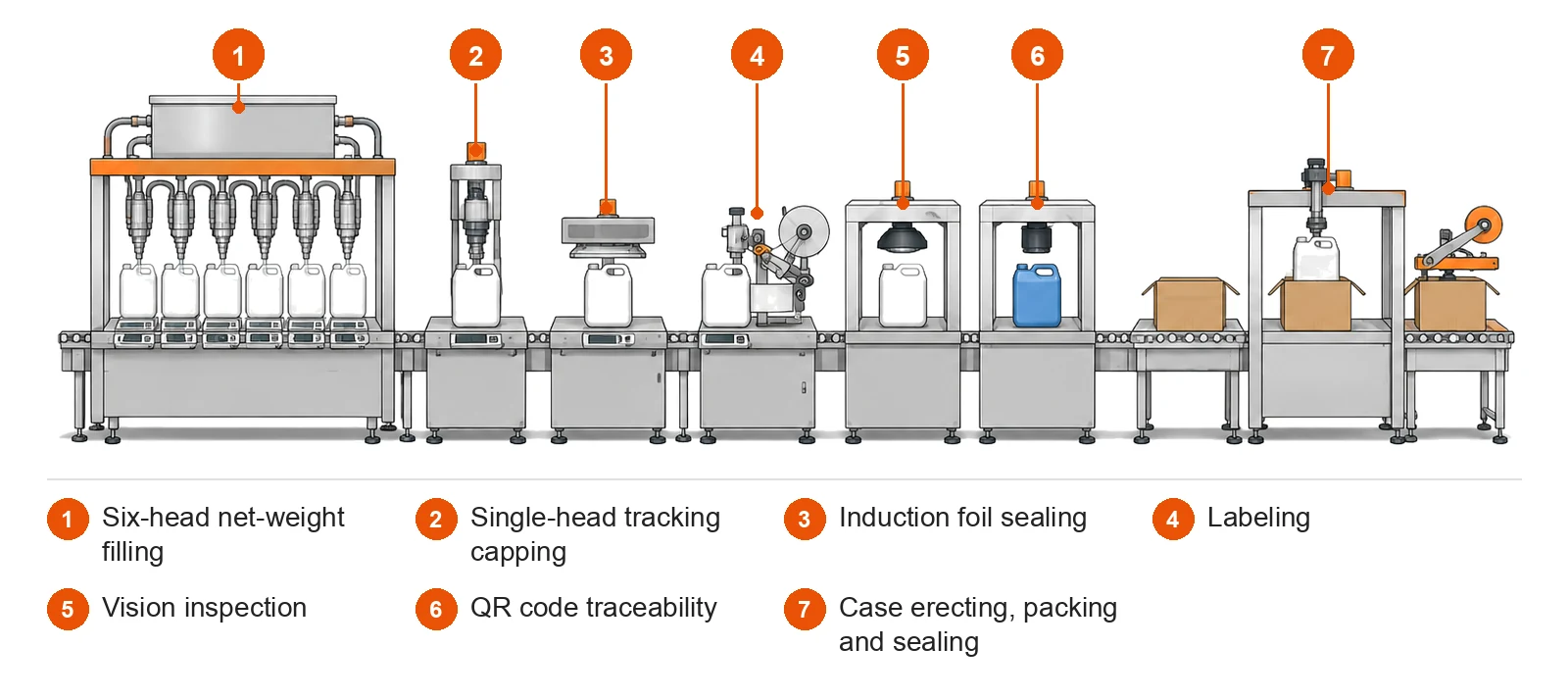
- Net-weight filling: six filling heads, each weighing the container from below.
- Tracking capping: a single-head capper tightens the cap while the pail keeps moving, with servo-controlled torque for pump caps and round caps.
- Induction foil sealing: the foil under the cap is sealed.
- Označevanje: a multifunction labeler applies the labels.
- Pregled vida: cameras check the result and faulty units are rejected.
- QR code traceability: each container’s code is read and linked.
- Case erecting, pick-and-place case packing and case sealing.
Steklenice in vrči 1–5 l
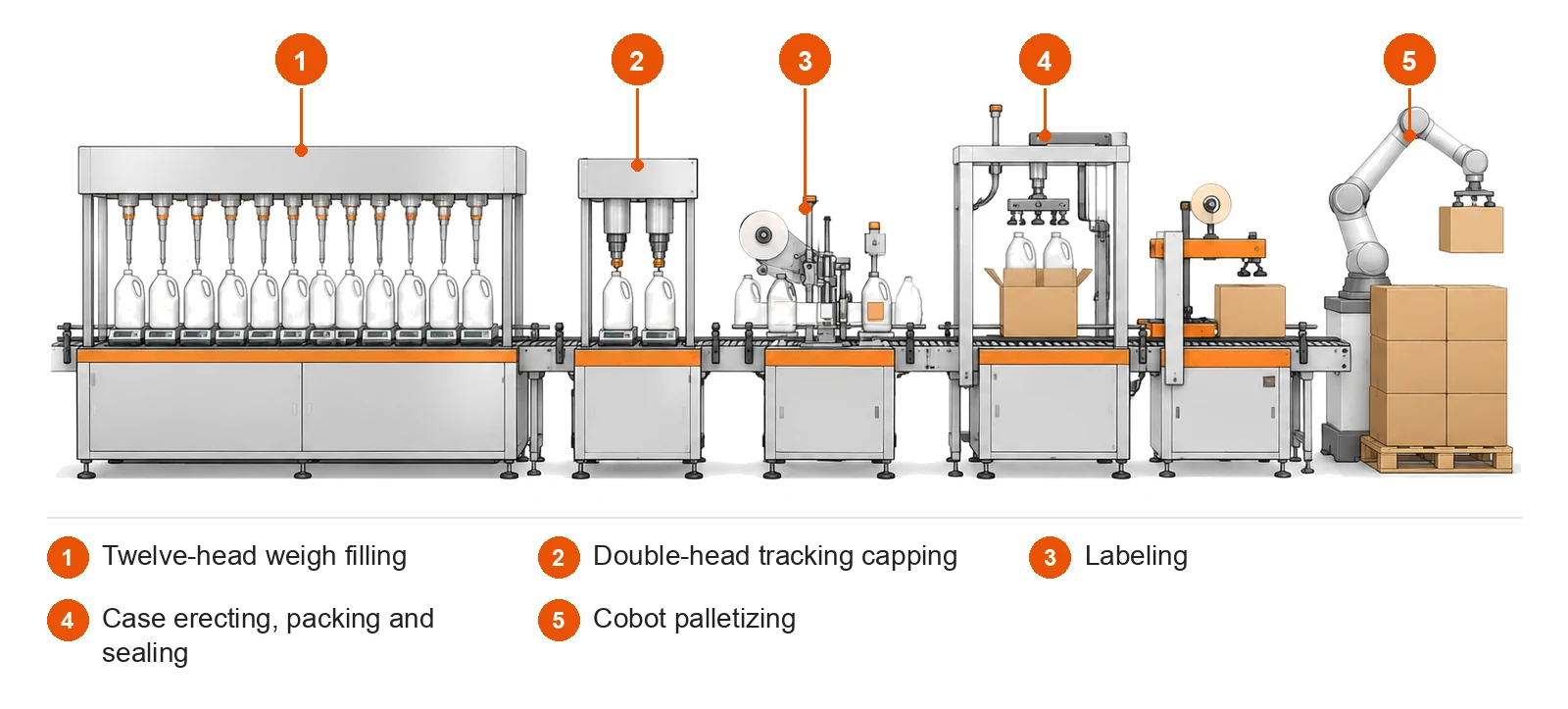
- Weigh filling: twelve heads with plug-type filling nozzles, weighing control valves and an in-line layout.
- Tracking capping: a double-head capper.
- Označevanje: a multifunction labeler.
- Case erecting, pick-and-place case packing and case sealing.
- Paletiranje: a collaborative robot stacks the cases on the pallet. See light palletizing with cobots on packing lines.
100–1,000 ml bottles
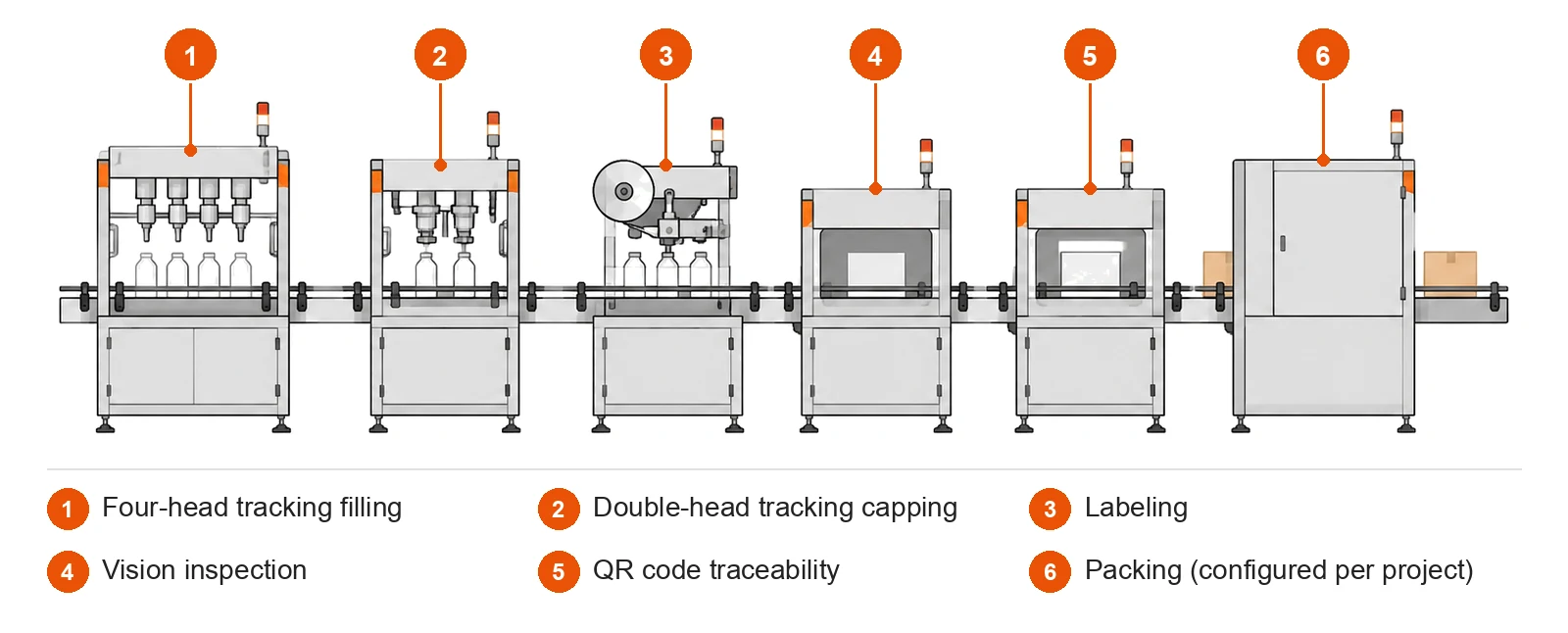
- Tracking filling: a four-head filler follows the bottles.
- Tracking capping: a double-head capper.
- Označevanje: a multifunction labeler.
- Vision inspection.
- QR code traceability.
- Pakiranje: Downstream packing is configured for each product and project. For boxed products see the stroj za kartoniranje pregled.
What the three lines have in common
- Different liquids, no drips: the lines are designed for liquids with different properties, with accurate filling and no dripping.
- Servo torque capping: capping torque is controlled by an independent servo motor, so the same capper handles pump caps and round caps. See the avtomatski stroj za zapiranje.
- One line, several sizes: one line runs several container sizes; when the fill volume changes, the operator switches the format with one touch on the touchscreen.
- Labeling and inspection built in: glej avtomatski stroj za etiketiranje steklenic for labeling modes and speeds.
Which filling method for which volume?
| Metoda polnjenja | Napolni volumen | Output (stated condition) |
|---|---|---|
| Gear pump filler | 50-1,000 ml | 5,000 pcs/h (50 ml bottles, 12 heads) |
| Weigh filler, top weighing | 1–5 l | 2,800 pcs/h (5 L bottles, 12 heads) |
| Net-weight filler, weighing under the container | 5–30 L containers on the line above | Konfigurirano za vsak projekt posebej |
| Bat za polnjenje | Konfigurirano za vsak projekt posebej | Konfigurirano za vsak projekt posebej |
These are single-machine values for each filler type at the stated condition. They are not the output of the line configurations above.
The net-weight fillers use vacuum suck-back to stop drips, need no piston cylinder or piston drive, adjust the filling heads from the touchscreen when the product changes, have no wear parts that need routine replacement, and can be cleaned in place.
What liquids are these lines used for?
Products on our filling and capping machines include dishwashing liquid in duck-bill jugs and round-cap bottles, and hand wash in pump bottles. One line we built fills, caps and case-packs cleaning liquid and plant nutrient solution in double-port spray bottles, and our capping, labeling and code reading machines are used on agrochemical bottles (see below).
Bottled liquid lines of this kind typically run filling, then capping, then labeling, often with a front and a back label. Inspection and case packing or shrink wrapping can follow. The exact process steps are configured for each product and project.
Explosion-proof filling and capping line
For flammable liquids, the whole line is configured for explosion protection. One explosion-proof line we built runs:
- Hranjenje po steklenički from a hopper.
- Eight-head in-line filling.
- Automatic cap sorting and placing.
- Eight-head tracking capping.
- Cap and label vision inspection.
- Inkjet coding.
- Code vision inspection with automatic rejection.
- Case packing platform.
The configuration for your liquid is assessed for each project. We build the line to the explosion-protection and safety specification you give us; certification for your site and market is discussed for each project.
Agrochemical bottles: capping, labeling and traceability
On agrochemical bottles, round caps run on a multi-head capper at 2,500, 5,000 or 7,200 pcs/h with 4, 8 or 12 heads. Labels with batch data are printed and applied on the line, and a code reading station reads round bottles at 15,000 per hour, linking each bottle’s code to its batch. With one-code-per-item traceability, the order, batch, raw material, packaging material, quality inspection, traceability and logistics codes are tied together, and each bottle is linked to its distributor when it ships, so product that turns up outside its sales channel is flagged.
The exact process steps are configured for each product and project.
Lessons from lines we have built
Spray bottles that must ship nozzle-up
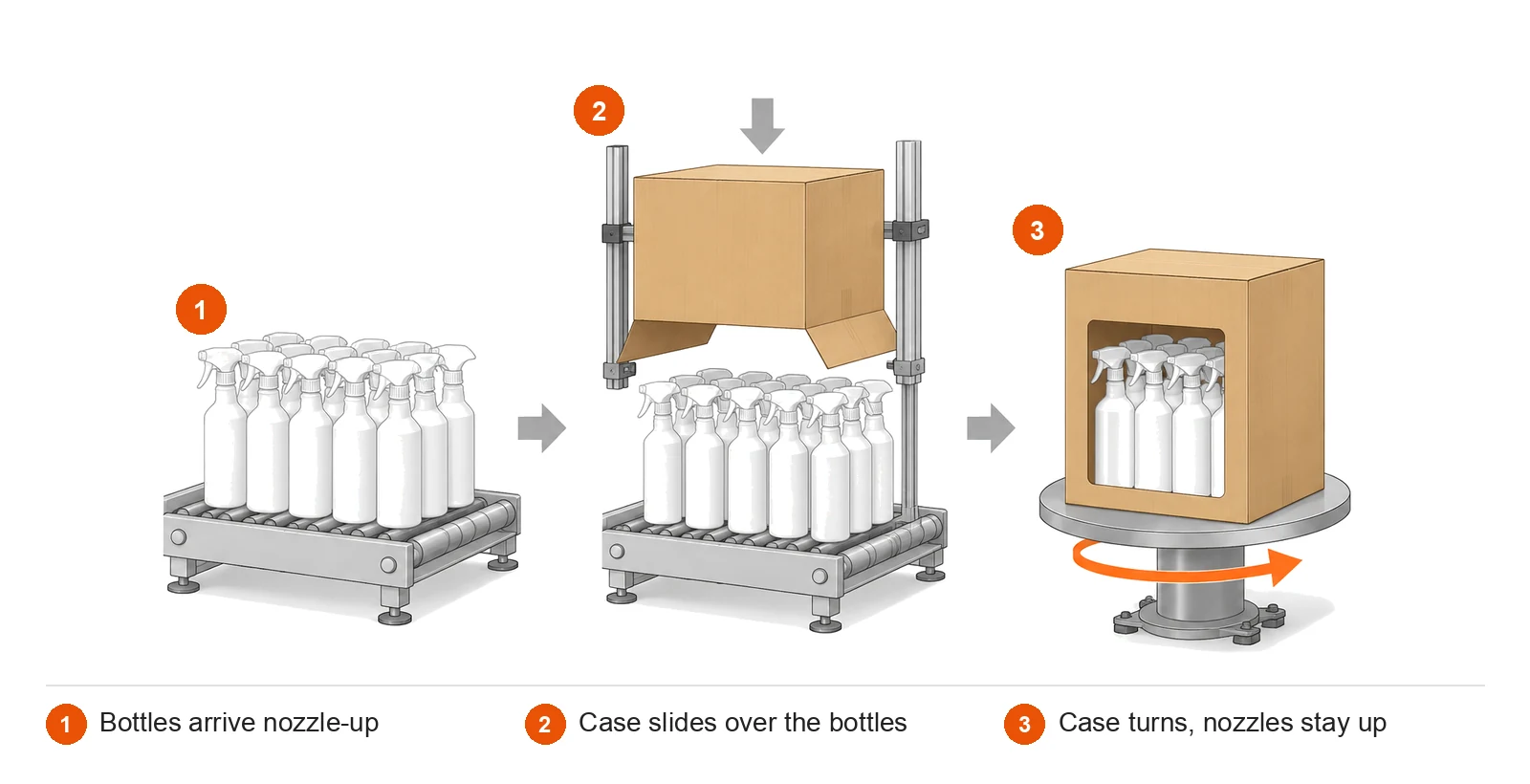
On one line for cleaning liquid and plant nutrient solution in double-port spray bottles, the sprayer had to face up in the case. The customer wanted to alternate the bottles head-to-tail so a smaller case would do, which would cut carton and shipping cost, but that was not workable for this product. The case packer therefore slides the case over the bottles and turns it, so every nozzle ends up facing up. This is done entirely with mechanical design, without vision.
Glass bottles are fed by hand, tray by tray
Glass bottles are hard to unscramble automatically: in a hopper they knock into each other and can break. On glass bottle lines we have built, bottles are pushed onto the line one tray at a time, and glass bottles are usually washed before filling.
Start with filling and capping
Filling and capping are the stations a liquid plant cannot run without. Where the budget is limited, they are automated first, and labeling and other downstream stations are added later.
End of line: case packing and palletizing
The 5–30 L and 1–5 L lines finish with automatic case erecting, pick-and-place case packing and case sealing; the 1–5 L line adds a collaborative robot palletizer. For how case packing is accepted on site, see automatic case packing acceptance; for picking one unit or a group per cycle, see piece picking or group transfer for case packing. For pallet-level automation, see paletiranje.
What to send for a liquid filling line quote
- Container drawings or samples, and every container size that will run on the line
- Cap type for each container
- The liquid: viscosity, whether it foams, and whether it is flammable or corrosive
- Fill volumes and the fill tolerance your quality standard requires
- Labels, codes and traceability data required
- Target output per shift, and how the product is packed for shipping
- Floor space, and any explosion-protection requirements at the site
Sample containers, caps and liquid help confirm the filling method and nozzle choice before the line is fixed.
Pogosta vprašanja
What is a liquid filling line?
A liquid filling line is a connected set of machines that fills, caps, seals, labels, inspects, codes and packs liquid products, linking the stations from the empty container to the sealed shipping case. EVST builds standard configurations for 5–30 L, 1–5 L and 100–1,000 ml containers, plus explosion-proof lines.
Which filling method should I use for 100 ml, 5 L and 30 L containers?
For 50–1,000 ml bottles, gear pump fillers run at 5,000 pcs/h on 50 ml bottles with 12 heads. For 1–5 L, a top-weighing filler; as a single machine it is rated at 2,800 pcs/h on 5 L bottles with 12 heads. For 5–30 L pails and jerrycans, net-weight filling with the container weighed from below. The final choice is confirmed on your liquid and containers.
Ali lahko ena linija obdela več velikosti steklenic?
Yes. Each standard line runs several container sizes; when the fill volume changes, the format is switched with one touch on the touchscreen, and the servo-torque capper handles both pump caps and round caps. How many sizes share one line is assessed on your container list.
Do you build explosion-proof filling lines?
Yes. For flammable liquids the whole line, from bottle feeding through filling, capping, inspection and coding to case packing, is configured for explosion protection. We build to the explosion-protection and safety specification you provide; certification for your site and market is discussed for each project.
How much does a liquid filling line cost?
The price depends on the container range, the filling method and number of heads, the cap types, which downstream stations are included (labeling, inspection, traceability, case packing, palletizing), and any explosion-protection requirement. EVST quotes per project after reviewing your containers and liquid; kontaktiraj nas with samples or drawings and your target output. Lead time and warranty are confirmed in the quotation.
Podobni
- Automated packaging lines: filling, cartoning, inspection and case packing
- Automatic capping machine for screw, press-on and pump caps
- Automatic bottle labeling machine
- Cartoning machines: horizontal and vertical
- Lahko paletiranje: povezovanje kobotov s pakirnimi linijami
Line configurations and machine speeds on this page are those built to date; the line for your product is configured to your target output and confirmed for each project.