
By EVST Editorial Team · Reviewed by EVST Editorial Team · Last updated October 9, 2026 · Editorial policy · Corrections policy · Terms
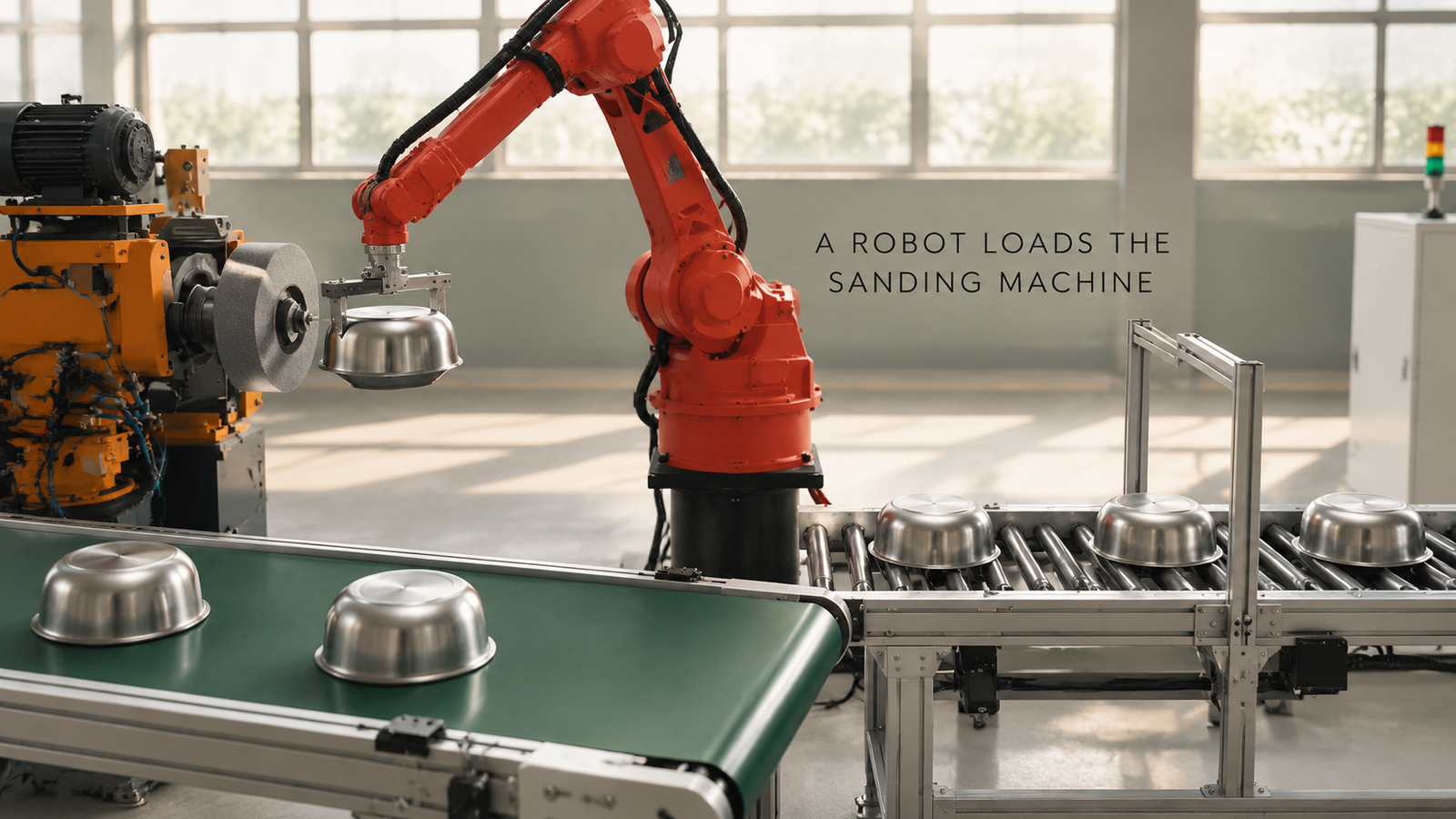
A person can step away from a bowl sanding machine once the robot has taken over everything the person’s hands and eyes were quietly doing: picking a bowl that arrives upside down, seating it centred on the spindle chuck, working in the dust, and doing all of it fast enough that the abrasive wheel never waits. The cell described here does that with one six-axis robot. It lifts stainless bowls off a roller conveyor, loads each onto the chuck of a sanding machine, and sets the sanded bowl on a belt conveyor.
Thinking about automating a sanding machine? Send us the part drawing and your daily output, and we will reply with a cell concept and a cycle-time estimate.
What an operator’s hands are doing at this machine
The wheel does the useful work. The operator is the supply line to it, and the job is repetitive, dusty and hard to keep staffed. Watch such a station and the operator’s tasks fall into a few small ones, each of which becomes a question for the cell:
| What the operator does | What the cell must answer |
|---|---|
| Takes the next bowl and turns it to suit the machine | How a gripper picks a bowl that arrives mouth down, and hands it over |
| Seats the bowl on the chuck and feels whether it is true | How the bowl ends up centred without a person checking |
| Stands in the dust | How the robot and its gripper survive it |
| Takes the sanded bowl off and puts it down | Where finished bowls go, and how the robot gets there |
| Keeps the next bowl ready while the wheel works | How the layout keeps the machine from waiting |
One loop through this cell
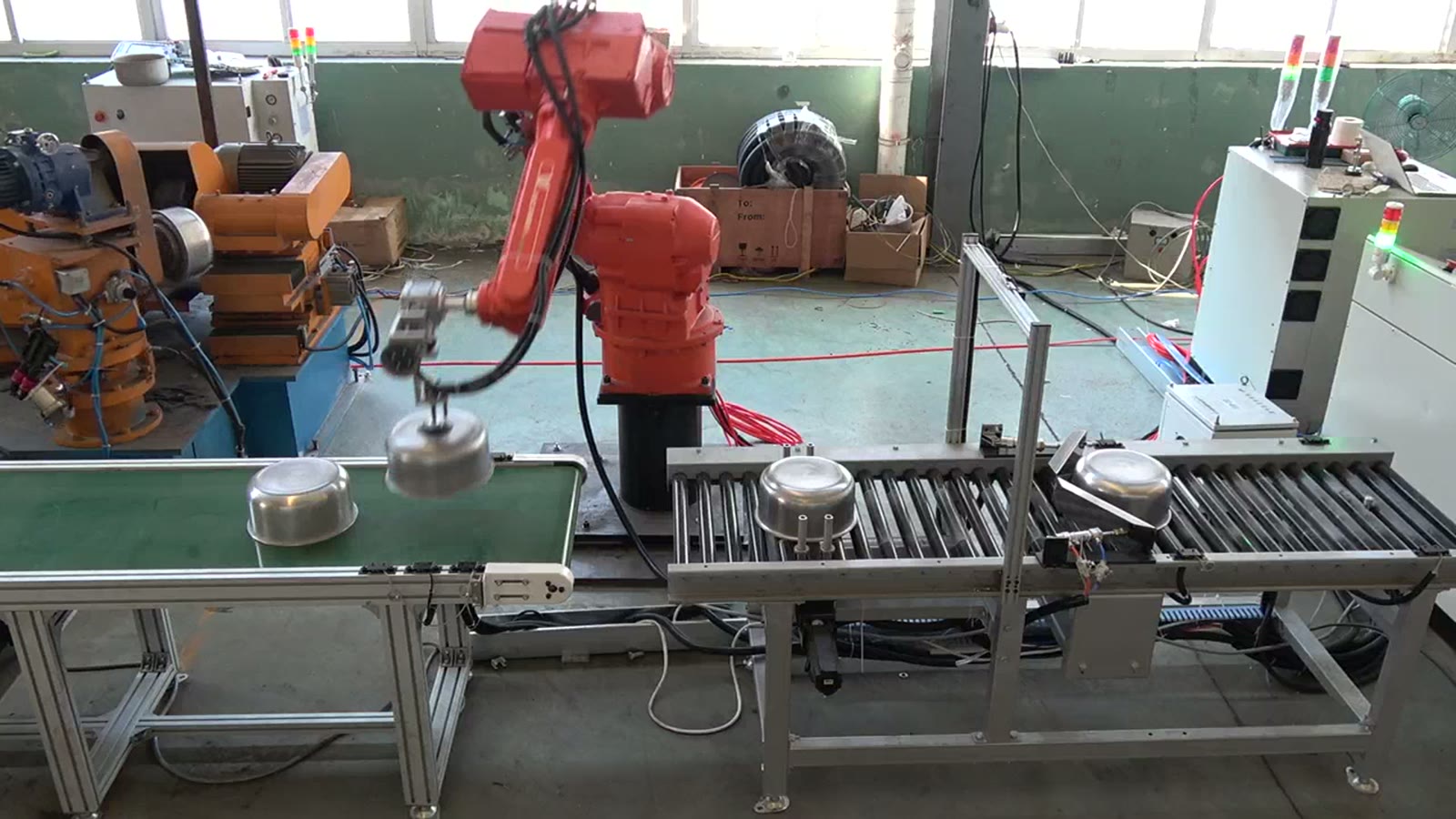
A roller conveyor brings the bowls in on the right. The orange sanding machine stands on the left, with a spindle chuck and a grey abrasive wheel. A green belt conveyor runs in front, and the red six-axis robot stands in the middle, within reach of all three.
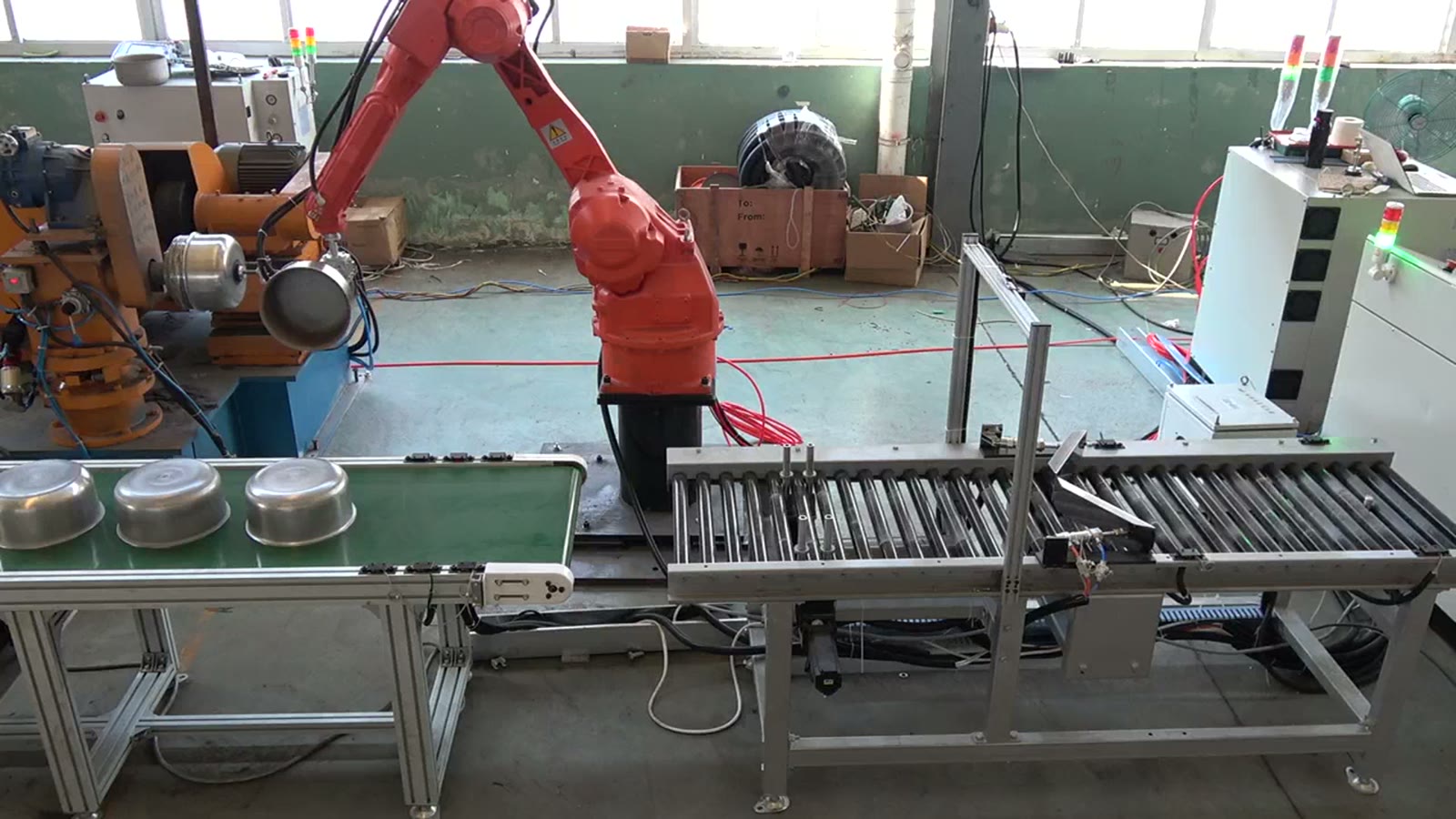
- The stainless bowls sit mouth down on the roller conveyor, one after another.
- The robot reaches the end of the conveyor and presses its bar-shaped gripper onto a bowl.
- It lifts the bowl and turns toward the sanding machine.
- The bowl is loaded onto the spindle chuck, and the arm stays at the machine for a few seconds while the bowl rotates and the wheel is set against it.
- When sanding is done, the robot takes the bowl away and turns to the front.
- It sets the bowl on the green belt conveyor, which carries the bowls forward.
- The robot goes back to the roller conveyor for the next bowl and repeats the motions.
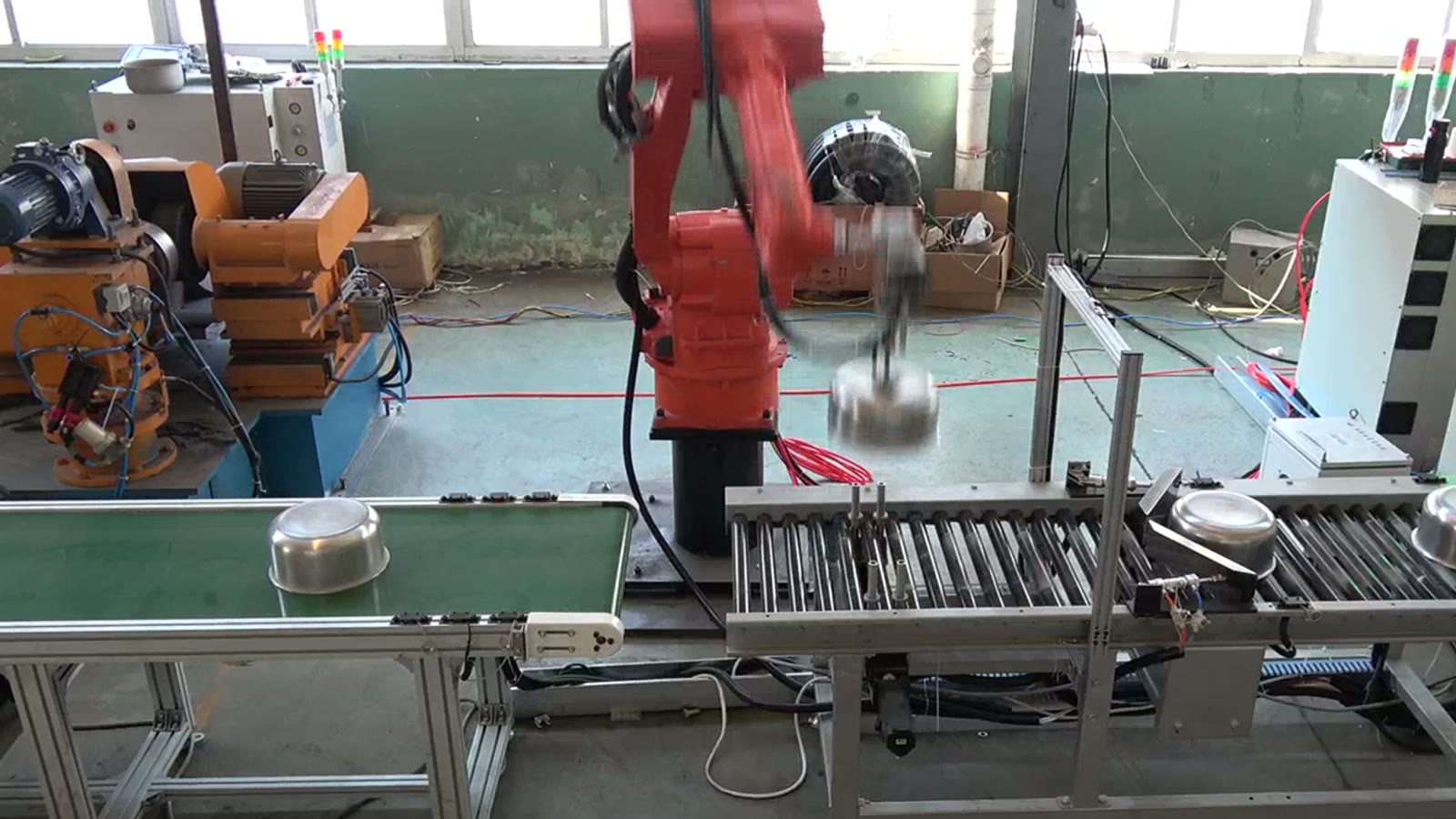
Seating the bowl: from gripper to chuck
A bowl that arrives mouth down sits stably on a conveyor. The catch is that the orientation in which the robot picks it up is not necessarily the one in which the chuck must receive it.
The sensible order is to decide which surface the chuck engages and which surface the wheel must reach, and only then define the gripper. It must leave the chuck’s contact area free, must not mark a surface that is yet to be sanded, and must release cleanly as the chuck takes over. A bar-shaped gripper is a simple answer when the bowl’s shape offers somewhere to press and lift. A family of several shapes may call for an adaptable gripper or a tooling change, and that is a question for the drawing.
Staying true on the spindle
An off-centre bowl on a rotating chuck wobbles, and the wheel then takes off material unevenly. Centring is therefore shared between robot and chuck. A chuck with a lead-in, a locating seat or a centring action forgives a small placement error. A chuck with none of these demands an accurate placement, and any shift in how the bowl sat on the conveyor travels straight through to the machine. A stop or guide at the end of the conveyor, so that each bowl arrives in nearly the same spot, gives the gripper a head start.
Dust and the robot’s wrist
Sanding throws off fine particles, and a robot beside the machine stands in the cloud. Dust works into joints and cable entries, coats the gripper and can disturb any sensing it uses. The usual remedies are a protective cover for the robot, a sealed or purged gripper, extraction close to the wheel and a layout that keeps the wrist out of the heaviest stream. Which of these a plant needs depends on the process and the machine. Ask early, since the answer affects robot selection and maintenance.
Keeping the wheel from waiting
A general principle: the robot’s travel between stations should be short compared with the time a bowl spends on the wheel. When it is, the machine sets the pace and the robot has spare time. When it is not, the robot becomes the bottleneck, and only then does a second robot or a second machine position come into question.
Buffers help. Waiting bowls on the roller conveyor and a belt that carries finished ones away let a short interruption at either end pass without stopping the sanding machine, at the price of floor space. Whether one robot keeps up with one machine depends on the sanding time per bowl against the robot’s round trip, and that is what a cycle-time estimate from your drawings answers.
When one robot per sanding machine makes sense
A robot at the sanding machine makes sense when the bowls come from a settled family of shapes, always arrive mouth down in a known place, and the machine runs most of the shift. It needs a closer look if one machine handles very different diameters or depths, if bowls can arrive tilted or stacked, if the sanding step needs the bowl turned over and re-gripped halfway, or if guarding and dust extraction leave the robot no room beside the machine.
What buyers ask about sanding cells
Does the sanding machine have to be replaced? Often not, but it must be ready for automatic loading: a way to tell the robot the machine is ready, and enough access for the robot to reach the chuck. We check this against the machine you already run.
Do pots and other cookware work the same way? The same questions apply, but gripper and chuck engagement are specific to each shape, so send the drawing for each.
Information that lets us size the cell
Send the part drawing with the range of bowl or pot sizes, tell us which sanding machine you run today and how the bowl is clamped on it, and give us your daily output. From that we can judge which of these questions weighs most for your parts and sketch a cell with a cycle-time estimate.
Running a sanding machine by hand today? Tell us about it or email sales@evsrobot.com with the drawing and daily output.
General principles of robot loading for sanding machines, illustrated with one bowl cell; bowl sizes, materials, sanding parameters, cycle times and surface results are not stated.