
A proposed tube-frame fixture should pass a complete handling trial, not just hold an unwelded assembly firmly. Locate the parts, close the clamps, check the torch’s approach and exit, and prove that the joined frame can be released and removed. These steps expose different problems; adding clamp force cannot solve a blocked torch or a trapped finished part.
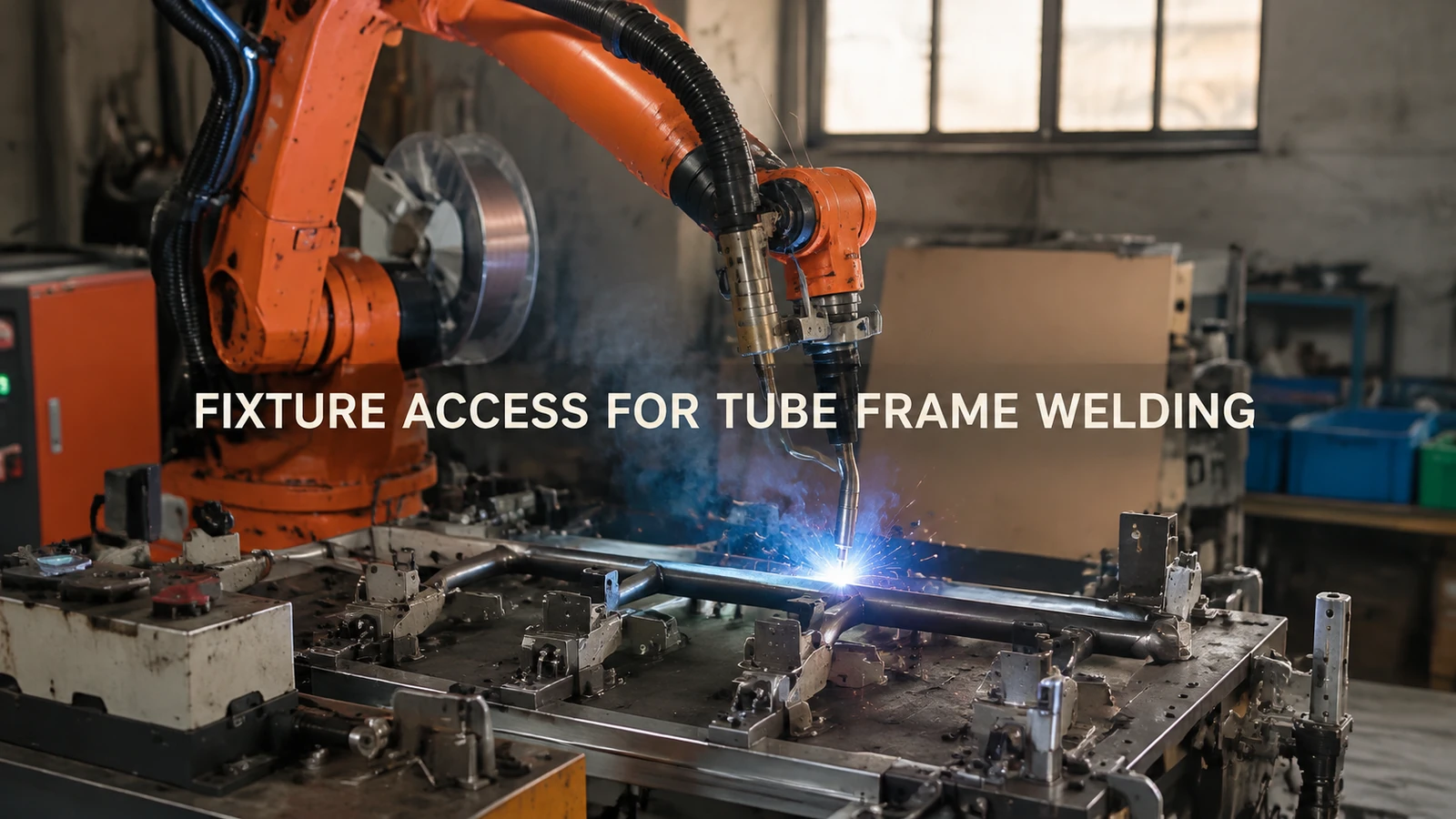
The application shows an orange industrial robot welding a bent-tube frame and plate components in a horizontal fixture. The relationship between the frame, plates and locating hardware makes access a useful design question before committing to tooling.
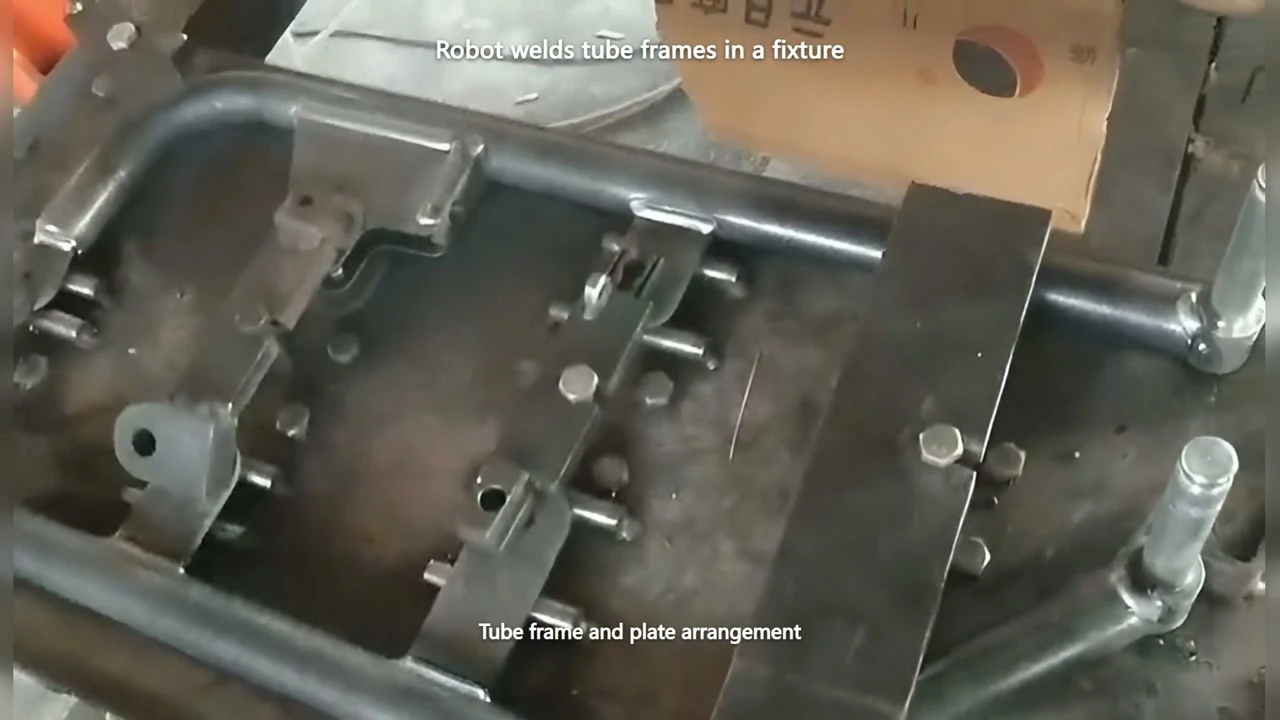
Close view of the bent tube frame, plate components and locating hardware. Video 01:09.
A clamp holds the tube but hides the joint
A locating stop or clamp can sit close to a plate-to-tube joint because that is a convenient place to hold the parts. The same hardware may occupy the torch’s approach space. A joint visible from above is not necessarily accessible at the required welding angle.
For a sample fixture, mark the required joints on the actual assembly and close every clamp that will be closed during welding. Check the complete tool body, wrist and cable route along the proposed approach, weld path and retreat. A check with the clamp open misses the very obstruction the robot will encounter.
If access fails, investigate moving the clamp contact, approaching from another direction or changing how the assembly is supported. Recheck location and holding after each change. Removing a clamp to make the torch fit is not a complete solution if the parts no longer seat reliably.
The parts fit only when the operator forces them in
Another failure can appear before welding: components rest against some locators but need force to reach others. In a proposed trial, first observe how permitted incoming parts seat, then what changes as each clamp closes. A clamp can pull a tube or plate away from a datum instead of merely retaining an already seated part.
Use representative parts across the permitted incoming variation, and record where they contact the fixture. If the problem follows a part variant, inspect that preparation or geometry; if it follows the same fixture contact, inspect the locating arrangement. This comparison helps avoid repeatedly changing a robot path to compensate for inconsistent fit-up.
Fixture restraint also interacts with welding movement. The appropriate balance depends on the component and process; more restraint is not a promise to eliminate distortion. Keep the finished-product requirements in the sample trial rather than accepting a part only because it looks correct while clamped.
The loose pieces load, but the welded frame cannot leave
Separate tubes and plates may be placed around locating pins or support brackets before joining. Once connected, the assembly may no longer follow that loading route in reverse. A finished frame can enclose a fixed feature, or a protruding plate can block the lift-out direction.
Before finalizing the fixture, represent the complete joined geometry and rehearse release and removal through the intended opening. Check clamp swing, pin withdrawal where provided, and the clearance for the plate as the frame moves. Then repeat the removal with a welded sample under the agreed handling conditions.
Where the route fails, a retracting locator, a different parting direction or a changed loading arrangement may be worth evaluating. These are options to test, not features assumed to exist in the filmed fixture. Any change must preserve the required location when closed.
Give the fixture trial a clear finish line
Ask for evidence of a complete load, locate, clamp, weld, release and unload sequence with the actual assembly. Record the obstruction or seating problem at its physical location and change that feature deliberately, then repeat the affected steps. A smooth unloaded robot path alone does not close the tooling decision.
Full-frame photographs or drawings, plate locations and a short clip of the intended loading action can start an EVST discussion. Discuss the fixture and robot match before a convenient clamp location becomes an expensive access problem.