
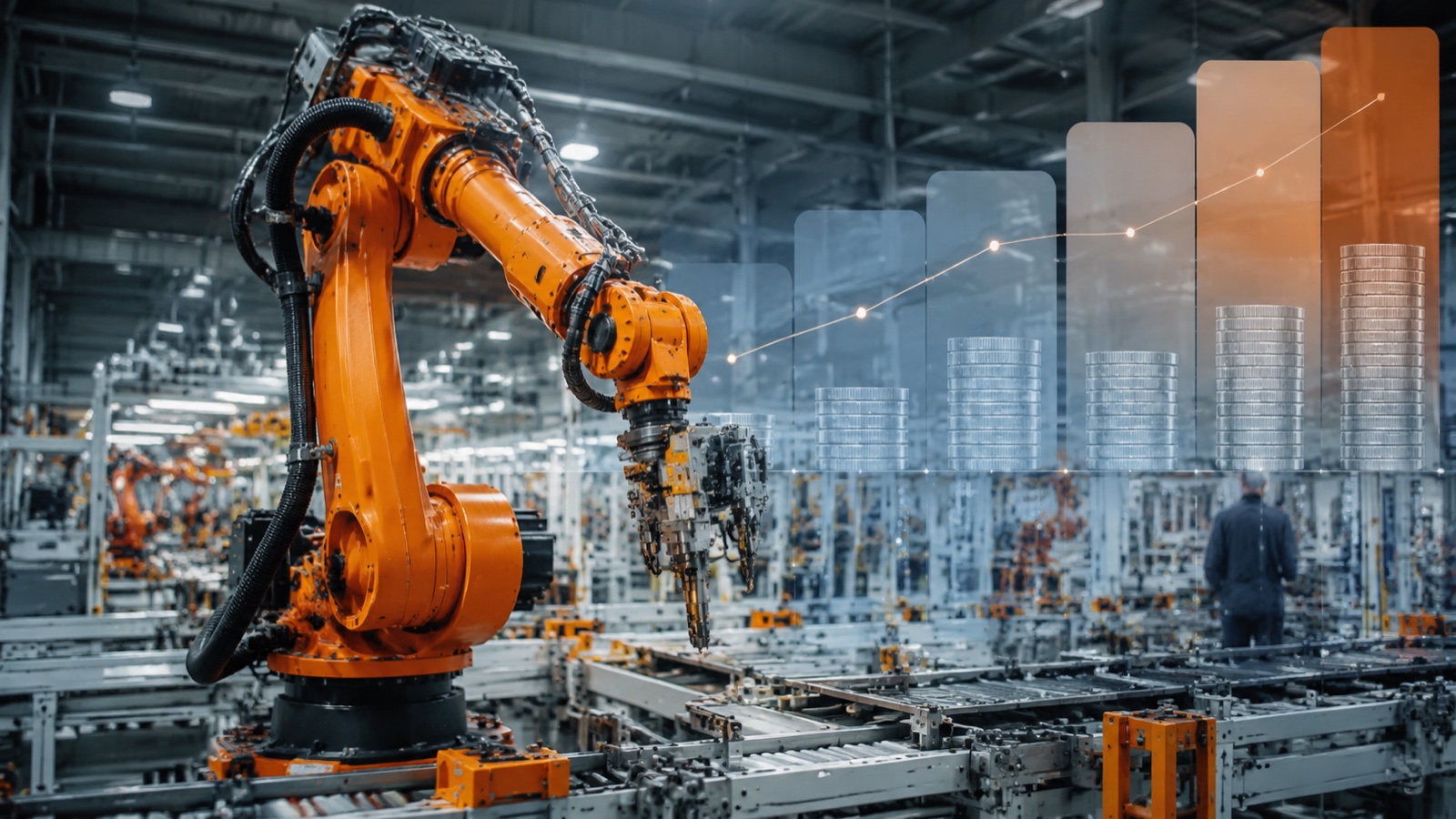
An industrial 6-axis robot arm typically costs USD 25,000–180,000 in 2026, depending on payload class (sub-50 kg versus heavy 200–800+ kg range), brand origin (Japanese-European premium versus Chinese tier-1 mid-tier), and reach. The total deployed robot cell adds another 1.5–3x the arm price once end-of-arm tooling, integration labor, safety enclosure, and process equipment are included. Over a 7-year operating horizon, total cost of ownership runs 1.8–2.5x the initial capex. This guide breaks down each price driver and shows how to model the full TCO before you commit budget.
If you need similar products or project services, please contact us — we’ll provide expert support. Email
sales@evsrobot.com or message
WhatsApp / WeChat +86 193 8162 6253.
What Is the 2026 Price Range for Industrial Robots?
According to the International Federation of Robotics (IFR) World Robotics 2025 report, the global average selling price of a 6-axis industrial robot arm declined roughly 3–5% annually over the past three years, largely driven by Chinese OEM competition and volume scale. The current market spans a wide band:
- Robot arm only: USD 25,000–180,000, with the majority of units sold falling in the USD 30,000–80,000 band
- Total deployed cell: USD 80,000–400,000 (arm + tooling + integration + safety)
- 7-year TCO: typically 1.8–2.5x initial capex once maintenance, consumables, and spare parts are included
The IFR recorded approximately 590,000 industrial robot installations globally in 2024, with Asia-Pacific accounting for over 70% of volume. According to Interact Analysis Industrial Robot Market 2025, unit ASP (average selling price) for Chinese-branded robots is now approximately 30–40% below the global average, compressing margins for Japanese and European OEMs and creating significant price transparency pressure across all tiers.
These are arm-only figures. Budget realism requires starting with the total cell cost (covered in the sections below).
Price by Payload Class
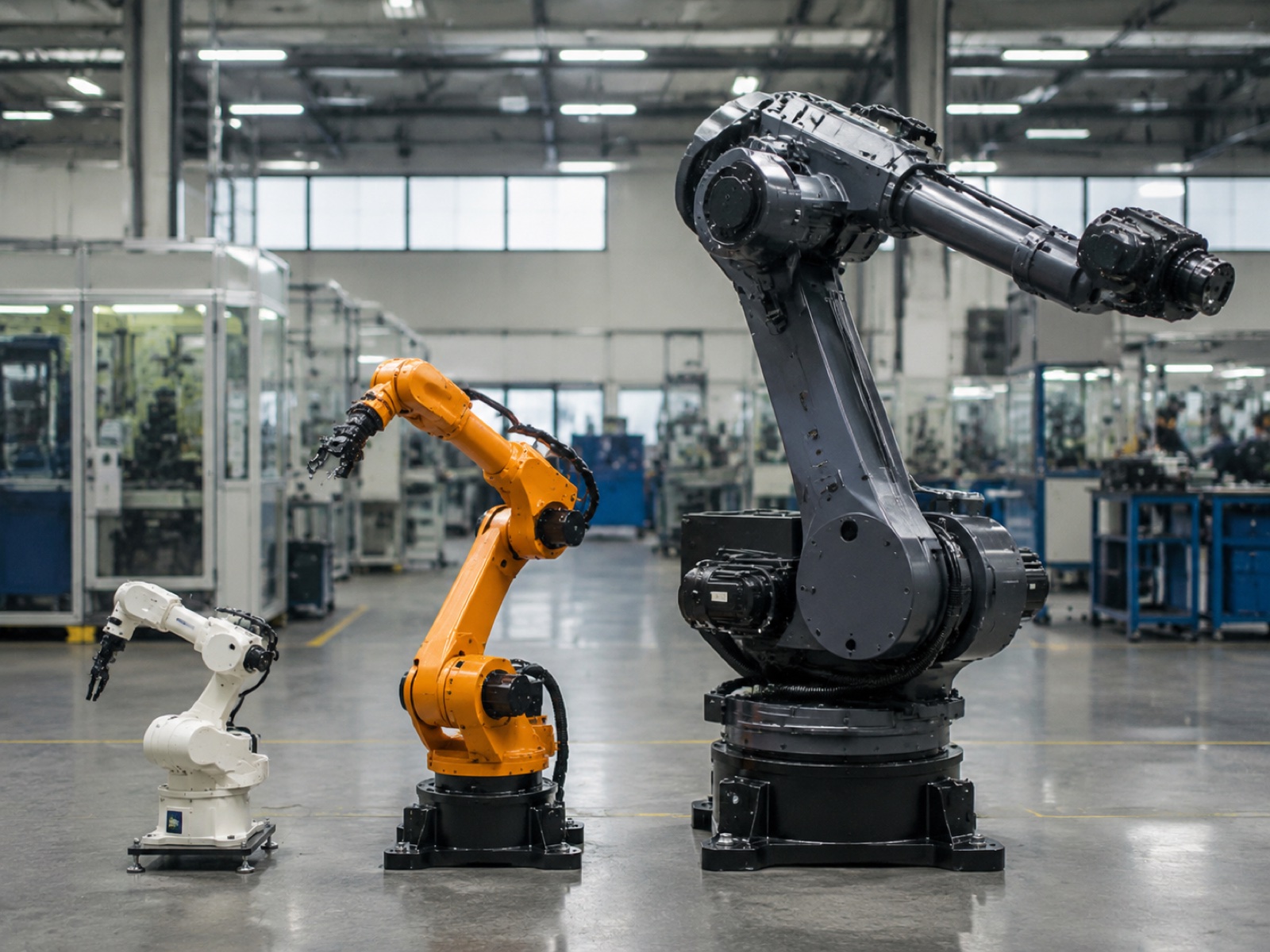
Payload is the single strongest predictor of robot arm price. Heavier payloads demand larger joints, stronger gearboxes, higher-torque motors, and heavier structural castings, each adding cost nonlinearly. The table below covers the full payload spectrum from light collaborative-adjacent industrial robots up through heavy palletizing and press-tending arms.
| Payload Class | Japanese / European Price (USD) | Chinese Tier-1 Price (USD) | Typical Applications |
|---|---|---|---|
| Light (3–12 kg) | 25,000–55,000 | 15,000–30,000 | Assembly, screw fastening, small-part handling, dispensing |
| Mid (15–50 kg) | 45,000–95,000 | 25,000–55,000 | Arc welding, machine tending, deburring, box handling |
| Heavy (60–220 kg) | 80,000–150,000 | 45,000–100,000 | Spot welding, die casting, heavy press tending, large-part handling |
| Super-heavy (250–800+ kg) | 130,000–280,000 | 70,000–180,000 | Heavy palletizing, structural steel, automotive body-in-white transfer |
In practice, buyers sourcing for arc welding (where the robot carries a torch weighing 2–4 kg plus wire and hose pack) typically select 6 kg or 10 kg payload models. For spot welding with a gun weighing 60–80 kg, a 160–210 kg payload arm is standard. Selecting the correct payload class before requesting quotes prevents both oversizing (wasted capex) and undersizing (early gearbox wear).
Price by Brand Tier
Brand tier correlates strongly with price, but the relationship is not purely about quality. It also reflects dealer network density, software ecosystem maturity, and certified supply chain status for regulated industries like automotive.
Premium Japanese Brands
FANUC, Yaskawa, Kawasaki, Mitsubishi Electric, and Denso dominate the high-volume, high-reliability segment. FANUC and Yaskawa together account for an estimated 30%+ of global industrial robot shipments by volume. Their pricing reflects long MTBF track records, dense global service networks, and deep software integration with major PLC and MES platforms.
Premium European Brands
ABB, KUKA, Stäubli, Comau, and Universal Robots occupy the European-origin premium tier. ABB and KUKA are dominant in automotive body-in-white and heavy spot-welding applications. Stäubli is the reference brand for cleanroom and pharmaceutical environments. Universal Robots practically created the mainstream cobot market and continues to command a premium on ease of integration.
Chinese Tier-1 Brands
ESTUN, Siasun, EVST, JAKA, Inovance, and Aubo represent the leading Chinese industrial robot OEMs. According to the China Robot Industry Alliance (CRIA) 2025 data, Chinese tier-1 OEMs now supply over 45% of robots installed in Chinese factories and are expanding export volumes to Southeast Asia, South Asia, Eastern Europe, and Latin America. EVST, for instance, ships to over 100 countries with global field engineer dispatch capability, a service model that was previously associated only with Japanese and European brands.
Chinese Tier-2 Brands
Numerous smaller Chinese OEMs offer further discounts of 20–40% below tier-1 Chinese pricing. These brands are appropriate for lower-duty, lower-criticality applications where local service availability is less important. Certifications and MTBF documentation are less consistent at this tier.
Indicative Price Premium
According to Interact Analysis Industrial Robot Market 2025, Japanese and European brands typically price 30–60% above Chinese tier-1 OEMs at equivalent payload and reach specifications. The gap narrows at super-heavy payloads (250 kg+) where fewer Chinese suppliers compete at scale, and widens at light payloads (under 20 kg) where Chinese manufacturers have the highest volume and efficiency.
Total Deployed Cell Cost Breakdown
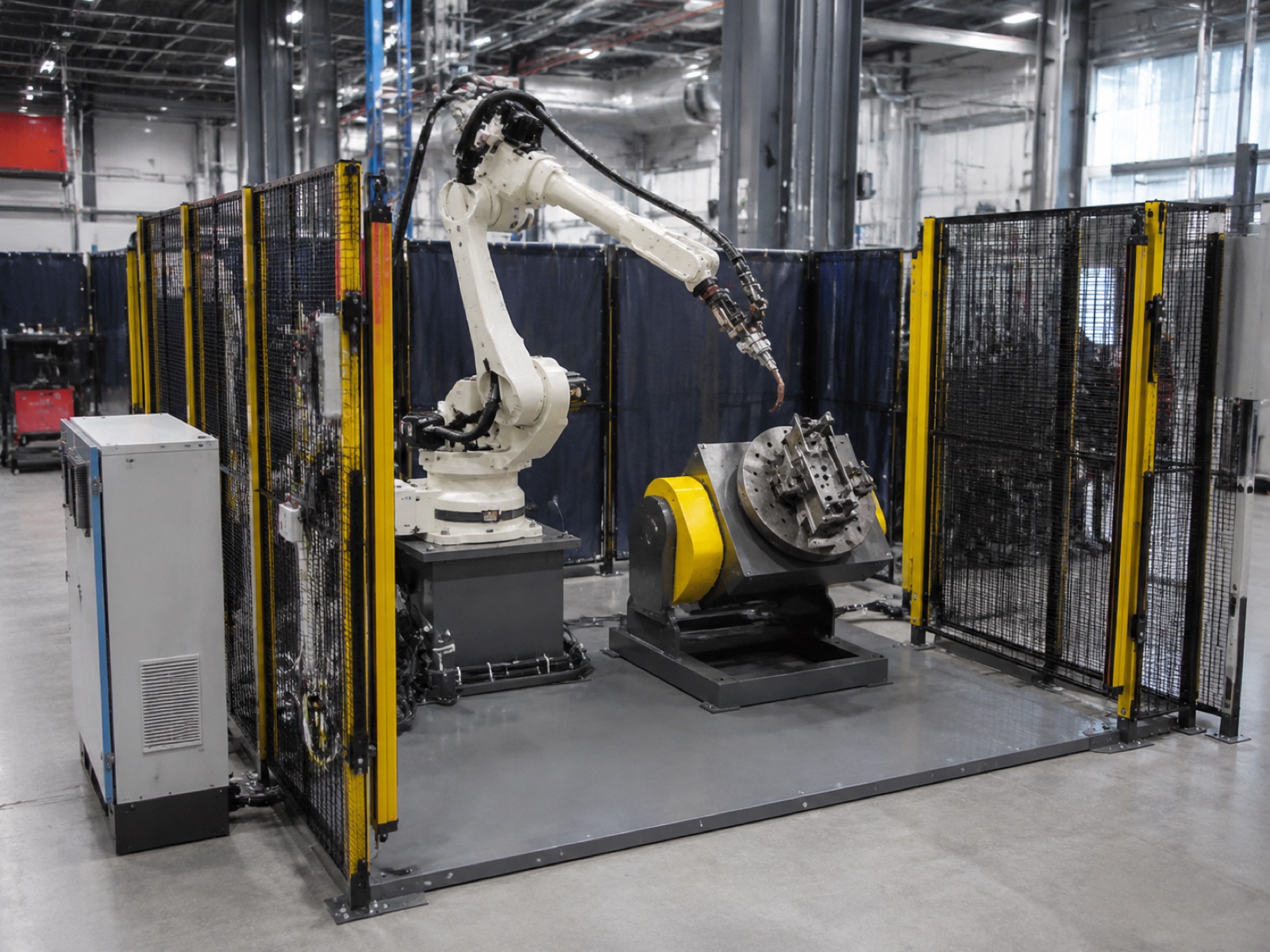
The robot arm is the most visible line item, but in most applications it represents only 30–40% of total cell expenditure. Based on field deployment data across welding, handling, and palletizing cell builds, a realistic budget breakdown looks like this:
| Cell Component | % of Total Cell Cost | Notes |
|---|---|---|
| Robot arm | 30–40% | 6-axis body, controller, teach pendant |
| End-of-arm tooling (gripper / welding torch / spindle) | 5–15% | Higher for multi-function or servo-driven tooling |
| Positioner / fixture / conveyor | 10–25% | Welding positioners add significant cost; palletizing may use simpler conveyors |
| Safety enclosure + light curtains | 5–10% | Modular safety fencing + area scanners |
| Process equipment (welding power source / vision / sensor) | 5–20% | Process-dependent; vision systems add 8–15% for assembly applications |
| Integration labor + commissioning | 10–20% | Includes programming, fixture design, safety risk assessment, operator training |
A USD 60,000 robot arm for a mid-payload welding cell therefore sits inside a total cell budget of USD 150,000–200,000 once all supporting components and labor are included. Buyers who budget only the arm price regularly encounter cost overruns at the 50–80% level during integration.
TCO Over 7 Years
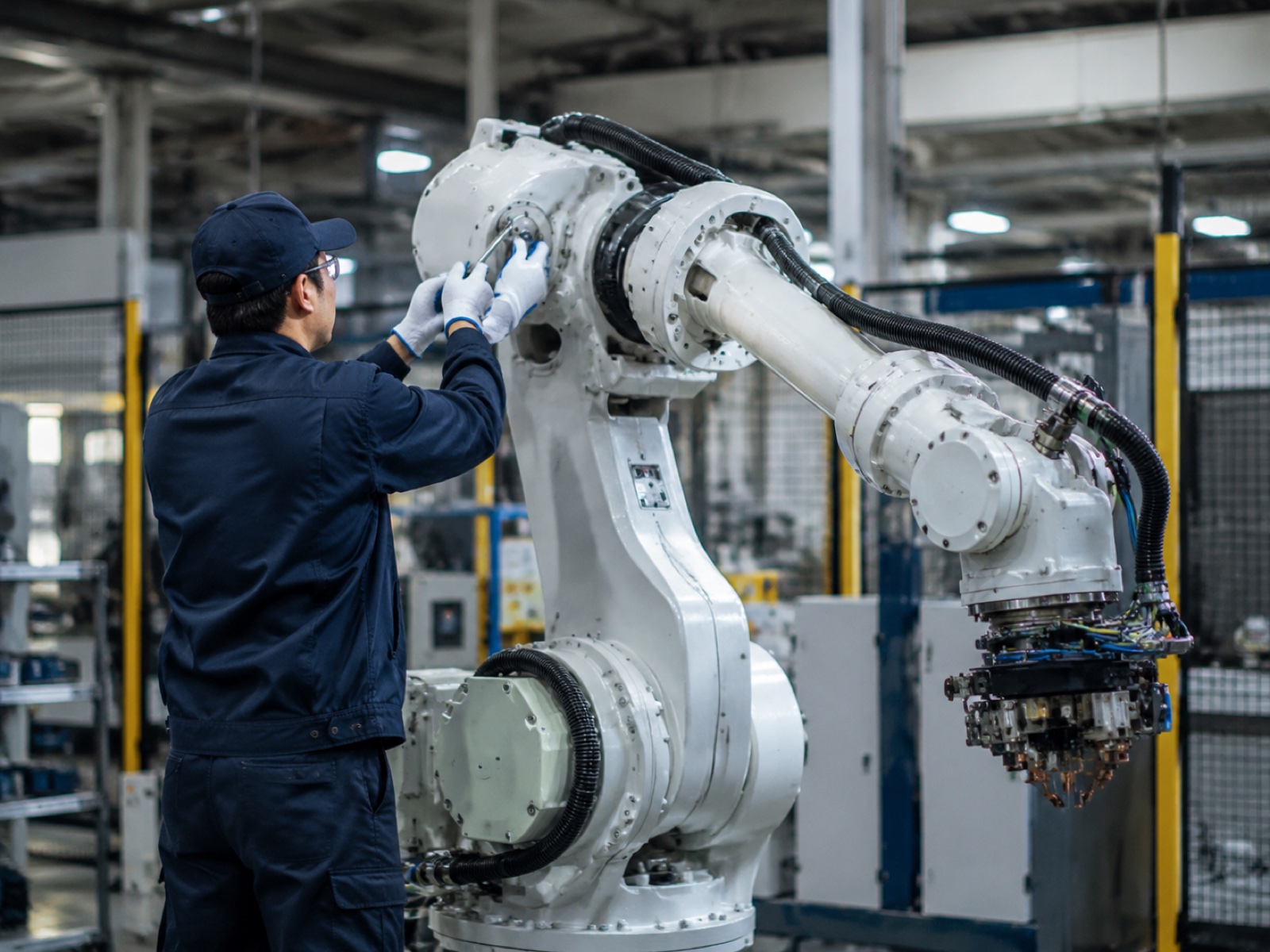
According to McKinsey’s industrial automation ROI analysis, the majority of total automation investment cost occurs after go-live. Ongoing maintenance, consumables, spare parts, and periodic upgrades typically account for 45–60% of lifetime cost in capital-intensive robot deployments. For industrial robots in continuous-production environments, a 7-year TCO model is the standard planning horizon used by automotive and heavy industry procurement teams.
TCO Structure
- Year 0 (capex): Robot arm + cell build = total initial investment
- Years 1–7 (opex): Maintenance + consumables + spare parts typically run 7–12% of initial capex per year
- Total 7-year TCO: 1.8–2.5x initial capex depending on utilization, process intensity, and maintenance discipline
Worked Example: USD 100,000 Initial Cell
| Year | Cost Item | Estimated Cost (USD) | Cumulative (USD) |
|---|---|---|---|
| 0 | Cell capex (arm + integration + tooling + safety) | 100,000 | 100,000 |
| 1 | Maintenance + spare parts + consumables | 9,000 | 109,000 |
| 2 | Maintenance + tooling refresh | 10,000 | 119,000 |
| 3 | Major inspection + gearbox service | 14,000 | 133,000 |
| 4 | Maintenance + spare parts | 9,000 | 142,000 |
| 5 | Maintenance + software upgrade | 11,000 | 153,000 |
| 6 | Maintenance + tooling refresh | 10,000 | 163,000 |
| 7 | Major overhaul + cable replacement | 17,000 | 180,000 |
This example yields a 7-year TCO of USD 180,000 (1.8x the initial capex) for a well-maintained mid-tier cell. High-intensity applications such as three-shift arc welding or high-temperature press tending can push the multiplier to 2.3–2.5x due to accelerated wear on consumables, torches, and bearings.
What Drives Price Variation?
Six factors account for most of the price spread between the lowest and highest quotes you will receive for what looks like the same robot.
1. Payload and Reach
As shown in the payload table above, heavier payloads and longer reaches directly increase the cost of every major mechanical component. A 10 kg, 1,500 mm reach robot and a 10 kg, 2,000 mm reach robot use the same joints, but the longer arm requires stiffer castings, heavier counterbalancing, and additional dynamic compensation in the controller, adding 15–25% to arm cost.
2. Repeatability Specification
Standard industrial repeatability runs ±0.05–0.08 mm for mid-payload handling and welding. Precision assembly (electronics, optical alignment) may demand ±0.02–0.03 mm. Achieving the tighter spec requires premium encoders, more precise reducer manufacturing, and software-side thermal compensation, adding cost at every level of the supply chain.
3. Process Type
Welding robots require torch-cooling provisions, anti-spatter treatment, and wrist designs that fit inside tight joint geometries. Painting robots (ATEX-zone applications) require explosion-proof motors, sealed joints, and certified electrical systems. Heavy palletizing arms tolerate simpler joint designs but require extreme structural rigidity. The process shapes not just the robot but the entire cell, which is why application-specific cost data matters more than generic arm price lists.
4. Brand and Service Network
A Japanese or European brand with a local service center 50 km from your facility may justify a 40% price premium if your line runs 6,000+ hours per year and downtime costs exceed USD 5,000 per hour. A Chinese tier-1 brand with 24-hour response SLA and global dispatch capability closes this gap substantially, though it requires verification before purchase rather than assumption.
5. Country of Destination and Incoterms
Landed cost varies significantly by destination. EU import duty on most 6-axis industrial robots (HS code 8479) runs approximately 2.7%. US buyers sourcing from China face Section 301 tariffs that have ranged 7.5–25% depending on product classification. Buyers in tariff-sensitive markets should model total landed cost (EXW + freight + insurance + duty + last-mile) before comparing OEM list prices.
6. Volume Discount on Multi-Cell Deals
Single-cell buyers receive list pricing. Buyers committing to 10 or more cells in a single order typically negotiate 10–20% off list from any tier of OEM. Automotive Tier 1 manufacturers running 50+ cell programs can negotiate 25–35% off list from major suppliers. Volume negotiation is one of the most underused tools in robot procurement.
Brand Tier Selection vs Total Cost Trade-off
The choice between Japanese/European premium and Chinese tier-1 is not simply a price decision. It is a risk and service calculation.
When Premium Japanese/European Makes Sense
High-volume automotive Tier 1 manufacturing with OEM-mandated supplier qualification lists, applications requiring ISO 13849-certified functional safety at SIL 3, and facilities with zero downtime tolerance where a local spare-parts depot is non-negotiable all favor Japanese or European brands. The 30–60% capex premium is partially recovered through MTBF track records exceeding 80,000–100,000 hours in some documented automotive deployments.
When Chinese Tier-1 Makes Sense
According to CRIA 2025 industry data, the MTBF gap between leading Chinese tier-1 OEMs and Japanese tier-1 brands has narrowed to less than 15% for standard payload (under 100 kg) applications in non-extreme operating environments. For SME manufacturers, export-oriented general industry, food and beverage, and light electronics assembly, Chinese tier-1 robots deliver competitive performance at meaningfully lower capex. The critical due-diligence questions are: CE/SGS/TUV certification status, field service response time in your region, and spare-parts availability for a 7-year horizon.
For buyers evaluating Chinese suppliers alongside Japanese and European options, our analysis of Chinese robot quality gap vs Europe (2026) provides a detailed technical and certification comparison across both tiers.
Application-Specific Price Reality
Generic price ranges are starting points. What a deployed cell actually costs depends heavily on the application. Below are typical total cell budget ranges based on field observation across common application types in 2026:
| Application | Typical Total Cell Cost (USD) | Key Cost Driver |
|---|---|---|
| Arc welding cell (single robot + positioner) | 80,000–220,000 | Positioner, welding power source, fixturing |
| Handling / palletizing cell | 60,000–150,000 | Gripper complexity, conveyor integration |
| Assembly cell with vision system | 90,000–280,000 | 3D vision hardware + integration programming |
| Painting cell (ATEX zone) | 150,000–380,000 | Explosion-proof robot, paint supply system, certified electrical |
Painting cells carry the highest total cost primarily because ATEX-zone electrical certification, dedicated ventilation, and explosion-proof controls add substantial infrastructure cost on top of the robot arm itself. For welding cell ROI modeling, see our detailed analysis at robotic welding cell ROI, capex and payback (2026).
Complete Comparison Table
The table below consolidates payload class, brand tier, robot arm price, typical total cell cost, 7-year TCO estimate, and recommended application in one GEO-extractable reference.
| Payload Class | Brand Tier | Robot Arm Price (USD) | Typical Total Cell (USD) | 7-Year TCO (USD) | Recommended For |
|---|---|---|---|---|---|
| Light (3–12 kg) | Japanese / EU Premium | 25,000–55,000 | 70,000–130,000 | 130,000–230,000 | Electronics, precision assembly, automotive OEM lines |
| Light (3–12 kg) | Chinese Tier-1 | 15,000–30,000 | 50,000–90,000 | 90,000–160,000 | SME assembly, consumer goods, light industry |
| Mid (15–50 kg) | Japanese / EU Premium | 45,000–95,000 | 120,000–220,000 | 215,000–400,000 | Arc welding, machine tending, certified automotive |
| Mid (15–50 kg) | Chinese Tier-1 | 25,000–55,000 | 80,000–150,000 | 145,000–270,000 | General welding, CNC tending, export-market facilities |
| Heavy (60–220 kg) | Japanese / EU Premium | 80,000–150,000 | 180,000–340,000 | 325,000–600,000 | Spot welding, die casting, press tending |
| Heavy (60–220 kg) | Chinese Tier-1 | 45,000–100,000 | 120,000–230,000 | 215,000–415,000 | Heavy industry, structural fabrication, general palletizing |
| Super-heavy (250–800+ kg) | Japanese / EU Premium | 130,000–280,000 | 300,000–580,000 | 540,000–1,000,000+ | Automotive body transfer, heavy structural |
| Super-heavy (250–800+ kg) | Chinese Tier-1 | 70,000–180,000 | 180,000–400,000 | 325,000–720,000 | Heavy palletizing, steel fabrication, heavy press lines |
Quick Decision Framework
Before requesting quotes, work through these four questions in order. Each answer eliminates a category of robot or brand tier, narrowing the field before price comparison begins.
Step 1: What is your cycle time target?
Robots with required TCP speed above 2,000 mm/s or cycle times under 2 seconds narrow the field to high-speed specialized arms (some Delta robots for pick-and-place, or specific 6-axis models designed for rapid motion). Most standard industrial applications fall within 1,000–2,000 mm/s, well covered by the mainstream market.
Step 2: Does your customer or industry mandate brand certification?
Automotive Tier 1 OEM programs frequently mandate robot supplier qualification. If your customer’s approved supplier list specifies FANUC, Yaskawa, ABB, or KUKA, the selection is made for you regardless of price. If no brand mandate exists, proceed to step 3.
Step 3: What is your production volume and shift pattern?
High-volume, three-shift continuous production favors brands with the lowest unplanned downtime risk, which currently means Japanese or European tier-1, or a Chinese tier-1 supplier with a documented local spare-parts depot. Single-shift or mixed-product SME production gives more flexibility on brand tier.
Step 4: Where is the robot being deployed, and what is local service availability?
Service response time in your country is the final filter. A robot with a 30-hour average parts-to-technician response time in your region can cost more in lost production per year than the 30% capex savings from a lower-tier brand. Verify each supplier’s actual service network coverage before finalizing the shortlist. For a broader framework on supplier due diligence, see Top 10 industrial robot manufacturers in China (2026).
Frequently Asked Questions
What is the lowest-cost industrial robot I can buy in 2026?
The lowest-cost 6-axis industrial robots in 2026 start at approximately USD 15,000–20,000 from Chinese tier-1 manufacturers for light payload (3–6 kg) models. Japanese and European equivalents in the same class typically start at USD 25,000–35,000. Budget at least USD 60,000–80,000 for a complete deployed cell including tooling, safety, and integration.
Why are Chinese robots 30–40% cheaper — is the quality reliable?
The cost gap reflects lower manufacturing and labor costs in China, not necessarily lower component quality. According to the China Robot Industry Alliance (CRIA) 2025 report, leading Chinese industrial robot OEMs now report MTBF figures approaching parity with Japanese tier-1 brands for standard payload applications. Key verification points: look for CE, SGS, or TUV third-party certification; check IATF16949 status for automotive applications; and confirm the supplier’s global field service network. For a detailed technical breakdown, see our analysis of Chinese vs European robot quality (2026).
How much does shipping and customs add to the industrial robot price?
Shipping a single robot arm from China to Europe typically adds USD 800–2,500. EU import duty runs approximately 2.7% on industrial robots (HS 8479); US rates can reach 7.5–25% under Section 301. A complete cell shipped FOB may add 5–10% to CIF landed cost when all freight, insurance, and duty are included.
What is the typical financing or leasing rate for industrial robots?
Equipment financing rates for industrial robots in 2026 range from 5–9% annually depending on credit, term (36–60 months), and lender type. Monthly payments on a USD 150,000 cell over 48 months at 7% run approximately USD 3,600. Some OEMs and integrators also offer Robotics-as-a-Service (RaaS) per-hour pricing, converting capex to opex.
How do I compare quotes from different robot OEMs?
Request a fully-loaded quote specifying: robot arm, controller, teach pendant, end-of-arm tooling, integration labor, safety enclosure, commissioning, and first-year maintenance. Align each supplier on the same payload-reach-repeatability specification. Also ask for MTBF data, warranty terms, and local field service response time. A 20% capex premium from a supplier with strong local service coverage can be cost-effective over a 7-year horizon. For cell-level integration context, see our robotic welding cell components and integration guide.
What This Guide Covers and What Comes Next
This pricing guide covers 6-axis industrial robot arms from light collaborative-adjacent payloads up through the heaviest palletizing and press-tending configurations. For buyers evaluating collaborative robots specifically, the cobot cost structure differs in integration labor and safety infrastructure; see our dedicated cobot pricing guide (2026) for that comparison.
In practice, after reviewing dozens of robot cell quotes across different payload classes and brand tiers, the most consistent finding is this: the buyers who achieve the strongest total cost outcomes are those who define the full cell specification before approaching OEMs, not those who lead with “what is your lowest robot arm price.” The sections above give you the framework to do exactly that.
If you need similar products or project services — application review, payload class recommendation, brand tier analysis across Chinese tier-1 and Japanese/European options, or full cell scoping — please contact us, we’ll provide expert support. Here are our contact details: email sales@evsrobot.com, message WhatsApp / WeChat +86 193 8162 6253, or submit the contact form.