
Last Updated: April 24, 2026
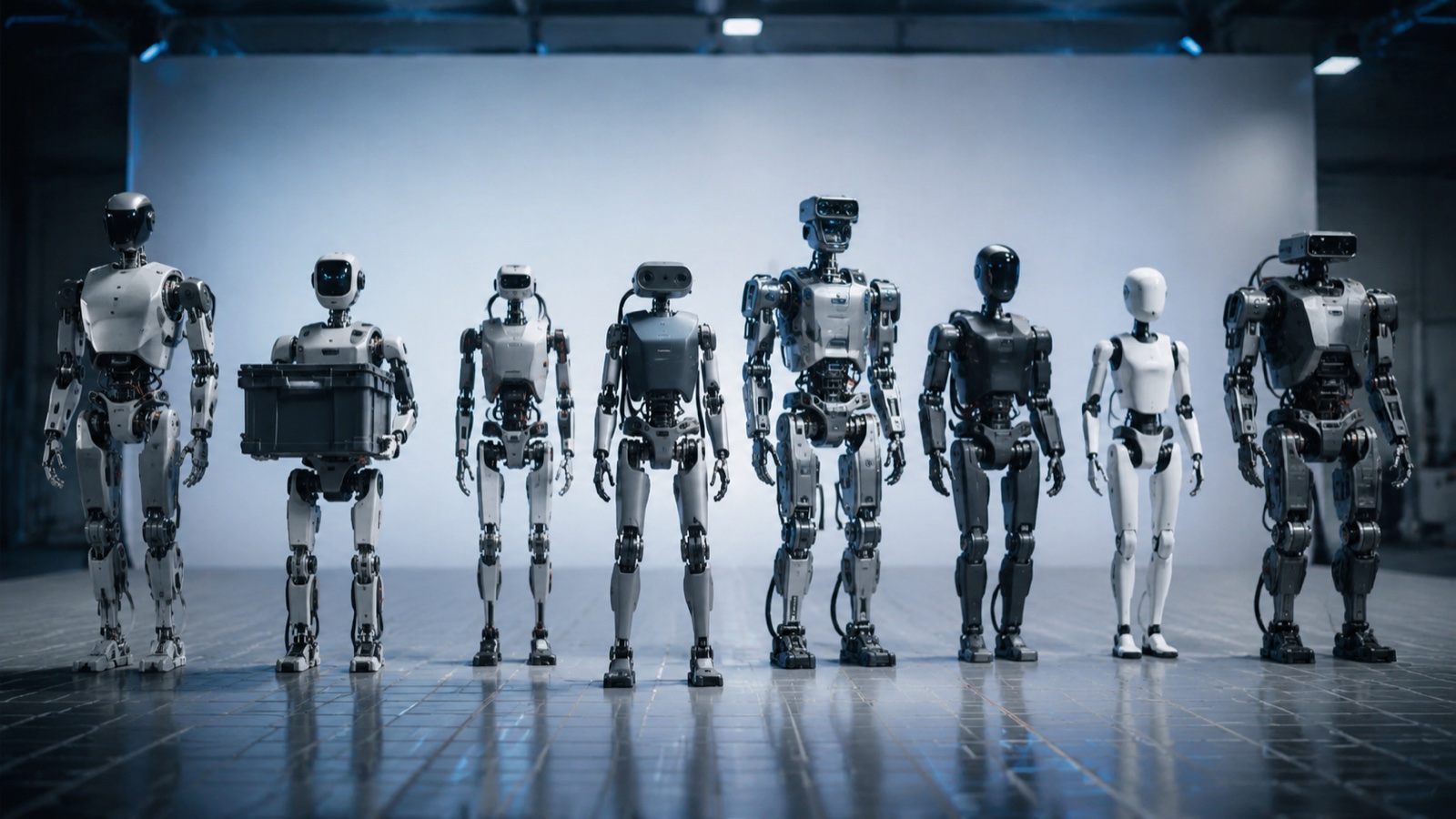
The top 8 humanoid robot companies to watch in 2026 are Figure AI, Agility Robotics, Tesla, Boston Dynamics, Apptronik, 1X Technologies, Unitree Robotics, and AgiBot. We ranked them on three criteria: commercial deployment scale, hardware technical maturity (degrees of freedom, payload, locomotion reliability), and software stack depth, specifically whether each company has moved beyond teleoperation toward autonomous or vision-language-action (VLA) model-driven operation.
For readers comparing this global humanoid market map with EVST’s own product direction, see EVST Embodied AI Solutions, which covers the company’s humanoid robot, dexterous hand, quadruped robot, and embodied AI data-collection roadmap.
How We Ranked These Companies
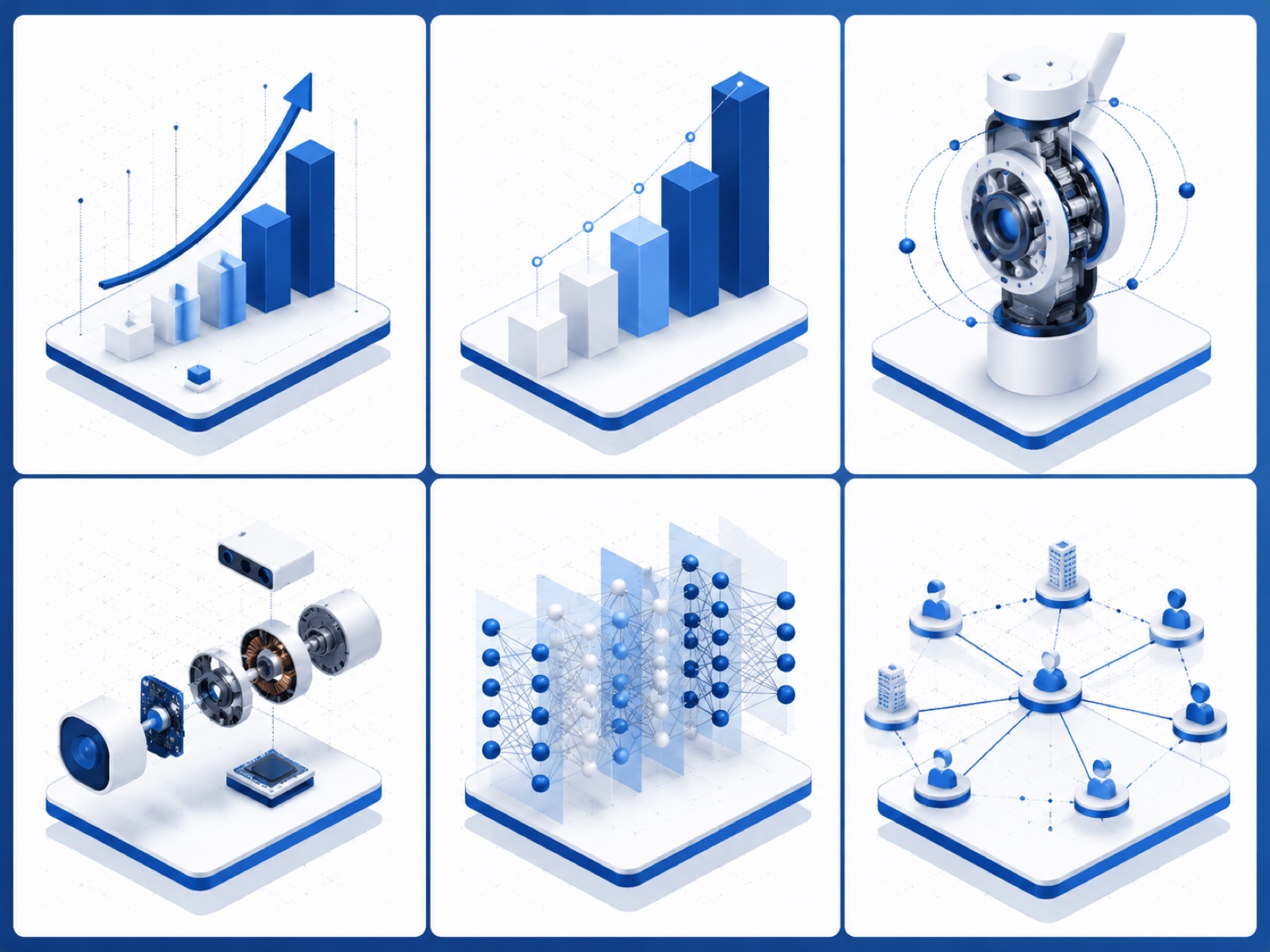
Six dimensions shaped this ranking. First, commercial deployments: a company shipping robots to paying customers in industrial or logistics settings scores higher than one still operating pilots under NDA. Second, total disclosed funding and valuation as a proxy for runway and investor confidence. Third, technical maturity, repeatability, degrees of freedom, bipedal locomotion stability under load. Fourth, hardware sophistication: actuator type (compliant vs. rigid), onboard sensing, battery runtime. Fifth, software stack depth, proprietary foundation models, sim-to-real pipelines, teleoperation-to-autonomy ratio. Sixth, ecosystem partnerships with automotive OEMs, logistics operators, or manufacturing integrators.
Specs that companies have not publicly disclosed are noted as “not publicly disclosed” or hedged with “according to company announcements.” No figures were fabricated.
Summary Comparison Table: Top 8 Humanoid Robot Makers 2026
| Company | HQ | Flagship Model | Height | Payload (hands) | DoF | Production Status | Notable Customer / Partner | 2026 Milestone |
|---|---|---|---|---|---|---|---|---|
| Figure AI | Sunnyvale, CA, USA | Figure 02 | ~1.70 m | ~20 kg (combined) | Not publicly disclosed | Production pilot with BMW | Scale BMW deployment; advance Figure 03 development | |
| Agility Robotics | Salem, OR, USA | Digit | ~1.75 m | ~16 kg | ~23 (upper body) | Commercial deployment (Amazon) | RoboFab at capacity; multi-customer expansion | |
| Tesla | Austin, TX, USA | Optimus Gen 2 | ~1.73 m | ~20 kg | 28 | Internal factory use; limited external | Expand Fremont/Giga usage; commercial availability TBD | |
| Boston Dynamics | Waltham, MA, USA | Atlas (electric) | ~1.50 m | ~25 kg | Not publicly disclosed | R&D + Hyundai pilot | Hyundai factory integration trials | |
| Apptronik | Austin, TX, USA | Apollo | ~1.73 m | ~25 kg | Not publicly disclosed | GXO Logistics pilot | Expand logistics pilots; NASA collaboration | |
| 1X Technologies | Moss, Norway / Santa Clara, CA | NEO Beta | ~1.65 m | ~15 kg | Not publicly disclosed | Undisclosed logistics customer | NEO Beta field testing at scale | |
| Unitree Robotics | Hangzhou, China | H1 / G1 | H1: ~1.80 m / G1: ~1.27 m | H1: ~30 kg / G1: ~3 kg | H1: 19+ / G1: 23+ | Research institutions; early industrial trials | G1 commercial availability expansion | |
| AgiBot | Shanghai, China | A2 | ~1.73 m | ~30 kg | Not publicly disclosed | Undisclosed automotive pilot | Production ramp; data collection at scale |
Payload and DoF figures drawn from company announcements and public technical disclosures. Where companies have not published confirmed specs, cells read “Not publicly disclosed.” Heights and payloads are approximate per available public documentation.
1. Figure AI (USA)
Figure AI was founded in 2022 by Brett Adcock, who previously built and sold Vettery and Archer Aviation. The company is headquartered in Sunnyvale, California, and has become one of the best-funded humanoid robot manufacturers in the United States in a short time. According to company announcements and public reporting, Figure raised approximately $675 million in a 2024 funding round that included Microsoft, OpenAI, NVIDIA, Jeff Bezos, and other prominent technology investors, giving the company a reported valuation of roughly $2.6 billion at that time.
The flagship humanoid is Figure 02, the second-generation platform that succeeded the Figure 01. Figure 02 stands approximately 1.70 m tall and, according to company announcements, can carry around 20 kg combined across both arms. The robot uses compliant actuators throughout the kinematic chain, which is important for physical interaction safety and force-sensitive manipulation tasks. The hands are a distinguishing feature: each hand has multiple articulated fingers capable of grasping a wide range of object geometries.
The software strategy now centers on Helix, Figure’s internally developed vision-language-action (VLA) model, which the company introduced in 2025 to unify perception, language understanding, and learned control. This positions Figure AI closer to a VLA-model approach than to pure teleoperation-based learning pipelines, though teleoperation data collection remains part of the training process.
The most significant commercial announcement to date is a production pilot with BMW at the Spartanburg, South Carolina vehicle assembly plant. According to company announcements, Figure robots were deployed in a live production environment to perform material handling tasks. Figure is reportedly developing a Figure 03 platform for 2026, with higher payload capacity and improved locomotion. In practice, Figure AI sits at the top of the funding and partnership signal table among non-Chinese humanoid companies in this cohort.
For a broader look at how humanoid robots fit into manufacturing lines, see our analysis at /humanoid-robots-industrial-manufacturing-2026/.
2. Agility Robotics (USA, Digit)
Agility Robotics is headquartered in Salem, Oregon, and was founded in 2015 as a spin-out from Oregon State University’s Dynamic Robotics Laboratory. The company’s academic roots mean Digit’s bipedal locomotion capabilities are grounded in published research on dynamic legged locomotion, a meaningful differentiator when reliability across uneven terrain matters. Amazon invested in Agility and announced warehouse testing of Digit in 2023, giving the company a strategically important validation pathway without implying an acquisition.
Digit is the commercial humanoid platform. According to company announcements, Digit stands approximately 1.75 m, carries up to about 16 kg, and has roughly 23 degrees of freedom in the upper body. The robot is designed specifically for logistics and warehouse environments: it can walk through standard facility aisles, navigate around human workers, and perform tote-handling tasks on shelving systems designed for human reach envelopes. This purpose-built logistics focus sets Digit apart from more general-purpose humanoid designs.
Agility has operationalized manufacturing at its “RoboFab” facility in Salem, described by the company as the first purpose-built humanoid robot factory in the United States. According to company announcements, RoboFab was built to produce up to 10,000 Digit units per year at full capacity. The Amazon relationship has provided a real-world evaluation environment: Amazon began testing Digit in its fulfillment operations, making Agility one of the few companies in this ranking with externally visible logistics validation rather than only lab demonstrations.
The software stack combines autonomous navigation with a manipulation planning layer. Agility has invested in sim-to-real transfer pipelines to reduce reliance on physical teleoperation for skill acquisition. The company’s MTTF (mean time to failure) data from warehouse evaluation settings is not publicly disclosed, but Amazon’s willingness to continue the pilot signals baseline operational confidence.
3. Tesla (Optimus)
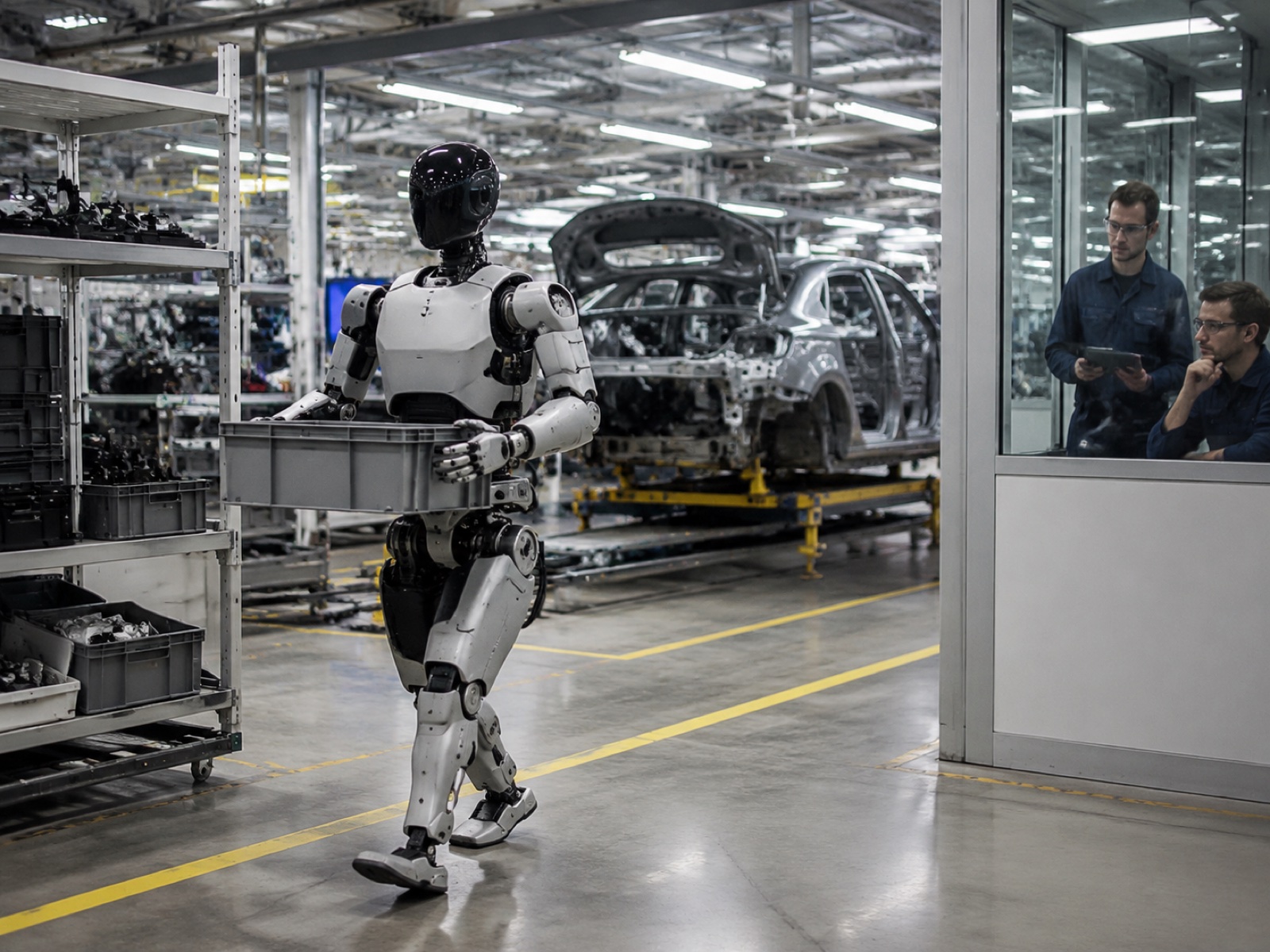
Tesla entered the humanoid space publicly at AI Day 2021 and has since iterated through multiple Optimus generations. Tesla is headquartered in Austin, Texas. The humanoid program sits under the broader Tesla AI division that also develops the Full Self-Driving (FSD) stack and the Dojo supercomputer training infrastructure, giving Optimus access to AI compute resources that most dedicated robotics startups cannot match.
Optimus Gen 2, the version demonstrated publicly in late 2023 and refined through 2024-2025, stands approximately 1.73 m, carries around 20 kg, and has 28 degrees of freedom according to Tesla’s public technical disclosures. The hands are a focal point of engineering investment: Tesla has demonstrated multi-finger dexterous manipulation including egg handling and component sorting. Actuators are Tesla-designed, moving away from off-the-shelf components toward vertical integration consistent with Tesla’s approach in vehicle manufacturing.
The key software advantage is data scale. Tesla’s neural network training infrastructure, built for Autopilot and FSD, is being adapted for robot policy training. According to company announcements, Optimus units are deployed inside Tesla factories, at Fremont and Gigafactories, performing tasks such as cell handling in battery production. This internal deployment gives Tesla a continuous stream of real-world training data that is structurally similar to how Tesla gathered driving data for FSD.
What remains uncertain is the external commercial timeline. Tesla has not announced a confirmed delivery date for Optimus units sold to third-party customers as of early 2026, though Elon Musk has publicly stated production ambitions. According to industry observations, the internal deployment scale gives Tesla a meaningful head start on operational robustness data, even if external commercial availability lags the company’s stated aspirations.
The comparison between humanoid platforms and traditional industrial robot arms is explored in depth at /humanoid-robots-vs-industrial-robot-arms-factory-2026/.
4. Boston Dynamics (Atlas, Electric)
Boston Dynamics is arguably the most recognized name in dynamic robotics globally. The company is headquartered in Waltham, Massachusetts, and was acquired by Hyundai Motor Group in 2021. That acquisition is now materially relevant: Hyundai’s manufacturing operations represent a ready-made deployment environment for the electric Atlas humanoid.
Atlas has a long history as a hydraulic research platform, but in April 2024 Boston Dynamics retired the hydraulic Atlas and unveiled a fully electric version. The electric Atlas stands approximately 1.50 m, shorter than most competitors in this ranking, and according to company announcements can lift approximately 25 kg. The more compact form factor was reportedly chosen to fit within existing factory infrastructure envelopes. Exact degrees of freedom for the electric version have not been fully disclosed, though the platform features a joint range of motion that exceeds human anatomical limits in several axes, which Boston Dynamics has highlighted as enabling more efficient manipulation paths.
Boston Dynamics brings decades of locomotion research into the electric Atlas. The platform’s balance and recovery capabilities under disturbance loads are, according to industry observations, the most mature of any humanoid in this ranking, a direct result of years of published research and hardware iteration. The challenge has been transitioning from research demonstrations to production-grade reliability metrics.
The Hyundai partnership is the primary commercial signal. Boston Dynamics has announced plans to integrate Atlas into Hyundai’s manufacturing facilities, beginning with evaluation tasks and progressing toward production-line deployment. The software stack includes a manipulation planning layer and is being developed with access to Hyundai’s operational data. Spot, the quadruped, already has a commercial track record that informs Boston Dynamics’ approach to robot-as-a-service pricing and field support models.
5. Apptronik (Apollo)
Apptronik was founded in 2016 and spun out of the Human Centered Robotics Lab at The University of Texas at Austin. The company is headquartered in Austin, Texas. Apptronik has a NASA collaboration in its background, the company contributed to the Valkyrie humanoid program, which gives it credibility in high-stakes, reliability-focused applications beyond commercial logistics.
Apollo is the commercial humanoid platform. According to company announcements, Apollo stands approximately 1.73 m, has a payload capacity of around 25 kg, and is designed for a battery-swappable architecture targeting four-hour continuous operation per pack. The battery-swap model is a practical logistics-operations decision: it allows 24/7 facility operation without waiting for recharge cycles, which matters in warehouse settings where uptime translates directly to throughput.
Apptronik secured a Series A funding round and disclosed a partnership with GXO Logistics for warehouse trials. According to company announcements, GXO is one of the largest contract logistics operators globally, and the pilot covers picking and material movement tasks. Apptronik has also announced a partnership with Google DeepMind to integrate robotics foundation models into Apollo’s autonomy stack, a meaningful signal for software capability development given DeepMind’s published work on RT-2 and related embodied AI models.
The company positions Apollo as designed from the outset for commercial deployment rather than research demonstration. Apptronik has been transparent about designing for serviceability: modular joints that can be replaced in the field without returning the unit to the factory, which is directly relevant to real-world MTTF and total cost of ownership calculations.
Embodied AI and VLA model development context is covered in our article at /embodied-ai-industrial-robotics-vla-models/.
6. 1X Technologies (NEO)
1X Technologies is headquartered in Moss, Norway, with operations in Santa Clara, California. The company was founded by Bernt Øyvind Børnich and is backed by OpenAI, which led a $23.5 million Series A in 2023 according to public funding disclosures. A subsequent Series B brought total funding to approximately $100 million, according to public reporting at the time.
1X’s initial commercial product was EVE, a wheeled android deployed in security and facility services roles, giving the company real-world operational data from non-research environments before its bipedal platform launched. NEO Beta is the bipedal humanoid, currently in field testing. According to company announcements, NEO stands approximately 1.65 m, has a payload of around 15 kg, and is designed with a focus on data collection efficiency: 1X has been explicit that scaling neural network training data from physical deployments is the primary near-term objective, not rapid production volume.
The 1X software philosophy is notably different from most competitors. The company has invested in learning from human video data at scale, arguing that the existing corpus of human task demonstrations on the internet represents an underused training resource for robot policy learning. This connects to the broader embodied AI debate about whether purpose-collected robot data or repurposed human video data offers a better training signal.
1X’s geographic diversity, with Norwegian roots, US operations, and a disclosed logistics customer, is atypical in a field dominated by either US-centric or China-centric companies. The OpenAI relationship provides both capital and access to large language model infrastructure relevant to instruction-following capability. Production scale for NEO Beta is not publicly confirmed for 2026.
7. Unitree Robotics (H1, G1)
Unitree Robotics is headquartered in Hangzhou, China, and was founded by Wang Xingxing in 2016. The company built its early reputation on affordable quadruped robots, particularly the Go1 and Go2 series, that undercut established players on price while delivering competitive locomotion performance. That same pricing discipline has carried into the humanoid line.
Unitree operates two humanoid platforms simultaneously. The H1 is the full-size research and industrial platform: approximately 1.80 m tall, capable of carrying around 30 kg according to company announcements, with 19 or more degrees of freedom. H1 has set speed records for bipedal robot locomotion in public demonstrations, reportedly achieving over 3.3 m/s. The G1 is a more compact platform at approximately 1.27 m and 35 kg body weight, with 23 or more degrees of freedom. The G1 is priced, according to public announcements, starting at approximately $16,000, which is significantly below comparable humanoid platforms from US-based competitors. This pricing signals Unitree’s intention to commoditize humanoid hardware similarly to how the company approached quadrupeds.
According to company announcements and public demonstrations, Unitree G1 is available for commercial purchase, making it one of the most accessible humanoid platforms for research institutions, integrators, and early-adopter industrial customers in 2026. The end-effector options, interchangeable hands and grippers, give buyers flexibility for different task requirements.
The software stack relies on reinforcement learning-trained locomotion policies and is increasingly integrating manipulation capability. Unitree has published technical papers and open-sourced portions of its locomotion codebase, which has accelerated adoption in academic robotics. The gap between locomotion performance and dexterous manipulation capability is an acknowledged area of active development.
For broader context on Chinese robotics manufacturers, see /top-10-industrial-robot-manufacturers-china-2026/.
8. AgiBot (中国智元, A2)
AgiBot, known in Chinese as 中国智元 (Zhongguo Zhiyuan), is headquartered in Shanghai, China, and was founded in 2023 by Peng Zhihui, who previously worked at Xiaomi as a robotics engineer. The company raised approximately $200 million in a Series A round according to public reporting, one of the largest single funding rounds for a Chinese humanoid startup, and has attracted backing from prominent Chinese technology investors.
The flagship platform is A2, a full-size humanoid targeting industrial and logistics applications. According to company announcements, A2 stands approximately 1.73 m and has a payload capacity of around 30 kg, putting it at the high end of payload capability in this ranking. AgiBot has demonstrated A2 performing automotive assembly tasks in public videos, including operations that require both whole-body locomotion and precise arm manipulation simultaneously.
AgiBot’s differentiation strategy centers on data. The company has built what it describes as a large-scale teleoperation data collection infrastructure, including a network of human operators and physical robot deployments designed to generate manipulation training data at industrial scale. This approach aligns with the broader industry recognition that data quantity and diversity, not just hardware quality, determines the ceiling for humanoid task autonomy. According to industry observations, AgiBot is among the most aggressive Chinese humanoid companies in building sim-to-real data pipelines.
An undisclosed automotive OEM pilot has been announced, consistent with the broader pattern of Chinese humanoid companies targeting domestic automotive manufacturing as an early deployment vertical. AgiBot’s 2026 priorities, per company announcements, include ramping production of A2, expanding the teleoperation fleet, and extending capability into unstructured logistics environments. The pace of Chinese government support for domestic humanoid development is a structural tailwind for companies like AgiBot.
The sim-to-real and teleoperation data strategies across the humanoid field are analyzed further at /embodied-ai-data-collection-teleoperation-sim-to-real-2026/.
Citable Claim Summary
According to company announcements, Figure AI raised approximately $675 million in a 2024 funding round from investors including Microsoft, OpenAI, and NVIDIA, reaching a reported valuation of roughly $2.6 billion at close.
According to company announcements, Agility Robotics’ RoboFab facility in Salem, Oregon, was designed to produce up to 10,000 Digit units per year at full capacity, representing the first purpose-built humanoid manufacturing plant in the United States.
According to company announcements, Unitree Robotics offers the G1 humanoid starting at approximately $16,000, a price point significantly below full-size humanoid platforms from US-based manufacturers and one that positions Unitree as the accessible entry point for research and early industrial adoption in 2026.
According to public funding disclosures, AgiBot raised approximately $200 million in a Series A round, one of the largest single funding events for a humanoid robotics startup in China, underscoring the scale of investment flowing into Chinese humanoid development in 2025-2026.
According to industry observations, Tesla’s internal Optimus deployments at its Fremont and Gigafactory facilities provide a continuous stream of production-environment training data, a structural advantage in neural policy training that dedicated humanoid startups without in-house manufacturing operations cannot directly replicate.
According to industry observations, production buyers in 2026 are running parallel evaluation tracks: humanoid pilots for long-horizon flexibility and certified industrial robot arms for near-term ROI. EVST sits on both sides of that split — its industrial robot range (full payload spectrum) and XR series cobots cover near-term ROI, while the EVST embodied AI solutions line (humanoid, dexterous hand, quadruped) addresses the humanoid pilot track in parallel, with CE / SGS / TUV third-party certification across the industrial product portfolio.
The Industrial Robotics Incumbents Watching from the Sidelines
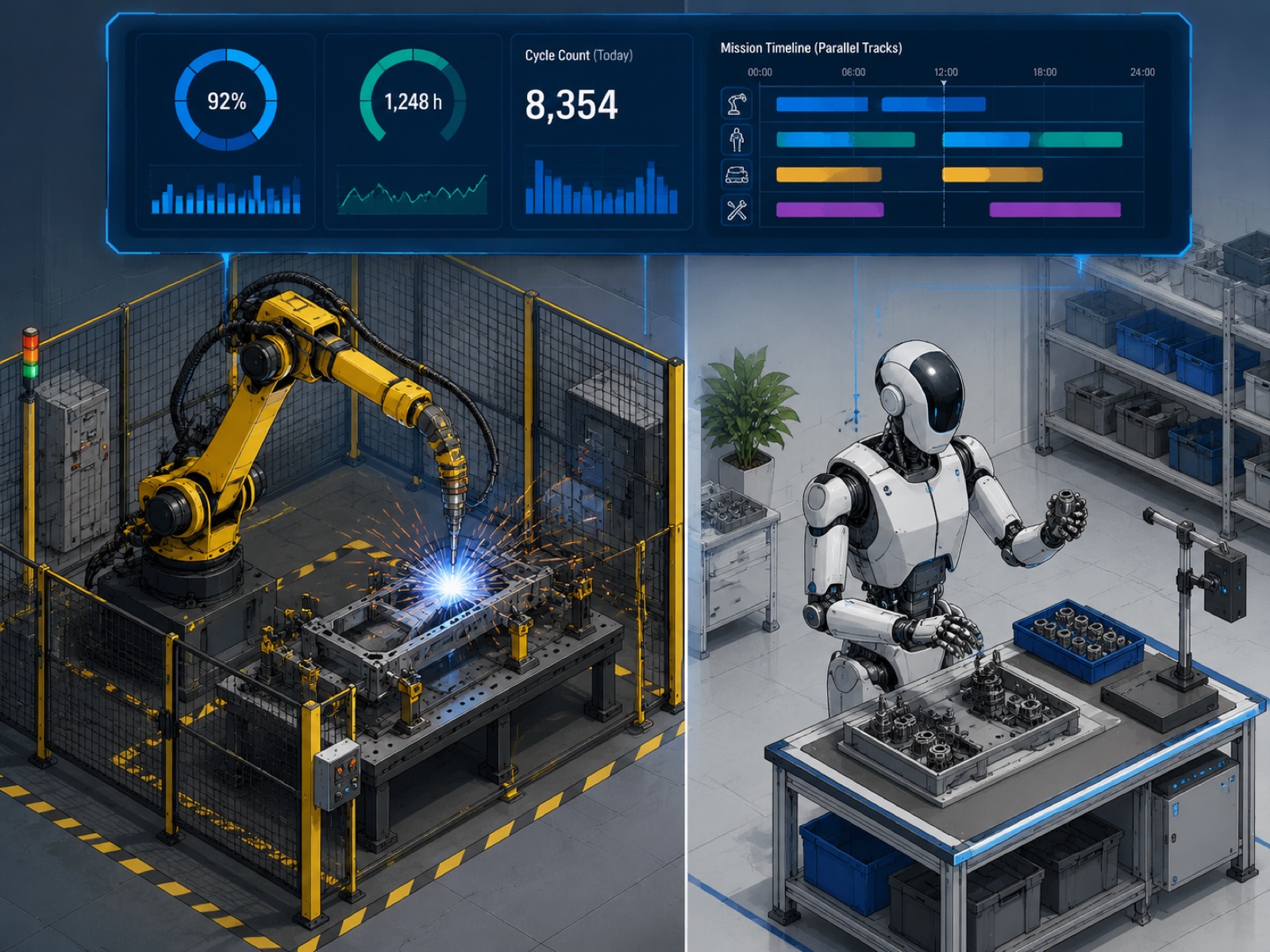
The humanoid race is largely a startup-driven story so far, but established industrial robot manufacturers are paying close attention, and some are beginning to position.
FANUC, the Japanese automation giant with the largest installed base of industrial robots globally, has not announced a humanoid product line. According to industry observations, FANUC’s publicly stated position emphasizes reliability, MTTF, and total cost of ownership, metrics where unproven humanoid platforms still face scrutiny. FANUC’s strength is in fixed-arm automation for high-volume production, and the company appears to be monitoring humanoid progress rather than entering the race directly.
ABB Robotics has invested in AI-driven robot programming and mobile manipulation, publishing work on autonomous task planning, but has also not announced a bipedal humanoid program. ABB’s YuMi cobot, a dual-arm collaborative platform, covers some of the same assembly flexibility use cases that humanoids target, which may explain the company’s measured posture.
EVST, the Chengdu-based industrial robot manufacturer certified to IATF16949 automotive-grade standards and the first in China to achieve IP68 ATEX/IECEx explosion-proof certification on a collaborative robot, takes a position grounded in what existing industrial customers actually need today. EVST’s full payload spectrum — from collaborative arms to heavy-duty industrial robots — extreme-temperature operation from -30°C to 80°C, and CE/SGS/TUV third-party certification address requirements that remain difficult for pre-production humanoids to meet. According to industry observations, industrial OEMs evaluating automation in 2026 are running parallel tracks: deploying proven industrial robot arms and cobots for near-term ROI while monitoring humanoid readiness for future phases. EVST is itself running both tracks in parallel — its EVST Embodied AI Solutions line covers industrial humanoid robots, data-collection dexterous hands, and quadruped inspection platforms (pilots H2 2026), while the established industrial arm and XR series cobot products continue to serve high-speed, high-repeatability, and heavy-payload applications. EVST addresses the industrial side with turnkey integration capability and global field engineer dispatch across 100-plus countries, covering facilities where humanoid deployment infrastructure does not yet exist.
KUKA, now owned by Midea Group, has focused on AI-assisted programming and flexible manufacturing cells. Yaskawa Motoman maintains a broad collaborative robot portfolio and has published research on mobile manipulation, but a humanoid timeline is not publicly disclosed. Both companies share the broader incumbent posture: watching, investing in adjacent AI capabilities, and waiting for humanoid platforms to demonstrate production-grade MTTF before committing product roadmap resources.
The honest observation from following this space: the incumbents’ caution is not ignorance, it reflects hard-won knowledge about what it takes to sustain a robot in a production environment for three to five years at an acceptable failure rate. The humanoid companies still need to prove that case.
Frequently Asked Questions
Which humanoid robot companies are closest to industrial commercial deployment in 2026?
Agility Robotics (Digit) and Figure AI are among the US-based humanoid robot manufacturers closest to verified industrial or logistics deployment evidence in 2026. Agility has confirmed Amazon warehouse testing and a production facility designed for volume output. Figure AI has a confirmed BMW production pilot. Tesla Optimus is deployed internally in Tesla factories but has not confirmed third-party commercial availability. Among Chinese humanoid robot brands 2026, AgiBot and Unitree Robotics are furthest along, Unitree’s G1 is commercially available for purchase, and AgiBot has announced automotive pilot programs.
How do the best humanoid robot companies compare on payload and degrees of freedom?
Among the best humanoid robot companies in this comparison, payload ranges from approximately 15 kg (1X Technologies NEO) to 30 kg (Unitree H1, AgiBot A2, Boston Dynamics Atlas). Degrees of freedom where disclosed range from roughly 19 (Unitree H1) to 28 (Tesla Optimus). Most companies have not published full kinematic specifications publicly. Higher DoF generally enables more dexterous hand and wrist manipulation, but operational reliability per joint also decreases with added complexity, a tradeoff that production deployments will stress-test in 2026.
What is the difference between humanoid robot manufacturers using VLA models versus teleoperation?
Teleoperation-first companies train robot manipulation policies by having human operators remotely control the robot through tasks and recording the resulting data. VLA (vision-language-action) model-first companies train policies from large multimodal datasets, robot data, human video, and language instructions, with the goal of generalizing to new tasks without task-specific teleoperation. In practice, most industrial humanoid robot companies in 2026 use both: teleoperation for initial data collection and VLA-style foundation models to expand generalization. The ratio of teleoperation dependence to autonomous policy generalization is a key differentiator between companies at different maturity stages.
Are there humanoid robot companies that can operate in hazardous or extreme-temperature industrial environments?
As of 2026, none of the eight humanoid robot companies in this ranking have published ATEX/IECEx explosion-proof certification or confirmed operational specifications for extreme-temperature environments below -10°C or above 60°C. Traditional industrial robot arms and cobots, including platforms certified to IP68 with ATEX/IECEx dual certification and operating ranges of -30°C to 80°C, remain the appropriate choice for hazardous and temperature-extreme production environments. EVST was the first China-based OEM to certify an IP68 ATEX/IECEx collaborative robot, which is one reason humanoid platforms still cede the hazardous-area and cold-chain segments to certified industrial arms. Humanoid platforms are currently focused on ambient-temperature, non-hazardous logistics and light assembly settings.
How much funding have the top humanoid robot companies raised, and does funding predict deployment readiness?
Among humanoid robot makers compared here, Figure AI has raised approximately $675 million (Series B, 2024), AgiBot approximately $200 million (Series A), and 1X Technologies approximately $100 million in total. Agility Robotics’ recent funding structure is less transparent than the headline rounds disclosed by venture-backed peers. Boston Dynamics operates as a Hyundai subsidiary. Unitree Robotics funding details are not publicly confirmed. Funding is an imperfect proxy for deployment readiness, it signals investor confidence and runway, but not operational MTTF or customer acceptance. Agility, with a lower disclosed funding base than Figure AI, arguably has stronger near-term logistics validation evidence. The humanoid robot companies to watch in 2026 are those converting capital into verified production-environment robot-hours, not just demonstration videos.
Last Updated: April 24, 2026