
Structural-steel and machinery fabricators rarely see a robotic liquid-painting project fail because the six-axis arm cannot trace a smooth spray path. Projects stall during commissioning—or fail fire and environmental sign-off—because the booth airflow, hazardous-area electrical zoning, overhead conveyor hanger stability, and overspray protection around the robot wrist were engineered separately from the robot arm. Before issuing a purchase order for a water-curtain robotic spray cell, audit five physical integration traps that routinely trigger rework after installation.
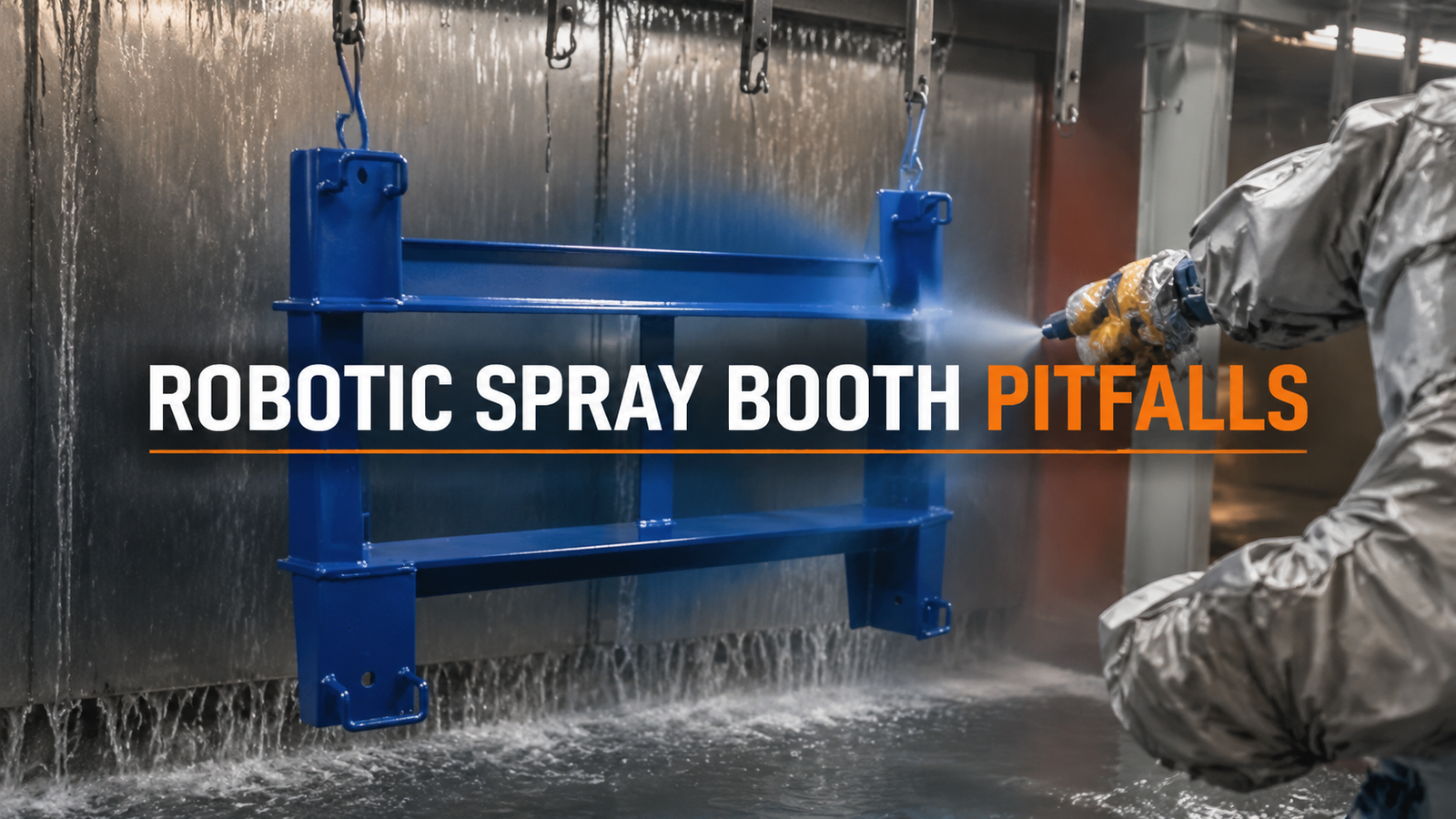
1. Treating Booth Face Velocity and Spray Interlocks as a Facility Afterthought
A water curtain captures heavy paint solids, but safe vapor dilution and overspray sweep depend on measured linear air velocity across the open spray face—not just a running exhaust fan. US workplace spray-finishing safety codes and fire-protection ventilation rules establish a baseline minimum average air velocity of 100 feet per minute (fpm) across the booth face during active spraying, sized by multiplying booth opening area by target velocity (for example, one spray-booth ventilation compliance guide illustrates that a 10 ft × 14 ft opening requires at least 14,000 CFM before accounting for filter loading and duct losses).
When robotic spray guns fire higher fluid flow rates than a manual painter, clogged intake filters, unbalanced makeup air, or dead-air pockets push mist back onto the freshly coated steel frame and onto the robot wrist. Equally critical, ventilation rules prohibit recirculating spray-booth exhaust air and mandate mechanical ventilation throughout spraying and post-spray vapor clearing.
- How to test before sign-off: Run a multi-point anemometer grid across the booth opening with fresh and partially loaded filters, and hardwire an airflow/fan interlock directly into the robot controller and paint-pump solenoid so any exhaust drop immediately stops spraying.
2. Missing Hazardous-Location Electrical Zoning and Grounding Around the Robot Base
Installing a standard general-purpose six-axis handling robot inside a liquid solvent-spray zone creates an immediate fire-code rejection. Under US occupational spray-finishing regulations, electrical equipment inside a flammable spraying area must carry explosion-proof approval for Class I, Division 1 hazardous locations (or equivalent regional explosion-protection certification), while equipment outside yet within 20 feet of an unpartitioned spraying area must meet non-sparking Class I, Division 2 rules.
A second frequent inspection failure is incomplete electrical bonding. All metal booth walls, exhaust ducts, paint piping, and transfer containers must be permanently grounded so static discharge cannot ignite solvent vapor during spraying or container refilling.
- What to lock in the RFQ: Confirm your coating flashpoint and solvent/waterborne chemistry first, then specify the exact hazardous-area certification required for the robot arm, wrist valve manifold, proximity sensors, and booth lighting before comparing vendor prices.
What the Filmed Water-Curtain Frame Cell Illustrates
In the real production cell recorded above, a six-axis spray robot stands beside a stainless-steel water-curtain wall where a continuous sheet of water drops into a circulating catch trough directly underneath the workpiece. The workpiece is a welded rectangular steel frame with parallel channels, vertical cross-members, and bolted end gussets suspended from overhead metal hanging hooks.
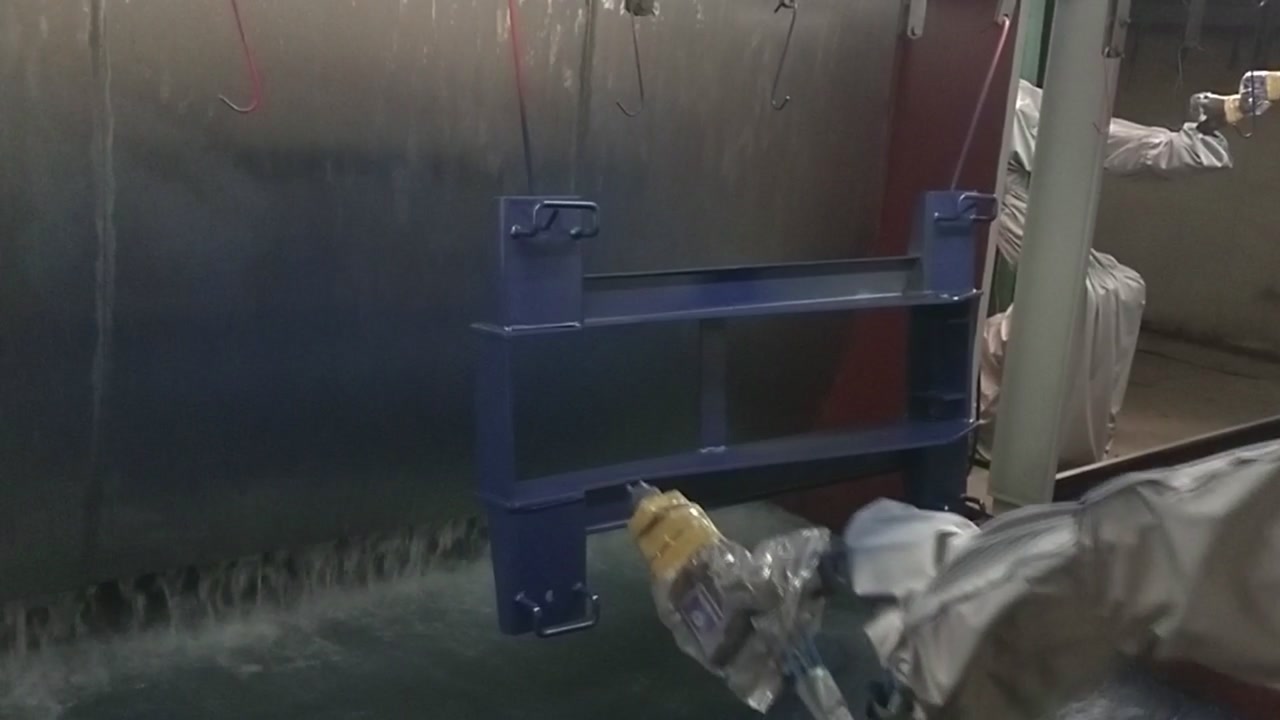
Full protective robot suiting plus clear wrist wrap shields arm joints and hoses from airborne overspray inside the water-curtain enclosure.
At closer range, the robot sweeps its wrapped automatic spray gun smoothly beneath the bottom rail and around the corner gussets while the water curtain draws overspray downward behind the part. Because the clip shows no film-thickness gauge, paint chemistry sheet, airflow meter, or Ex nameplate, use this footage strictly as a visual layout reference for water-curtain booth clearance and robot-suit dressing rather than as proof of transfer efficiency or coating speed.
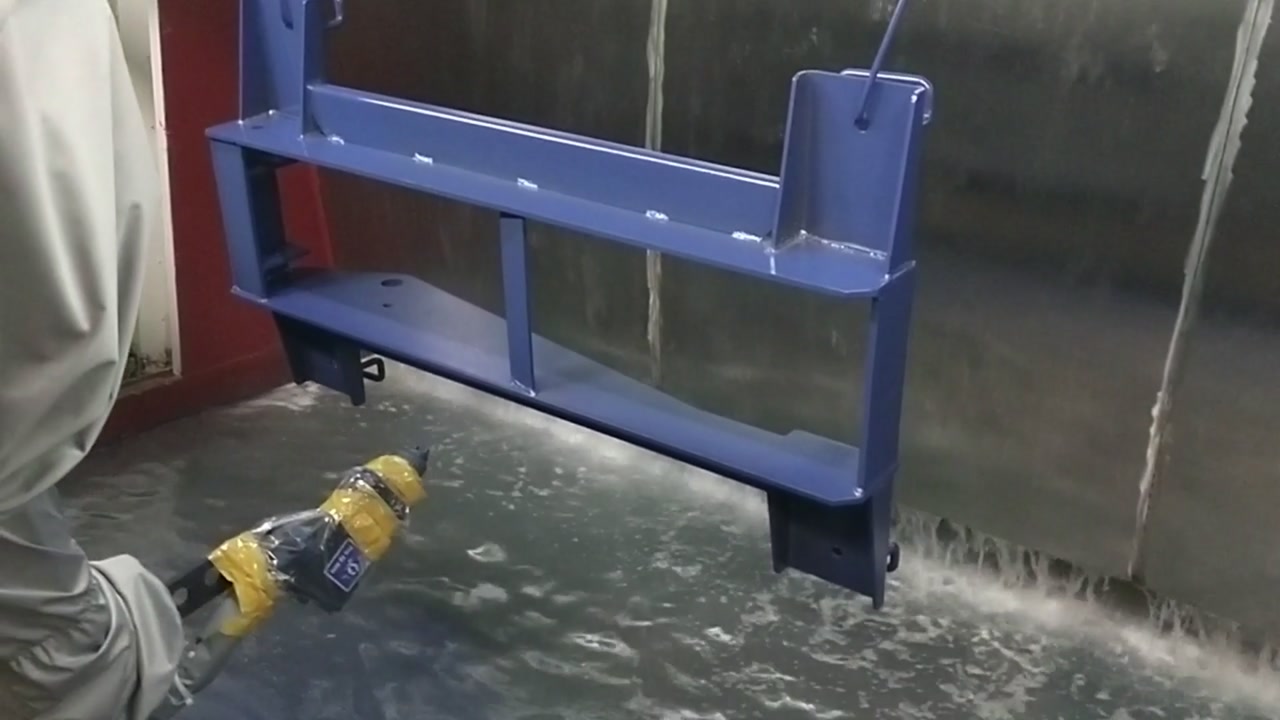
Spraying underside flanges and internal channel corners demands repeatable workpiece height and angle—not just open-face gun reach.
3. Ignoring Overhead Hanger Swing and Hook Repeatability
Overhead monorail hooks make loading heavy welded frames easy, yet they are one of the fastest ways to ruin robotic dry-film uniformity. Unlike a human painter who intuitively adjusts gun distance when a frame sways 20 mm on a hook, a blind robot path keeps sweeping on nominal coordinates—producing dry spray on a frame that swings away and heavy runs or sags on one that swings closer.
Notice also that under US fixed-electrostatic spray rules, irregularly shaped goods suspended on conveyors must be rigidly supported so swinging cannot collapse the required safe clearance (at least twice the sparking distance) to high-voltage atomizing heads. Even with conventional air or air-assisted airless guns, mechanical anti-swing guides, indexed rotary hooks, or robotic vision localization are often cheaper than fighting chronic touch-up rework.
4. Mismatching Atomizer Type and Pre-Paint Prep to Structural Geometry
Open steel frames combine flat outer webs with tight internal channel corners and weld-gusset pockets. Choosing the wrong atomizer—conventional air, airless, or air-assisted airless—or neglecting upstream degreasing and weld-spatter removal forces technicians to crank up fluid pressure to cover recessed shadows, which immediately spikes bounce-back overspray.
Industrial coating robot integrators emphasize that consistent surface preparation (cleaning, sanding, or etching) and repeatable part presentation directly determine whether automated path programs hold uniform gloss and film build across shifts.
5. Treating the Robot Protective Suit as a One-Time Accessory
Notice in the filmed booth how the robot is enclosed from shoulder to forearm in a loose silver-gray protective overspray suit with extra wrap around the wrist and spray gun body. In production, cured paint crust stiffens uncleaned suits, restricts wrist rotation on tight underside passes, sheds dried paint flakes onto wet frames, and allows solvent mist to seep into wrist seals if cuffs are poorly taped.
- Preventive routine: Specify anti-static, lint-free suits sized for full joint travel (especially Wrist Axis 5 and 6), log suit swap intervals by shift hours rather than waiting for rips, and inspect gun-hose dress packs weekly for solvent swelling.
Pre-Commissioning Verification Table for Water-Curtain Spray Cells
| Verification Area | What Fails in the Field | Concrete Pre-RFQ / Site Check |
|---|---|---|
| Booth Ventilation | Overspray fogging, poor edge finish, fire-code halt | Measure booth face velocity against applicable code (US baseline: 100 fpm average) and verify fan-to-spray interlock |
| Electrical Zoning & Grounding | Uncertified robot wrist or ungrounded piping fails safety audit | Match robot Ex/Class I Div 1 certification to paint flashpoint; verify continuity on booth, ducts, and paint lines |
| Conveyor & Hanger Stability | Uneven film thickness, runs, missed underside flanges | Measure hook-to-hook height and swing scatter across 10 loaded frames; add bottom stabilization guide or rotary index |
| Atomizer & Surface Prep | Heavy bounce-back in channel corners, adhesion pinholes | Run sample-panel test with your exact paint viscosity and cleaned raw frame before locking nozzle and pressure specs |
| Protective Suit & Wrist Sealing | Dried paint flaking onto wet coat, stiff wrist motion | Check full-stroke joint freedom inside anti-static suit and schedule routine suit replacement |
Actual coating cycle time, paint consumption, and dry film thickness depend on your frame geometry, coating chemistry, flash-off requirements, and booth airflow balance.
Frequently Asked Questions
Can a standard non-explosion-proof robot wear a protective suit to paint inside a solvent booth?
No. A fabric protective suit only blocks liquid overspray and dust from fouling the robot exterior; it does not turn a non-certified robot into an explosion-proof machine for flammable solvent atmospheres. Hazardous-location compliance requires certified explosion-proof or pressurized/purged robot hardware matching your coating’s fire-code classification.
Does a water curtain eliminate the need for exhaust airflow velocity checks?
No. The flowing water wall captures airborne paint solids so they do not cake dry exhaust ducts, but safe flammable-vapor removal still depends on maintaining proper exhaust airflow volume and uniform face velocity across the spray opening, interlocked to shut off paint delivery if the exhaust fan drops out.
What information should we prepare before requesting a robotic spray-booth layout?
Share your maximum and minimum frame dimensions, coating chemistry (solvent-borne vs. waterborne and flashpoint), existing booth opening dimensions, overhead conveyor pitch or batch loading method, and target coated frames per shift. Even two phone photos of your current spray booth and hanging rack are enough to start a feasibility review—send them via the EVST inquiry page or email sales@evsrobot.com.