
A tightening tool can reach its torque target while the assembly process still has an unresolved problem. A screw may encounter resistance before the joint seats, a required position may be missed, or a successful retry may hide an earlier failure. These are different problems. Recognising which ones matter to your joint helps specify the tool, sequence and result handling without buying an unexplained list of “smart” functions.
Start with the tool contact, then ask what it proves
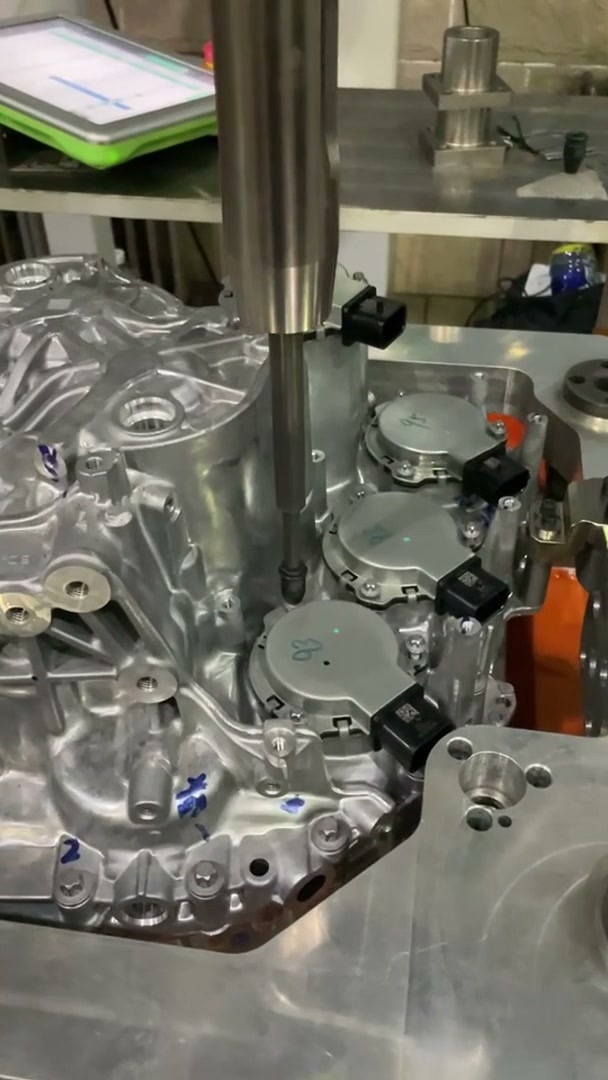
The accompanying footage follows a vertical screwdriving tool over several positions on a cast housing. The close view shows approach, contact, lifting and relocation. It makes the sequence easy to follow, but does not display tightening values or the controller’s acceptance logic.
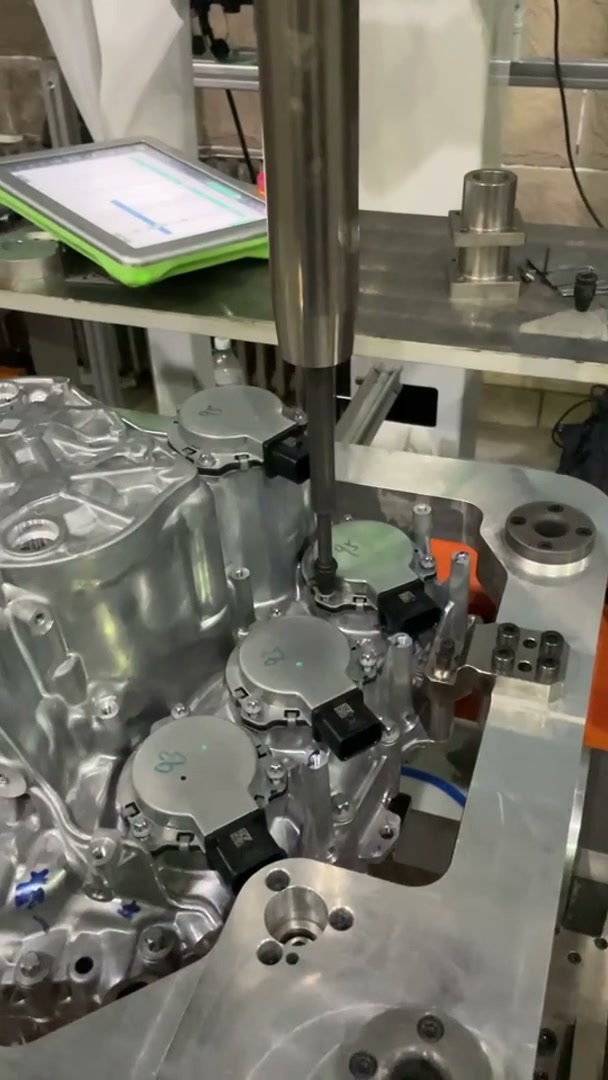
For a similar application, a smooth demonstration answers whether the tool can approach the positions. The purchase also needs to address how the process decides that each required fastening is acceptable.
1. The target was reached, but resistance came too early
Consider a trial in which one fastener reaches the torque target unusually soon. Repeating that target does not explain whether the joint seated normally or the screw encountered abnormal resistance. Friction affects the relationship between applied torque and clamp load; damaged threads can also change how resistance develops. A torque result is not a direct measurement of clamp force.
This is where a second process measurement can help. Angle monitoring can compare rotation, measured from a defined starting condition, with a window established for the actual joint. An angle outside the window calls for the defined response; it is not a universal diagnosis of one particular defect.
Be precise when a proposal says “torque and angle.” Monitoring angle while shutting off at a torque target differs from deliberately tightening through an additional angle after a preliminary condition. Both require settings appropriate to the actual joint; neither supplies a universal setting for unrelated assemblies.
The buying decision is to specify a validated tightening strategy, not to assume more displayed numbers mean better assembly. If abnormal resistance is the concern, demonstrate the proposed response on representative joint conditions and confirm what a failed result stops or flags. The limits belong to that joint and its acceptance requirements.
2. There are enough green results, but one hole was missed
Imagine a component with four required fastening positions. A system records four acceptable tool results, but one position was processed twice and another was skipped. The count is correct; the completed assembly is not. This is a simplified hypothetical example, not a fault observed in the video.
A better torque sensor alone would not solve it. The cell needs a way to associate results with required operations and decide when the component is complete. Depending on the arrangement, that can involve a programmed position sequence, position confirmation and a new-part reset that does not carry the previous component’s status forward.
Turn the concern into a demonstration: omit one required operation in a controlled acceptance test and show that the component cannot receive an ordinary complete status. Then show how the missing operation is identified and resolved. This tests the sequence requirement more directly than asking whether the controller can “save data.”
A controller may offer result, trace, identifier and batch views, but the availability of a screen does not establish that its data correspond to every required operation. Demonstrate that relationship through the proposed cell sequence.
3. The second attempt passed, so the first disappeared
Suppose an attempt stops abnormally and a later attempt is accepted. If only the last status is retained, someone reviewing the component cannot tell that it needed intervention. That record also cannot explain whether the same fastener was retried, replaced or inspected.
The answer is not to forbid every retry. Decide which conditions permit another attempt and which require inspection, replacement or another disposition under the plant’s joint-quality procedure. For operations requiring this history, retain the attempts and eventual disposition against the same component and fastening position.
Ask for a controlled demonstration of an abnormal result followed by its permitted recovery. Review the record as well as the final green status. If needed history disappears, the quotation must address result storage or integration. Changing the robot’s motion accuracy would not fix that gap.
Specify the error you need to prevent
These examples point to different purchases: joint-behaviour measurement for abnormal tightening, operation control for a missed position, and history handling for rework. They need not all become elaborate systems on every cell. Scope should follow the actual fastening requirement and the consequences of an undetected error.
When discussing a screwdriving project with EVST, start with the joint and fastener, the positions to be completed, and the assembly errors you need the process to prevent or record. These give us a basis to discuss tool, robot and workstation options with a meaningful acceptance sequence. Discuss multi-position screwdriving with EVST.
Method: Application-footage review, manufacturer documentation and hypothetical acceptance-test scenarios. Editorial policy · Corrections policy · Terms of use