
A second robot is worth considering when preparing and moving trays regularly interrupts the robot handling the parts, or when the two jobs need substantially different tooling. It is a weaker investment when the real delay is a conveyor, an occupied transfer position, or a downstream machine that both robots must wait for. Before comparing robot prices, separate part handling, tray preparation, and tray exchange on the production timeline.
The extra job behind every tray
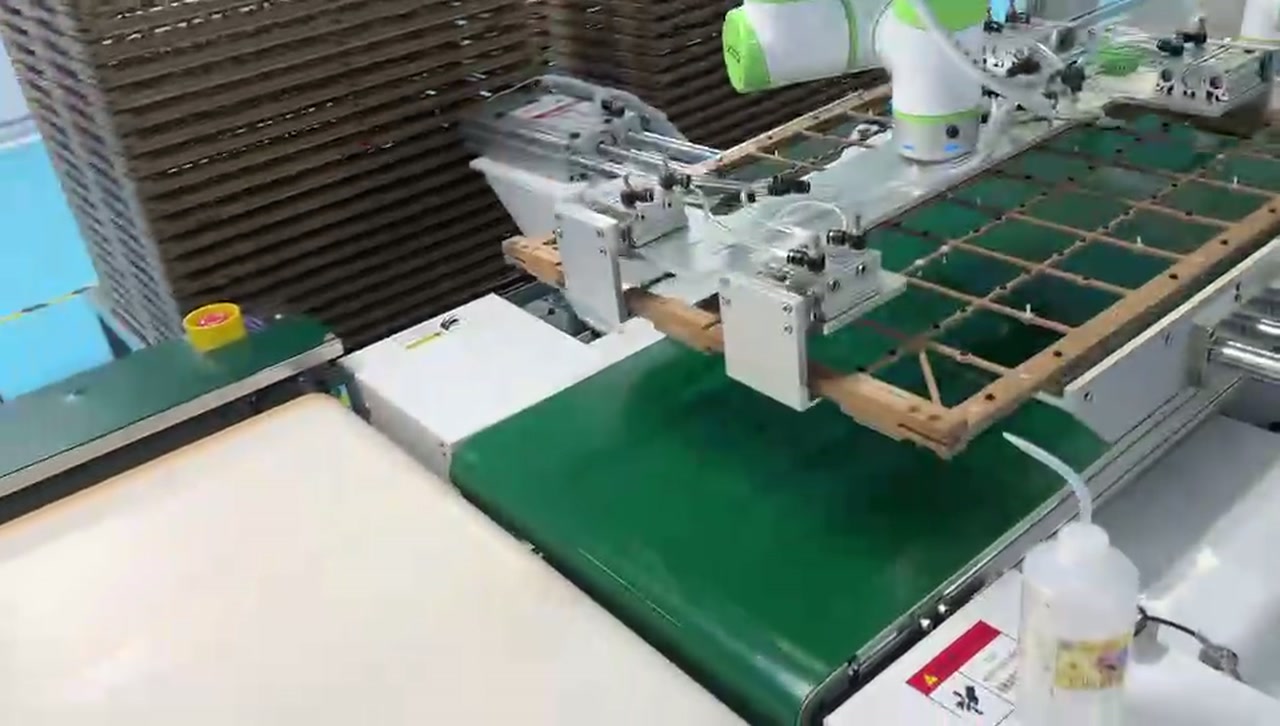
In the accompanying cell footage, one arm works between a rear belt surface and a grid carrier frame. Another arm holds and places a complete frame. A frame travels away on the green conveyor before the next one is supplied. This makes the division of work easy to see: moving the pieces and supplying their carrier are different handling tasks.
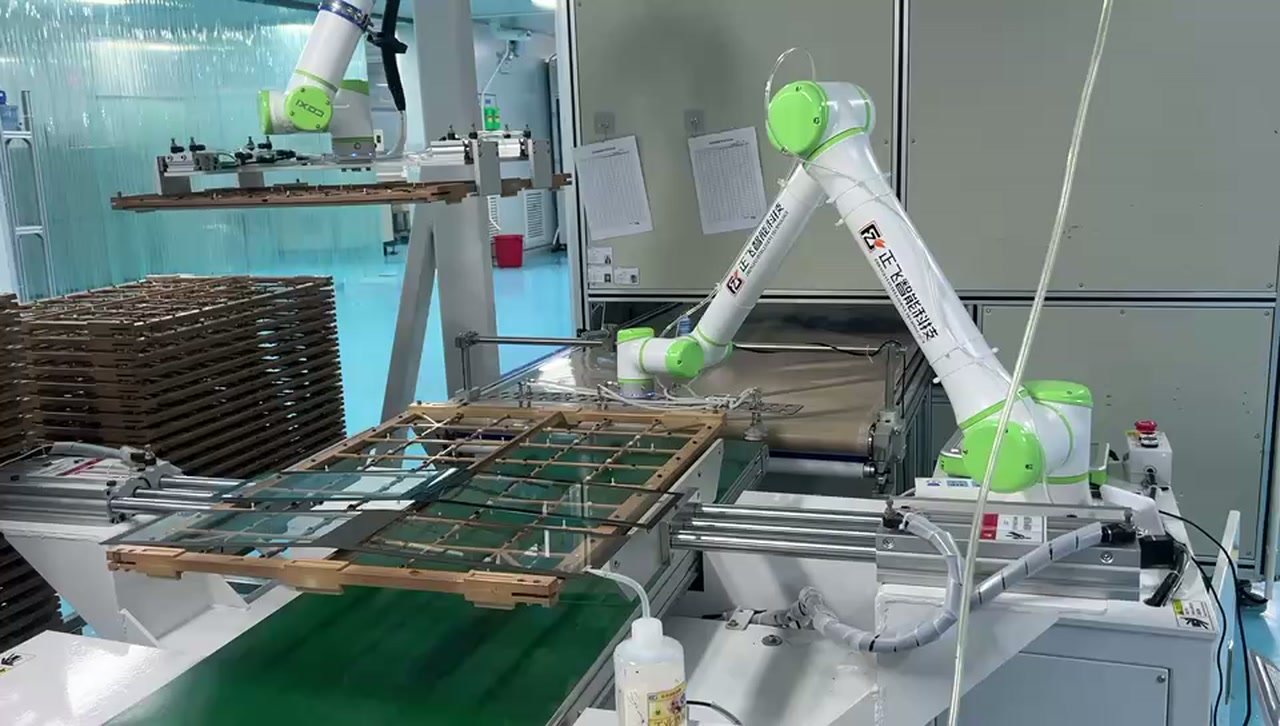
For a factory or integrator planning a similar cell, the useful question is how those tasks fit together. A robot can finish its last part transfer and still have work left: fetch the next tray, change its grip, clear the outgoing tray, and establish the next working position. Those actions belong in the cycle estimate even if the sales demonstration focuses on picking a single part.
Compare the handling arrangement before the robot count
| Arrangement | When it deserves a closer look | What can make it unattractive |
|---|---|---|
| One robot handles parts and trays | Tray changes are infrequent; the arm can reach both jobs; one tool or a practical tool-change sequence handles both | Each change interrupts part handling; a bulky tray tool may restrict access to small pieces |
| One part-handling robot plus a tray magazine, lift or conveyor mechanism | Tray geometry and presentation stay consistent, and the transfer is a repeatable mechanical movement | Variations in tray size, stacking or destination can require mechanical changes |
| Separate robots for parts and trays | Tray preparation can happen while parts are being handled; different tools or destinations justify separate motion | More equipment, floor space and coordination; the shared exchange position can still force waiting |
The middle option matters. A second six-axis arm should compete with a suitable tray-feeding mechanism, as well as with a single-robot layout. For a stable tray family and a fixed transfer path, compare whether a dedicated mechanism can do the job more simply. For changing tray formats or several pickup and delivery positions, an independently programmed arm may offer useful flexibility.
That comparison changes if the “small” tray job needs a large tool. Robot payload includes the tool and carried load. A wide frame tool also changes the load’s centre of gravity and inertia, so a kilogram rating alone does not establish that the arm can follow the required motion. Evaluate the combined tool-and-load configuration against the selected robot’s load limits and motion requirements. Separating the jobs may allow the part-handling tool to remain compact; it also means buying and integrating another handling device.
A second arm can prepare the next tray; it cannot remove every pause
Consider an illustrative timing exercise, using assumed values rather than measurements from this cell. One tray requires 24 part transfers at 3 seconds each. After the last transfer, preparing the next tray takes 12 seconds and the physical exchange takes another 6 seconds. The preparation and exchange times include their respective return and positioning movements.
| Assumed sequence | Time per tray |
|---|---|
| All three tasks occur sequentially | 72 + 12 + 6 = 90 seconds |
| The full 12-second preparation fits inside part handling; the 6-second exchange still stops it | 72 + 6 = 78 seconds |
Under those assumptions, the ideal rate rises from 40 to about 46 trays per hour—not twice the output. These figures exclude interruptions, rejects and other production losses. Their purpose is to identify which time a proposed second device actually removes from the critical sequence.
The overlap is only available if the next tray can be prepared elsewhere while the current tray is in use. If both arms need the same physical position, or the conveyor cannot accept the outgoing tray, the second arm may simply wait. Mark those shared positions on the proposed layout before accepting a faster cycle estimate.
Ask for a tray-to-tray trial
A useful demonstration runs from the first part on one tray to the first part on the next. Include the outgoing carrier, the incoming carrier and the time needed to resume part handling. Watch whether the feeder has prepared the next tray before it is needed, and whether the outgoing tray has somewhere to go.
Repeat this with the tray conditions that production will actually present: the tallest and shortest stack, different approved tray formats, and the normal variation in flatness and position. Grid coordinates can define where parts belong, but a shifted tray changes those locations relative to the robot. Establish the tray’s reference position with suitable locating or sensing, rather than expecting a taught pattern to correct an unmeasured shift.
For the integrator, include the exchange signals in the same trial. The incoming tray should not move into an occupied position just because a preset time has elapsed. Demonstrate how the equipment confirms that the position is clear and the new tray is ready. This tests the part of the system that a smooth, isolated pickup cannot reveal.
The decision then becomes specific: does the added device remove an observed interruption, simplify incompatible tooling, or accommodate a tray family that a fixed mechanism cannot handle economically? If none of those applies, a simpler arrangement deserves the first quotation.
Discuss the tray and the part together
For an EVST handling-automation enquiry, start with a photo showing the part in its tray and a short video covering a complete tray change. Add the tray dimensions, loaded weight and required output if available. These show whether the challenge is picking the parts, supplying the carrier, or fitting both jobs around the existing line—and give us a useful basis for discussing robot, tooling and workstation options. Contact EVST about your handling application.
Method: Application-footage review, manufacturer documentation and an explicitly assumed timing example. Editorial policy · Corrections policy · Terms of use