
Most first-draft robotic welding payback spreadsheets get rejected by finance for the exact same reason: they divide only the bare robot quote by one welder’s salary. To estimate a defensible payback period for a compact bracket-welding cell, start from two shop-floor realities—your real ratio of arc time to manual fixture-loading time, and your full six-bucket installed cost—then test whether a single stationary jig keeps the robot busy enough or whether a 180-degree dual-station turntable is required to stop robot starvation.
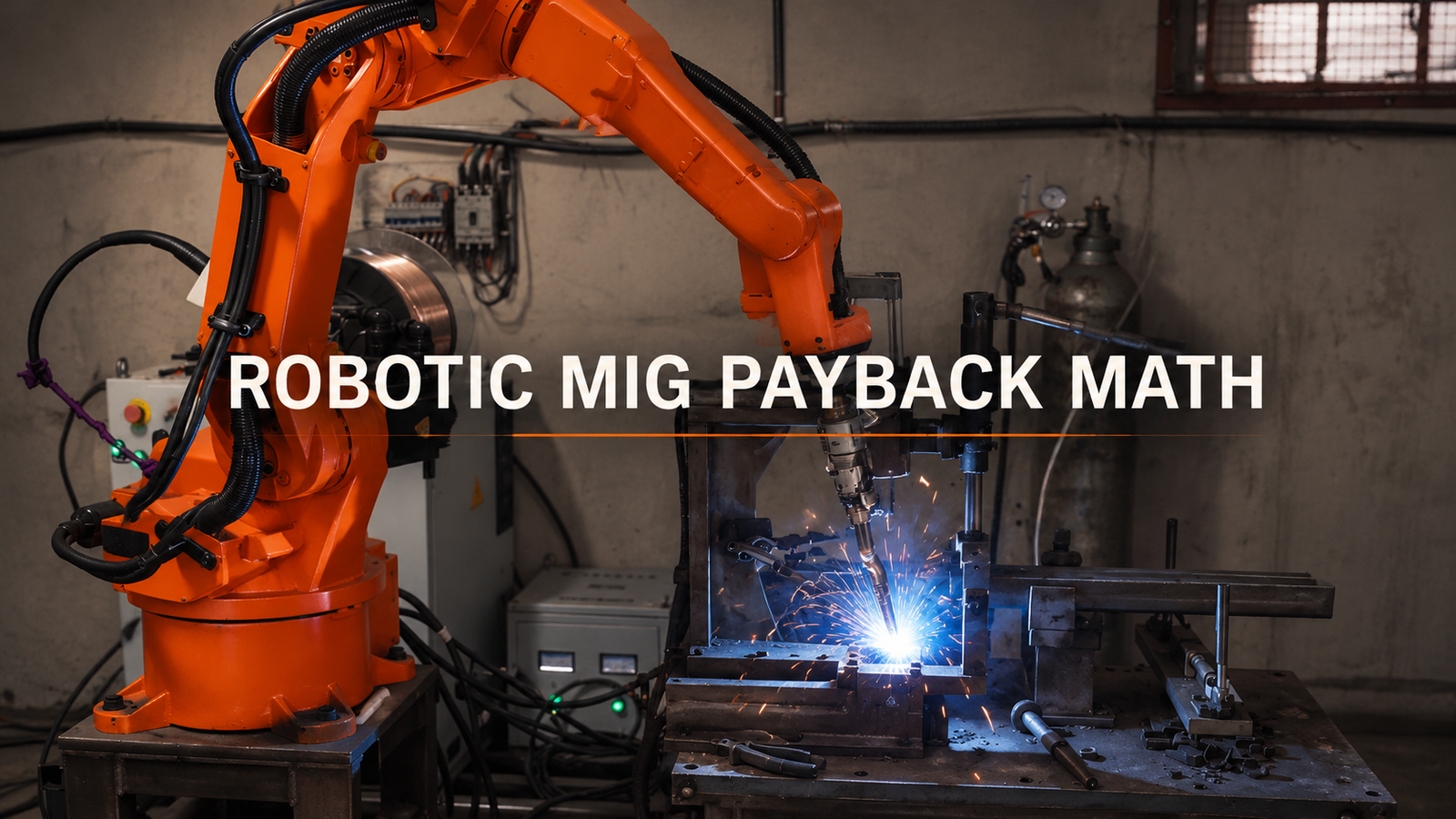
What the Filmed Single-Station Bracket Cell Shows
The production clip above shows a compact, single-station arc-welding layout typical of small-to-medium metal-fabrication plants. An orange six-axis welding robot stands on a welded steel floor pedestal beside one stationary upright clamping jig holding a dark steel motorcycle bracket assembly, with the wire-feeder spool mounted on the rear upper arm and the power cabinet and shielding-gas cylinder positioned behind the table.
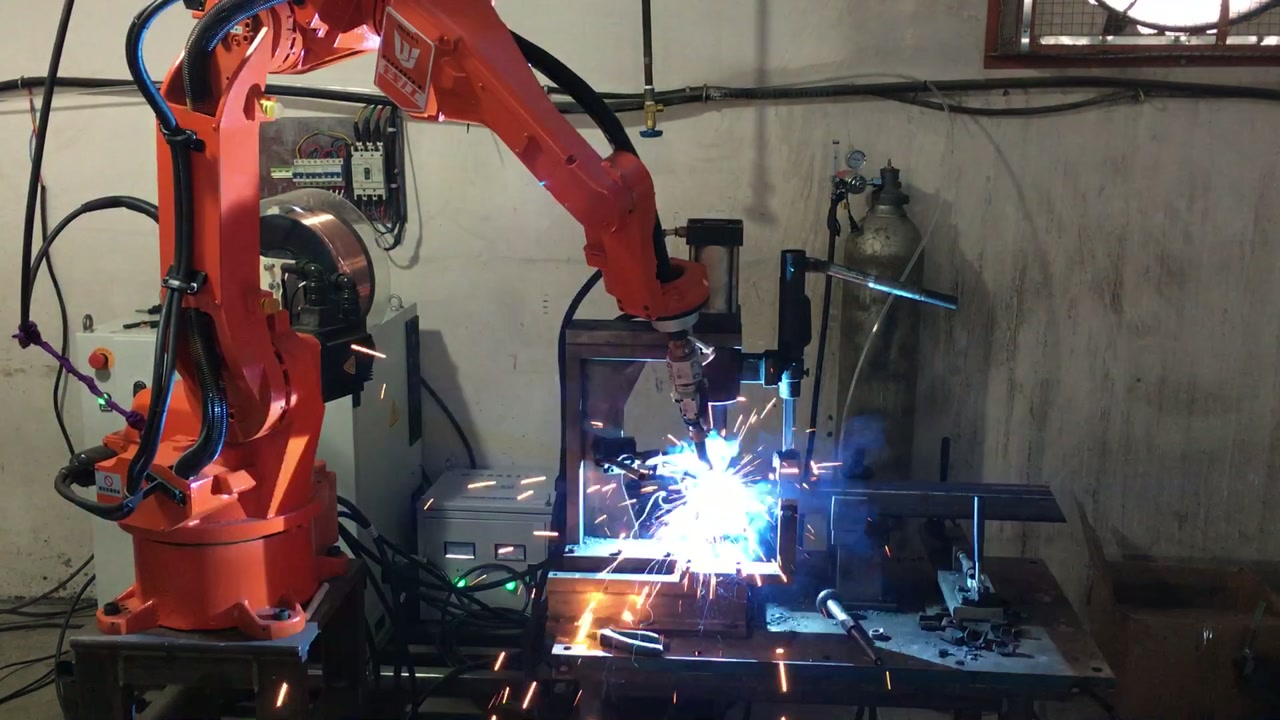
A single fixed fixture minimizes upfront floor space and tooling cost—making load-to-weld ratio the decisive utilization gate.
A closer frame between arcs highlights the hardware details that govern seam access and uptime: a curved swan-neck robotic MIG welding torch with a straight cylindrical gas nozzle and corrugated cable pack moves rapidly across short, multi-angle joints inside the vertical clamp structure. Because no live current readout, travel speed, load/unload stopwatch, or shift part count appears on screen, treat the cell strictly as a physical reference for single-station fixture architecture rather than as a measured throughput claim.
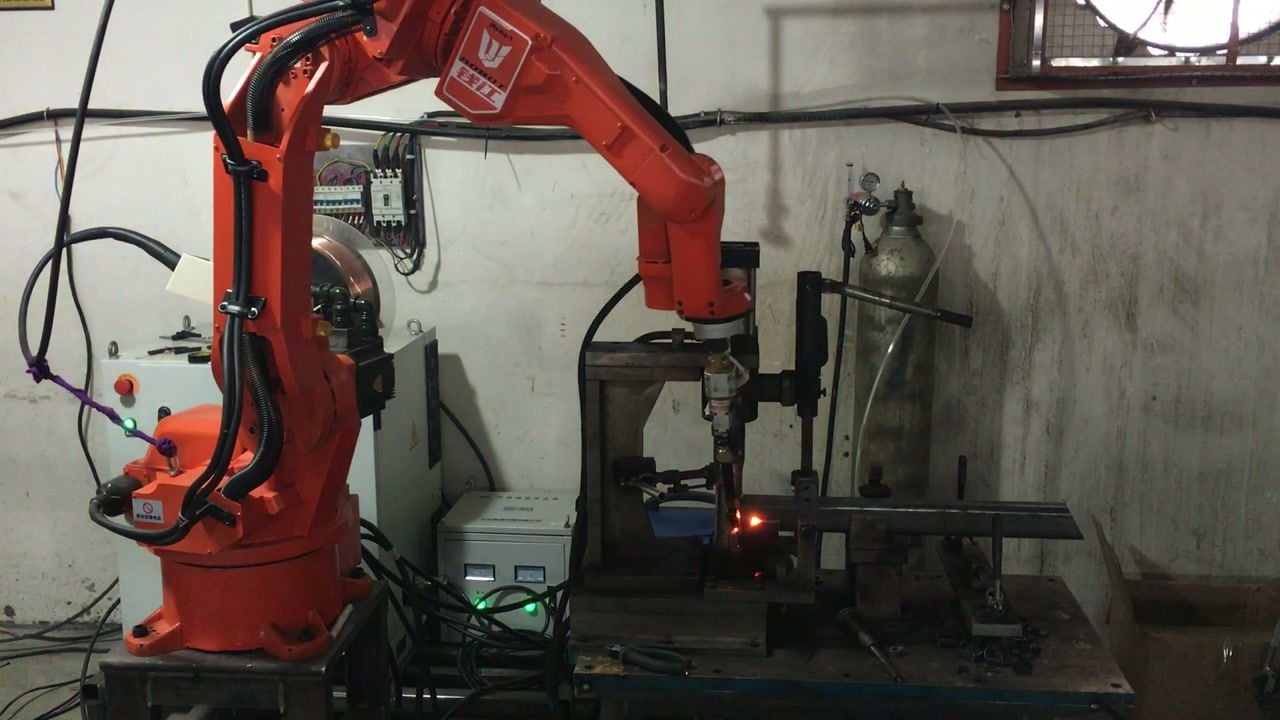
Short multi-joint bracket welds interleave active arc seconds with fast air-cut repositioning—and pause completely whenever the operator opens the cell to reload.
Step 1: Measure Manual Arc-On Time Before Pricing Hardware
Before modeling any robotic cell, measure how many minutes per shift your manual MIG stations actually burn wire. One major welding-equipment manufacturer reports that semi-automatic manual welding operations average only 10–12% arc-on time once fit-up, clamping, repositioning, wire changes, and post-weld spatter grinding are counted. That same productivity guide notes that cutting out and re-welding a single defective seam can triple total time spent—or worse—while switching from straight GMAW to a pulsed GMAW waveform can deliver roughly 10% faster travel speeds at equal heat input with less spatter cleanup (and switching from 100% CO2 to a mixed gas such as 90% argon / 10% CO2 further reduces post-weld grinding).
Step 2: Compare Single-Station vs. Dual-Station Cycle Utilization
Write your bracket’s real cycle components in seconds per assembly:
- T_arc: Total active weld-arc time across all seams on the bracket.
- T_air: Robot dry air-cut repositioning time between seams plus approach/retract.
- T_load: Operator time to open guarding, unclamp the finished bracket, brush/inspect locating pins, load raw sub-parts, clamp, and restart the cycle.
- T_index: Turntable 180-degree rotation time on a two-station cell (zero on a single-station cell).
Na single stationary fixture (like the filmed cell), the robot waits during every second of operator handling:
- Single-station cycle time:
T_cycle_single = T_arc + T_air + T_load - Single-station arc-on share:
U_single = T_arc / (T_arc + T_air + T_load)
Na two-station indexing turntable, the operator reloads Station B while the robot welds Station A:
- Dual-station cycle time:
T_cycle_dual = max(T_arc + T_air, T_load) + T_index - Dual-station arc-on share:
U_dual = T_arc / (max(T_arc + T_air, T_load) + T_index)
Illustrative arithmetic example (hypothetical shop inputs, not filmed measurements): Suppose a steel bracket needs T_arc = 50 s, T_air = 10 sa T_load = 45 sS T_index = 4 s on a turntable.
- Single station:
T_cycle_single = 50 + 10 + 45 = 105 s→34.3 parts/hrtheoretical (U_single = 47.6%). - Dual-station turntable:
T_cycle_dual = max(60, 45) + 4 = 64 s→56.3 parts/hrtheoretical (U_dual = 78.1%sa 64% output lift).
Now reverse the ratio: if a heavier weldment has T_arc = 220 s, T_air = 20 sa T_load = 35 s, single-station U_single = 220 / 275 = 80.0% versus dual-station U_dual = 220 / 244 = 90.2%. In that long-weld case, buying a second mirror-image fixture and heavy servo turntable adds modest utilization gain—which is why single-station cells stay smart when T_load is small compared to T_arc.
Step 3: Build a Six-Bucket Payback Worksheet
Following one robotic welding-cell integrator’s published ROI framework, evaluate payback in months:
Payback (months) = Total Deployed Investment ÷ Net Monthly Saving
Spočítať all six investment buckets up front so invoices in Month 4 do not wreck your forecast:
- Cell equipment: Robot, power source, torch (standard robotic necks include 22, 45, and 180 degrees; verify duty cycle—higher-amperage water-cooled guns typically serve 400 A a vyššie up to 100% duty cycle per published welding-gun configuration guidance), torch cleaner, fencing, and optional turntable.
- Integration and engineering: Layout, safety wiring, PLC handshake, and initial seam programming.
- Freight, rigging, and foundation: Local installation labor and floor anchoring.
- Fixtures and tooling: Váhy s čiastočná odroda, not robot size; a dual-station turntable doubles fixture tooling cost per part family.
- Operator training and ramp-up curve: First-month learning dip.
- Monthly running costs (deducted from savings): Consumables, wire, shielding gas, power, spares, and periodic calibration.
On the return side, include direct loaded labor (including overtime or unfilled welder seats), throughput capacity gain from higher arc-on utilization, and rework/scrap reduction. To show sensitivity without inventing local wages, that same integrator publishes a normalized 100-unit investment worked model:
| Scenario (Normalized 100-Unit Installed Cost) | Net Monthly Saving (Units) | Modeled Payback (Months) | What Drove the Shift |
|---|---|---|---|
| Baseline two-shift shop (1 station replaced/shift, ~50% output lift, rework cut ~5% → ~1%) | ~4 units / month | 25 mesiacov (100 ÷ 4) |
Balanced shifts + measured rework savings |
| Trojzmenná prevádzka (same hardware, higher weekly arc hours) | ~6 units / month | 17 mesiacov (100 ÷ 6) |
Fixed capital amortized over 50% more shift hours |
| Two shifts, rework savings excluded (conservative floor check) | ~3 units / month | 33 mesiacov (100 ÷ 3) |
Shows how omitting real rework understates return |
| Typical steady two-shift fabrication range (integrator benchmark) | ~3.3–5.6 units / month | 18-30 mesiacov | Single-shift high-mix shops run longer; >48 months signals undersized volume or oversized cell |
Actual cell payback, arc-on percentage, and consumable cost depend on your local fully loaded welder wages, shift hours, part mix, and upstream fit-up tolerances.
Často kladené otázky
When is a single-station robotic welding cell better than a dual-station turntable?
A single fixed fixture usually wins when active weld time per part is several times longer than operator load/unload time, when floor space is tight, or when high part variety makes duplicating expensive pneumatic clamping fixtures uneconomical. When load time equals or exceeds half of weld time on steady batches, a two-station turntable typically pays back faster despite higher upfront cost.
Why do part fit-up gaps break robotic welding ROI?
Consistent fit-up is the foundation of robotic arc-on time. Uneven gaps force slower travel speeds, increase spatter grinding, or require seam-finding sensors and rework—erasing the throughput multiplier that justified the cell.
How can we check single-station vs. dual-station math on our own brackets?
Send a drawing or two photos of your bracket assembly, estimated total weld seam length, current manual clamping time in seconds, and shifts per day via the EVST quote page alebo e-mail sales@evsrobot.com. EVST engineers can review torch reach, fixture complexity, and whether a fixed jig or 180-degree turntable fits your payback target.