
Does a takeout robot make an injection molding machine wait? Only the part of the robot sequence that holds the mold open or prevents the next machine action belongs in that answer. Motion toward a receiving table may occur outside the mold and may overlap later machine work. A buyer should measure those boundaries on the actual press and mold before accepting either a faster-cycle promise or the assumption that every robot movement adds to cycle time.
The case footage shows a blue robot moving between an injection machine opening and a nearby blue platform, with its end tool descending near each area. The small parts and mold signals cannot be read clearly enough to time or verify each takeout, so the useful observation is the handoff geometry.
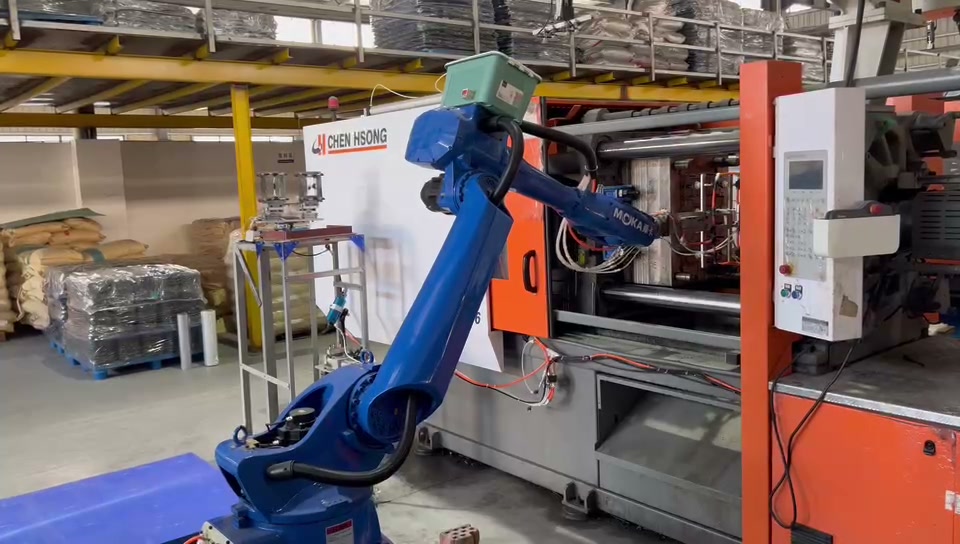
The machine opening and nearby platform show the two areas a proposed transfer path must connect.
Draw the cycle boundary at the mold, not the robot base
A takeout concept needs a safe point for the robot to enter, establish a hold on the part and leave the mold area. The machine cannot close until the required clearance and permission conditions are satisfied. This interval is the first place to check whether automation makes the press wait. Movement and release at an external table are separate. If they can occur while the next molding phase proceeds, adding the entire transfer time to the press cycle would double-count work that runs in parallel.
Removal-time guidance from equipment manufacturers treats mold-open occupancy and machine-to-robot signals as a specific part of the total molding cycle. The exact signal sequence and timing depend on the press, mold, robot and interface. A useful local measurement records the point at which the mold is open for takeout, when the robot has cleared the mold and when the machine is allowed to close. Repeat the measurement over stable cycles of the same mold, then compare it with the present method. This isolates machine waiting from robot motion elsewhere in the cell.
Changeovers can matter more than the best steady cycle
In a proposed cell, the receiving area is more than a place to drop a part. Its position, the intended part orientation and any downstream handling affect how the robot can leave the machine area and prepare for the next action. With another mold, the part may need a different contact point or exit direction. If the mold and downstream equipment cannot return to their expected positions after changeover, the cell may spend more time being retaught or adjusted than the steady-cycle demonstration suggests.
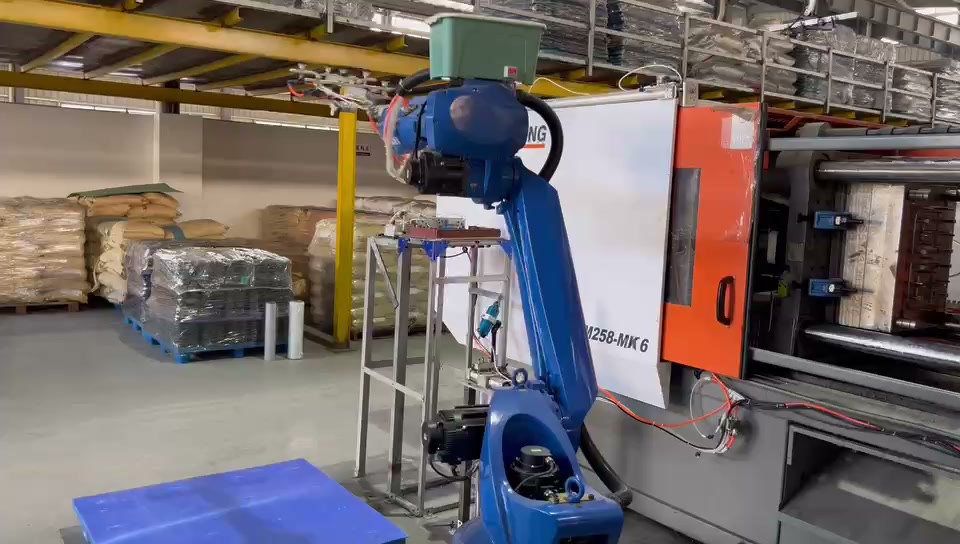
The platform area sits beside the machine; its position influences how a proposed robot path would leave the machine opening.
That is why a first trial should include a representative everyday mold and one meaningful changeover, not only the fastest uninterrupted sequence. Establish how parts are presented for pickup, what the end tool may touch, where the part is placed and what confirms that the robot has exited the mold area. Record how long the cell takes to resume after the mold change. These inputs turn a demonstration into a workcell scope that production and maintenance teams can evaluate.
A useful answer for the purchasing meeting
The proposal should distinguish three results: whether the machine waits longer or shorter at mold open; whether the robot’s outside-mold movement fits alongside the next molding phase; and how much work a mold change adds. Measure them with one agreed time boundary and a representative set of molds.
Send EVST a photo of the machine opening and receiving area, the direction from which one representative part must be removed, and a continuous clip of the current mold-open to mold-close sequence. We can discuss the transfer path, press and receiving-table interfaces, and the first timing trial. If cycle logs are unavailable, a clear shop-floor video is a useful starting point.