
Stacking blocks by hand at the end of a press or block machine is one of the heaviest jobs in a building-materials plant, and an obvious first candidate for automation. A palletizing robot can take it over, but only if the gripper, the stacking pattern and the robot’s payload are chosen for your product and your machine’s cycle. The seven questions below are the ones that decide whether a stacking cell works on day one.
1. Are the blocks still green when the robot picks them?
This matters more than anything else. Freshly moulded, very dry concrete block is fragile and has to be handled gently. In a conventional block plant the product is cured first and reaches the cuber on production pallets. The cuber takes whole layers off, and the empty pallets go back to the machine. If your robot handles product straight off the press, the gripper force, approach speed and set-down height have to be tuned for green strength. If it handles cured product, it can work faster and grip harder. Tell the integrator which case you are in.
2. Row gripper, layer gripper, or single block?
Plant cubers lift a full layer at once, and a robot doing the same job needs a gripper sized to the row or layer you want to move. Single-block picking is too slow for most block machines. The choice of clamp, fork or other gripper, and how many clamp pairs it carries, follows from block shape, surface and whether the blocks are hollow. Ask for a gripper concept drawing based on your actual block, not a catalogue photo.
3. How heavy is one grip, and does the robot carry it?
Block weight adds up fast. A standard 8-inch hollow concrete block weighs roughly 13–15.5 kg, and heavyweight units weigh more. A row of eight is already over 100 kg before the gripper. Common four-axis palletizing models in this size class are rated around 180–250 kg with about 3.1 m reach, and the rating includes the gripper; larger and smaller models exist. Work out the heaviest product × blocks per grip + gripper mass, then check it against the rated payload and the reach needed for your largest stack.
4. Can the robot keep up with the machine?
Block machines are quoted at cycle times from roughly 15–25 seconds up to a minute, depending on machine, mould and product height. These figures come from a manufacturer listing and a general reference, not a standard. Every cycle, the robot must clear one board. Count the grips needed per board and multiply by the robot’s pick-and-place time. If that total exceeds the machine cycle, you need a bigger gripper, a buffer, or a second robot.
5. What stack pattern does your yard and transport need?
The stacking pattern is not just geometry. If you ship pallet-free cubes, the pattern must leave fork pockets, because cubes without openings are awkward to load and move. Decide the layer pattern, the number of layers, interlocking and fork pockets with your yard and transport team before the cell is designed.
6. What is the business case beyond “one less worker”?
Stacking and pallet recovery is described in block-line engineering literature as the most labour-intensive part of the line, traditionally done by hand. The ergonomic case is clear. Common lifting guidance starts from a load constant of 23 kg under ideal conditions, and for repeated lifts with the block held away from the body, the recommended limit falls well below that. There is a health case too. Concrete masonry contains crystalline silica, and one manufacturer’s safety data sheet lists 50–85% by weight. Broken blocks at the stacking point, and any cutting nearby, release respirable dust, so keeping people out of that area has value of its own.
7. How will the cell handle broken or misplaced blocks?
Blocks crack, boards arrive skewed, and stacks lean. Ask how the cell detects a missing or broken block, what happens to a part-built layer, and how an operator safely clears a fault without entering the robot’s working area.
Mitä video näyttää
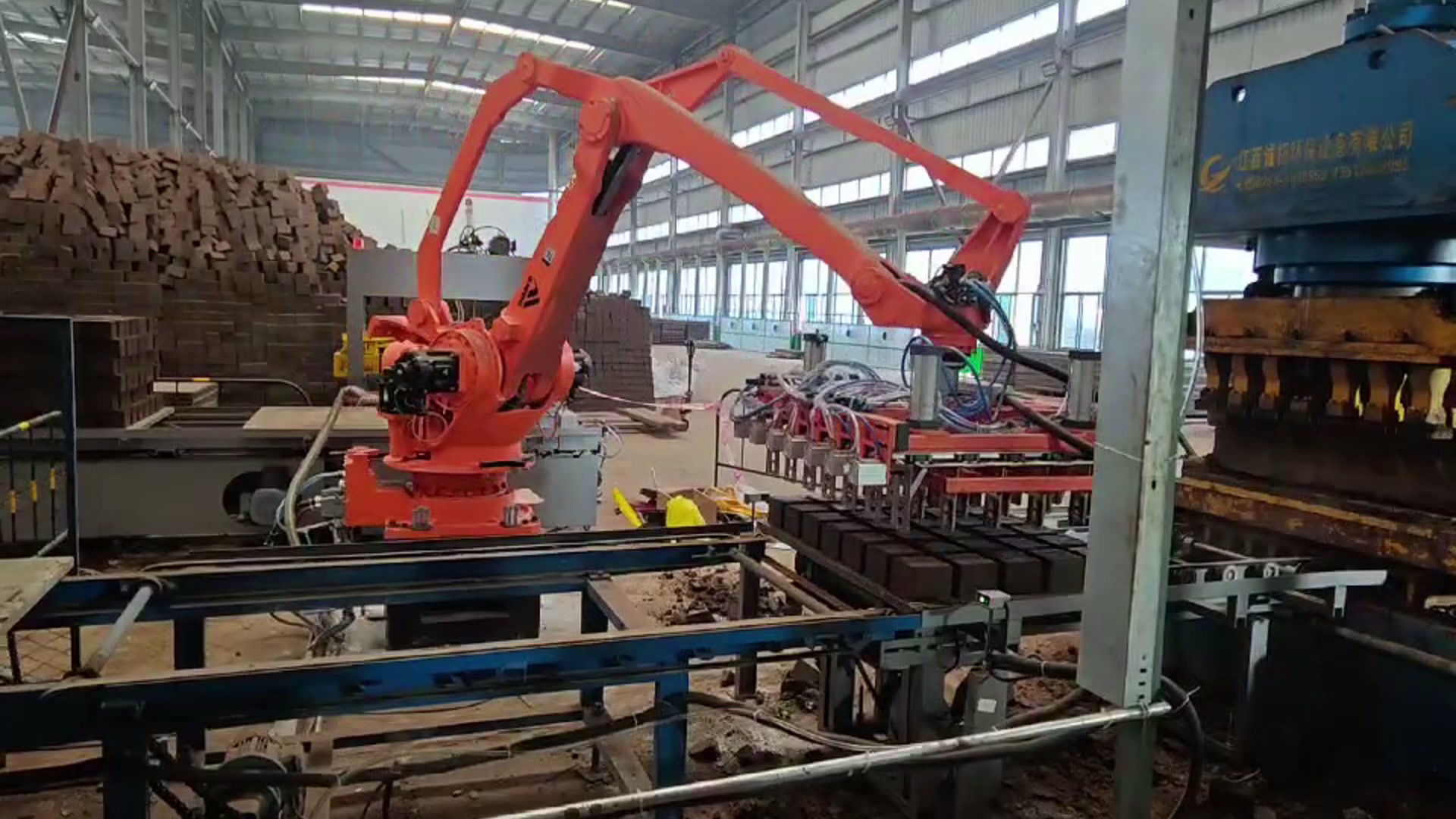
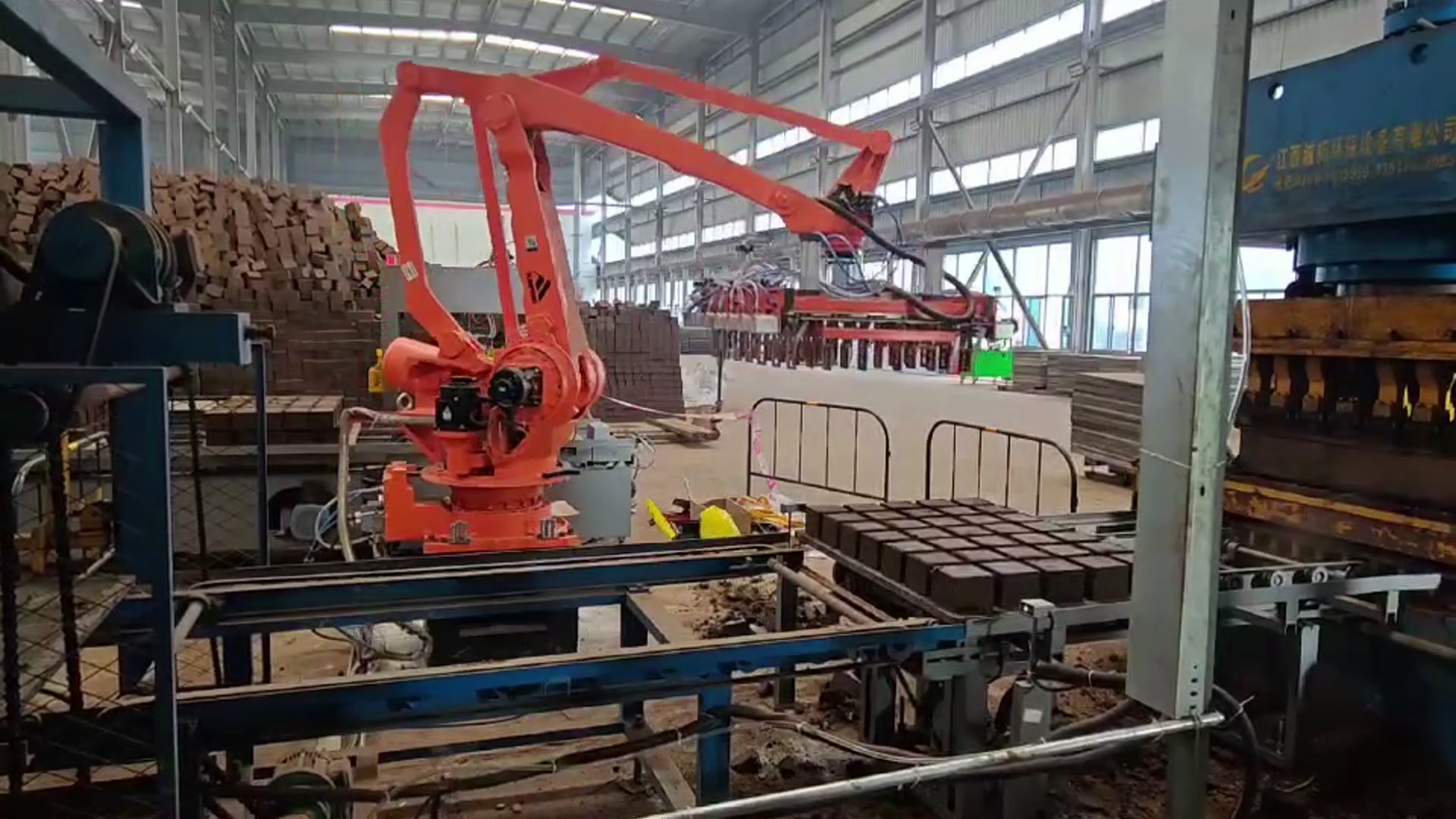
In the video, a four-axis palletizing robot stands beside a large press-type forming machine. Its end tool carries rows of pneumatic clamp pairs, and it lifts a whole row of blocks in one grip. It swings round, sets the row down on a board on the conveyor frame, and returns for the next row. Finished stacks fill the hall behind it.
Mitä valmistautua
- Block types with dimensions and weights (lightest and heaviest)
- Blocks per board and the machine cycle time
- Green or cured at the stacking point
- Required stack pattern, height and fork pockets
- Floor layout around the machine outfeed
Send these to our team and we will propose a gripper concept, check payload and reach, and work out whether one robot keeps pace with your machine.