
By EVST:n toimituskunta · Arvostelija EVST:n toimituskunta · Viimeksi päivitetty 9. lokakuuta 2026 · Toimituksellinen käytäntö · Oikaisupolitiikka · Ehdot
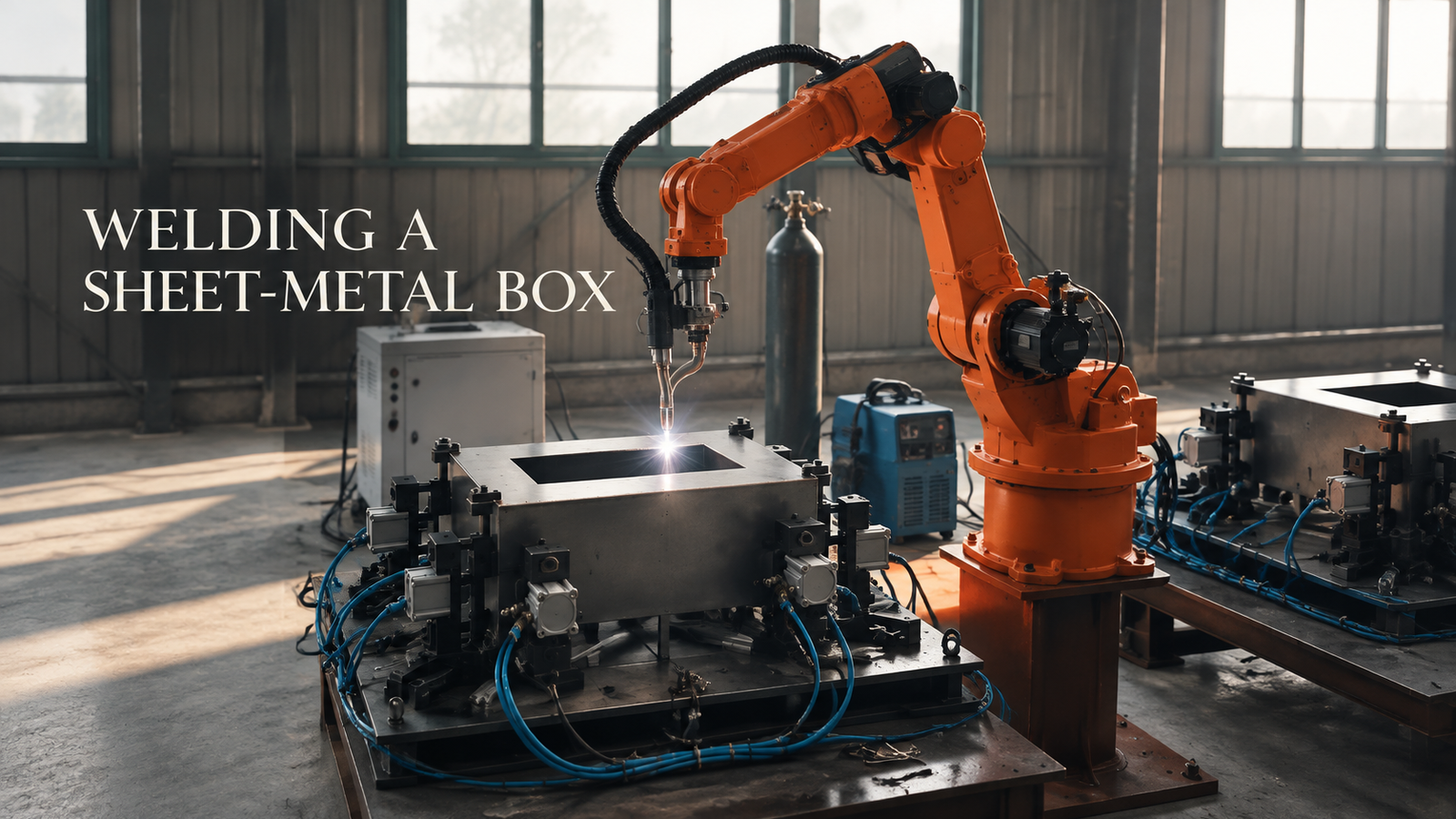
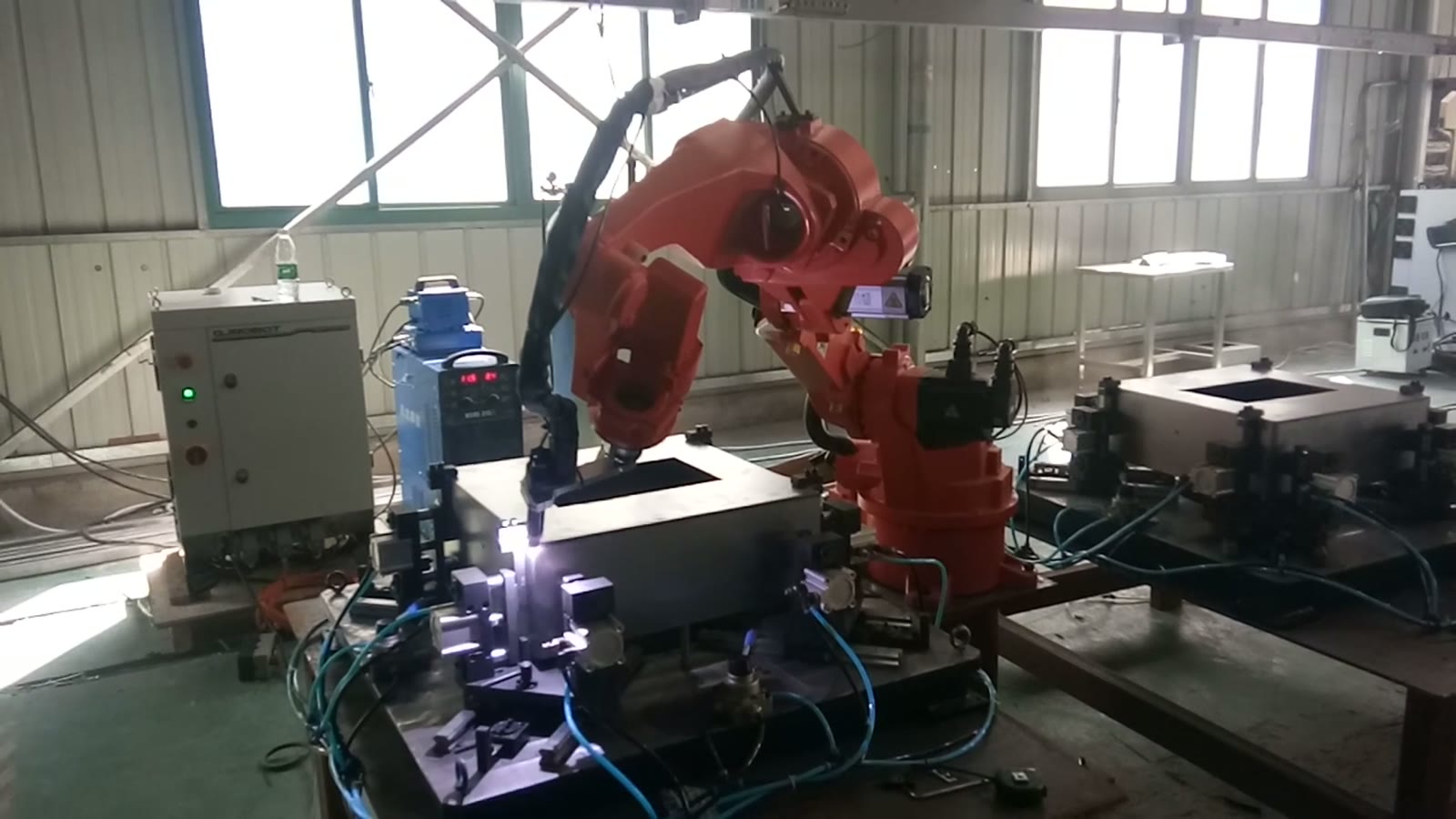
A square sheet-metal box can be robot-welded in one clamping when three constraints are satisfied at the same time: the clamps hold every face yet leave the torch a clear path, the torch can change angle between the top edges and the vertical corner seams without touching the fixture, and the order of the welds keeps the sheet from pulling out of shape. Fail any one and the box has to be unclamped and turned, which is where a robot cell loses most of its advantage. The case below is an air filter housing held whole in a single fixture, with one six-axis robot working around it.
Have a sheet-metal box, cabinet or housing to weld? Send us the part drawing with the seam list and your daily output, ja vastaamme kennokonseptilla ja sykliaika-arviolla.
Three constraints that cannot be settled one by one
On a box, the seams that need the torch are on the outside edges and corners, which is also where clamps want to sit. Hand welding gets round this by moving the part and the welder as needed. A robot has no such freedom, so the three constraints below have to be solved together, and each one limits the other two. The rest of this article follows how they interact, using the cell in the video as the example.
The box, the fixture and the robot
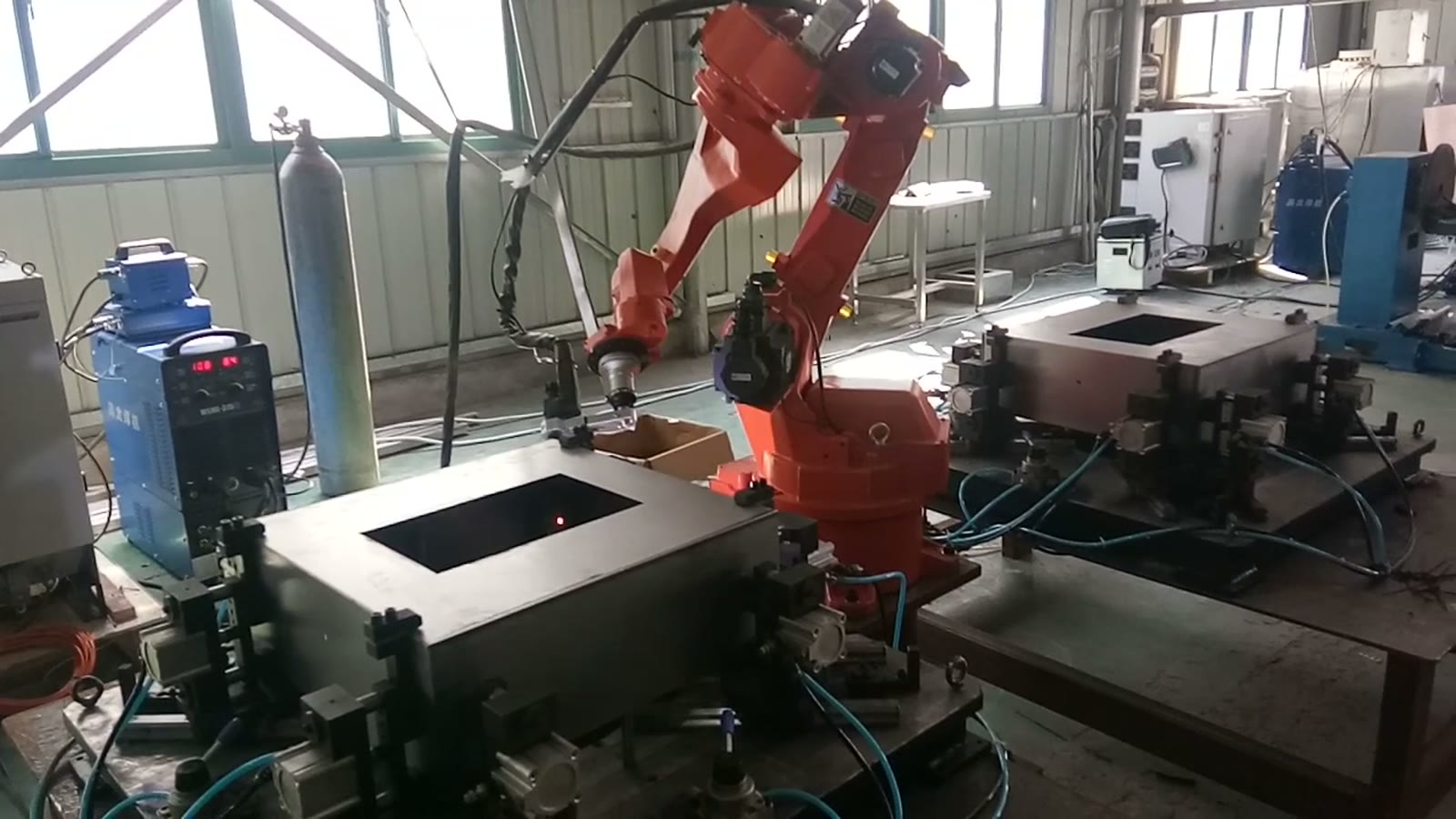
In this cell the box, with a rectangular opening in its top face, sits whole in a welding fixture on a work table. A ring of pneumatic clamp blocks, each fed by a blue air hose, presses on several faces. An orange six-axis robot stands at the table edge with a wire-feed torch; beside its base are the blue wire feeder, the white welding power cabinet and the gas cylinders. A second, identical fixture station stands next to the first, with another box in it.
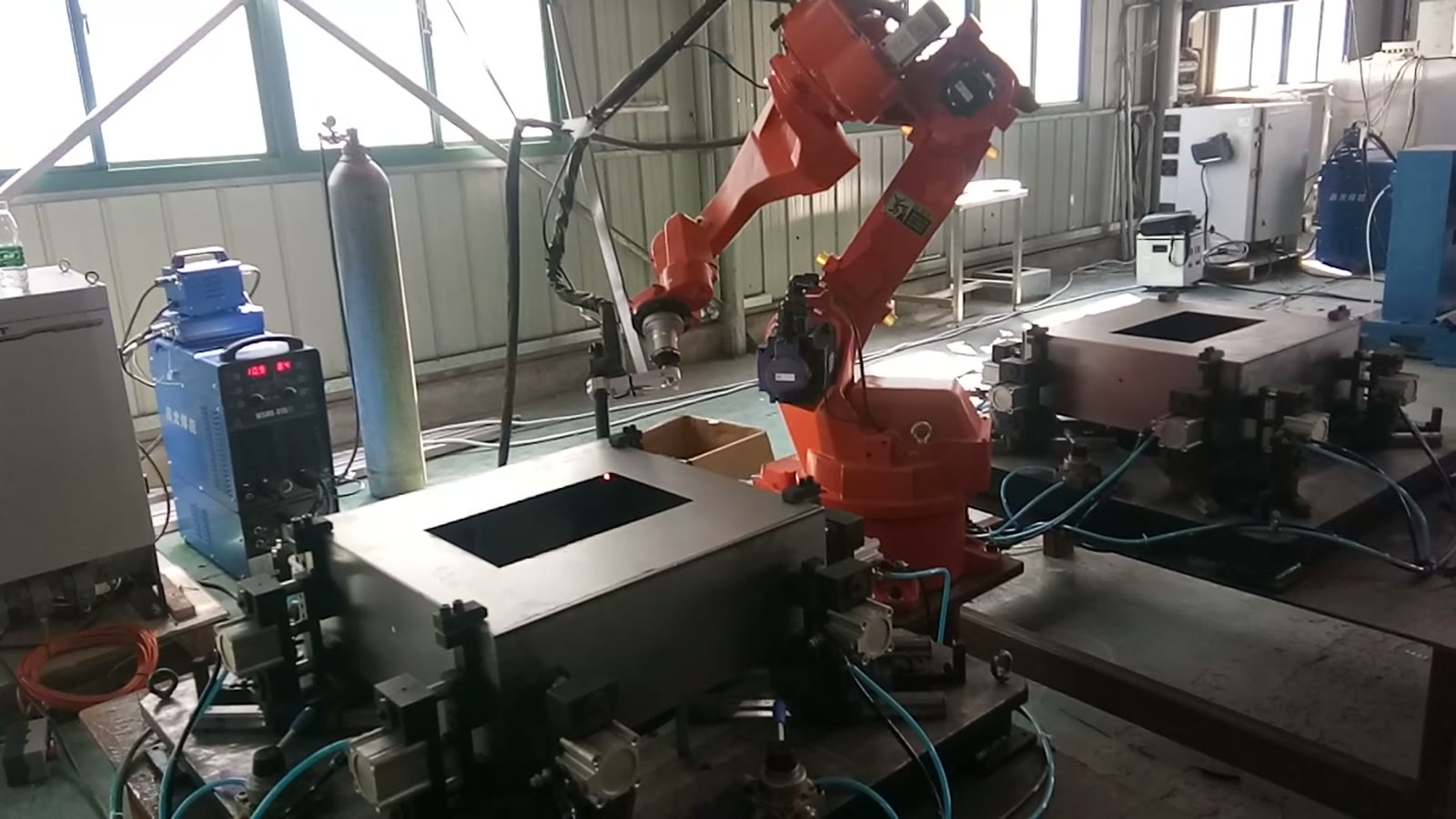
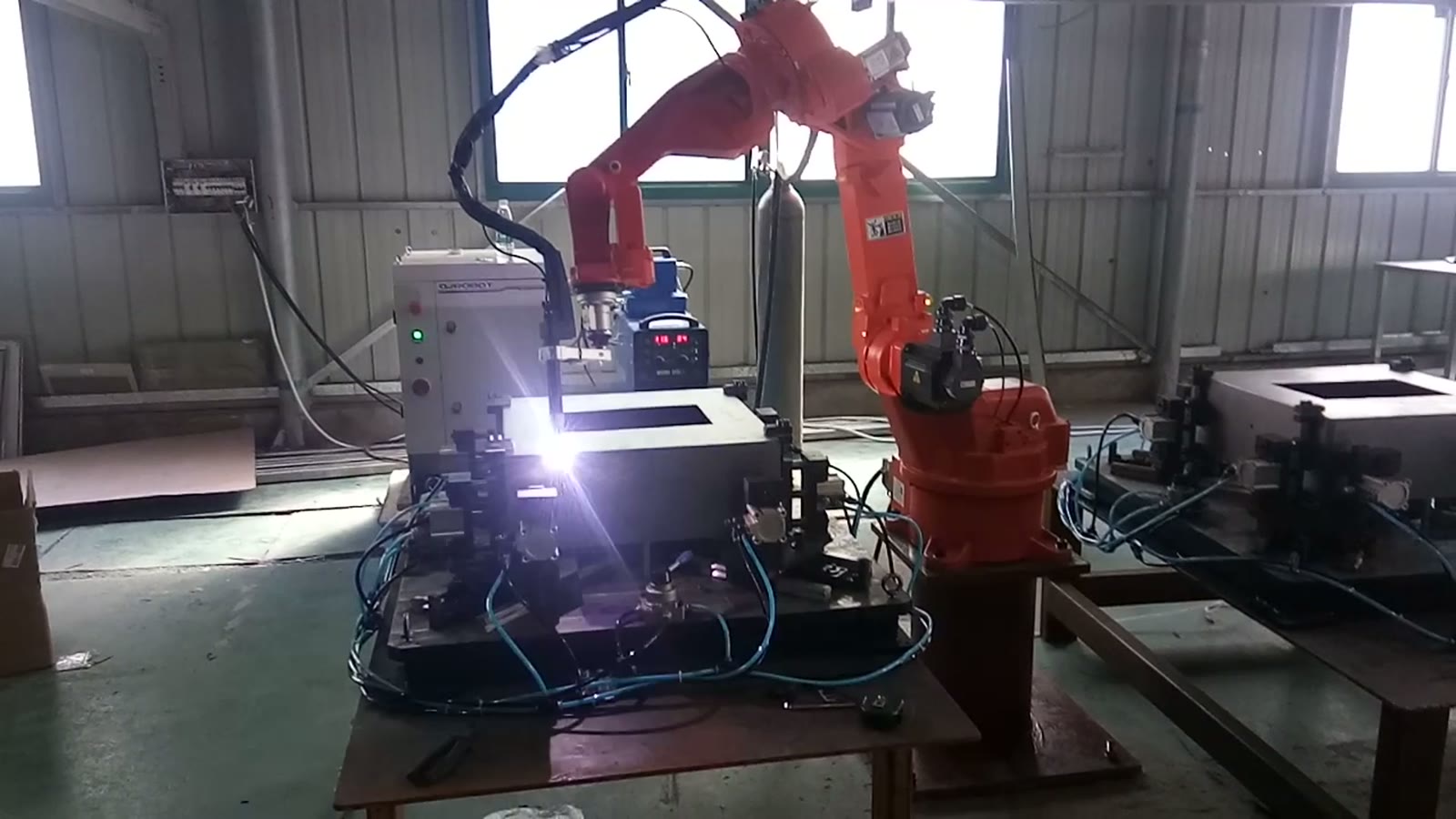
The robot’s work runs from the top of the box downward. The torch reaches over the box and strikes an arc at the edge of the top face, then runs along that edge. When the edge is done, the torch lifts and moves to the next edge or to a corner, and from there it welds the vertical corner seam from the top down. The clamps stay where they are throughout. That one fixed state is what the rest of the design depends on.
Clamps against the torch path
A box clamped on only some faces can move when it heats. Pressing on more faces makes it stiffer, but each clamp body, air hose and mounting block is also an obstacle, and the seam you most need to reach is often right where a clamp would like to go. The usual compromise is to press on the faces close to the edges but not on the seam line itself, with hoses and clamp heads kept low and outside the torch path. If a seam lies under a flange or behind a rib, clamp placement has to take it into account from the start, because a clamp can hide a seam from the torch as easily as it can steady the box.
Torch posture between the top edge and the corner
The top edges are worked with the torch over the box; the vertical corner seams need a tilted torch brought down along the corner. Between the two the wrist has to rotate, and the torch body, cable and feed hose all swing through space that the fixture also occupies. The check that matters is a clearance study of the whole torch, not just its tip. A reach figure that looks generous on paper can fail where a clamp head stands close to a corner. When that happens, moving the clamp a short way, or choosing a slimmer torch neck, is usually cheaper than adding axes.
Weld order as a distortion plan
Sheet metal moves when it is heated unevenly. Welding all of one side first and then the other can leave a box out of square even if every seam is sound. An order that spreads the heat, for example alternating between opposite edges or breaking a long seam into shorter runs, reduces that pull. Clamps help but do not remove the effect, and a clamp setup that works on one thickness can behave differently on another. That is why sheet thickness is one of the inputs we ask for, and why trial welds on a real box belong to the design rather than coming after it.
A quick feasibility test
Taken together, the three constraints give a practical test for any box. Walk through it with the drawing and the seam list.
| Kysymys | Jos vastaus on kyllä | Jos vastaus on ei |
|---|---|---|
| Can every face be held without a clamp on a seam line? | Clamp layout can proceed | Move clamps, or plan a second clamping |
| Can the whole torch reach each seam at its needed angle past the clamps? | Posture is feasible | Move a clamp, slim the torch neck, or change the split |
| Does a weld order exist that spreads heat and that the torch can reach in sequence? | Distortion can be managed | Add support, shorten runs, or revise the order |
| Are there seams deep inside the part where the torch cannot enter? | Not a one-clamping part | The three checks above decide it |
Two fixture stations are worth a word. In this cell a second station stands beside the first. As a general principle, two stations let a person unload and load one fixture while the robot works at the other, so the robot spends more of its time welding rather than waiting. Whether that pays depends on how long a box takes to weld compared with how long it takes to load, and on the safety arrangement between the stations. A single station is simpler and cheaper, and is the right choice when welding time is long compared with loading.
Where one clamping stops working
Boxes, cabinets and housings with their seams on outer edges and corners suit this approach, in batches large enough to justify a fixture. It becomes difficult when seams sit deep inside the part, where the torch cannot enter, or when the part is so flexible that clamps alone cannot hold its shape. In those cases a different split of the work, or turning the part on a positioner, may be needed.
Buyer questions on this kind of cell
Do all faces of the box need a clamp? Not necessarily. The aim is to keep the box in its true shape during welding, which may take clamps on some faces and a locating stop on others. The seam list decides it.
Can the same fixture take more than one box size? Sometimes. Adjustable stops and movable clamp blocks allow it within a range, at the cost of setting time. A family of similar boxes is much easier than unrelated ones.
Mitä sinun täytyy lainata? The box drawing with the seams marked, the sheet thickness if known, and the number of boxes you need a day.
Send us the drawing
If you have a similar sheet-metal box, cabinet or housing, send the part drawing with the seam list and your daily output through our contact form, or write to sales@evsrobot.com. We will reply with a cell concept and a cycle-time estimate.
This article describes the general principles of robot welding of sheet-metal boxes and what is visible in this cell; it does not state weld quality, cycle time or process parameters.