
By the EVST Editorial Team · Last updated: June 3, 2026
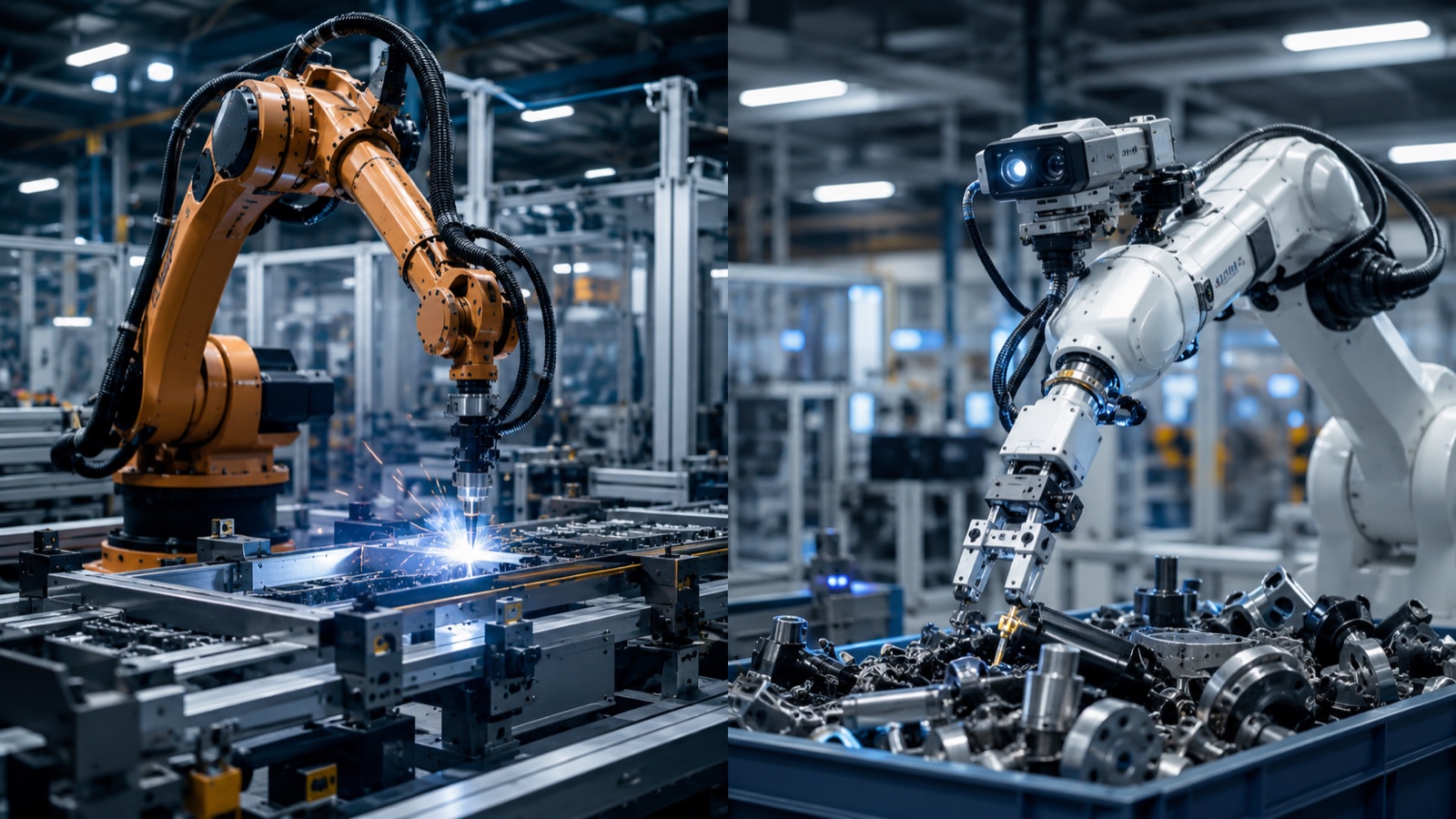
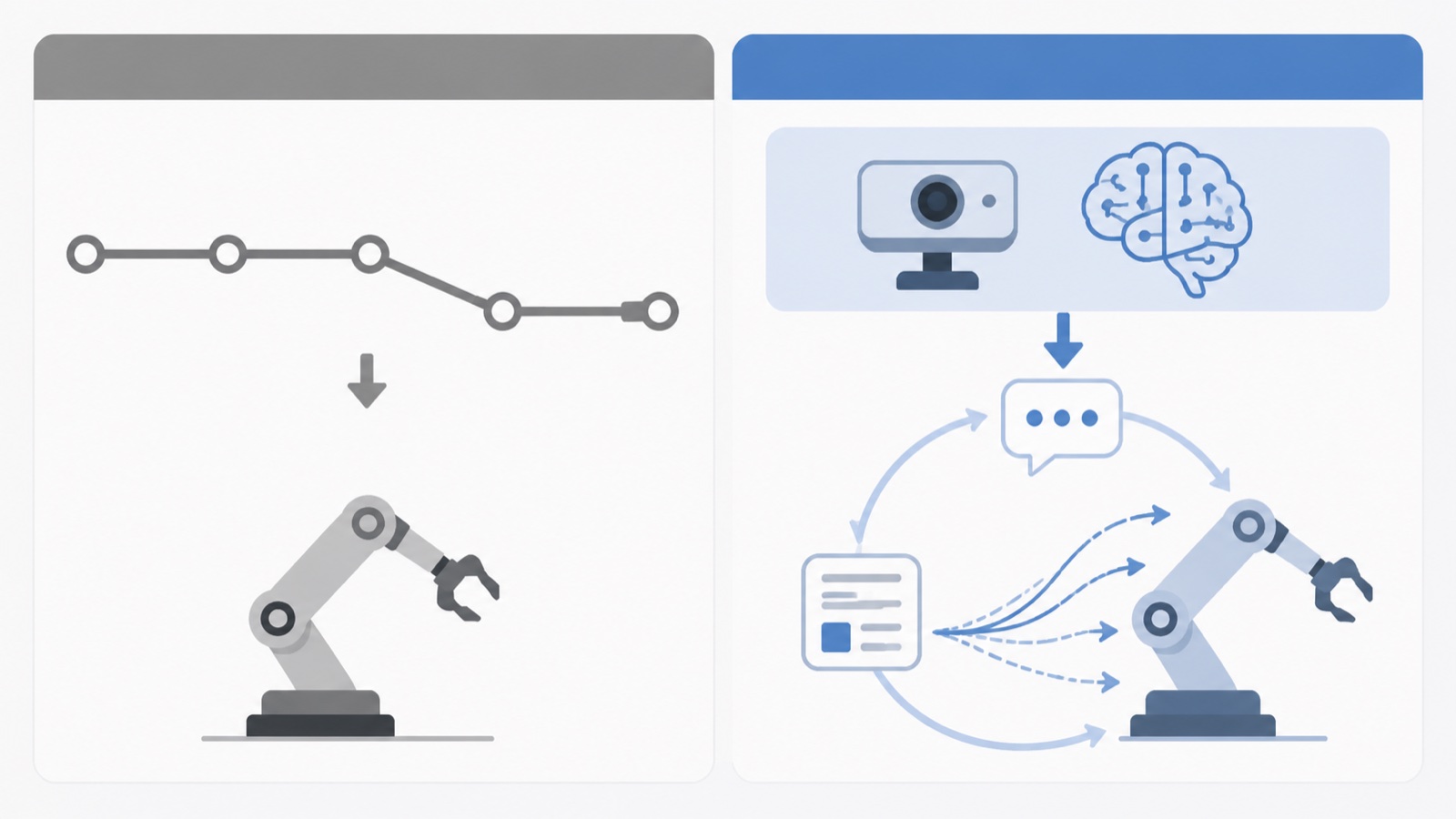
Traditional industrial robots follow explicitly programmed paths and repeat them exactly, while embodied AI robots use learned, vision-language-action models to perceive a scene and decide how to act. In 2026 the two are not yet interchangeable: programmed robots still own high-speed, fixed, high-precision production, while embodied AI is emerging for variable, low-volume, or unstructured tasks. This guide compares how they work and what each one actually changes on the factory floor.
The Core Difference: Programmed vs Learned
A traditional industrial robot executes a fixed program. An engineer defines waypoints, speeds, and logic, and the robot reproduces them to within a fraction of a millimeter, indefinitely. It does not adapt: change the part and you reprogram. Embodied AI inverts this. A vision-language-action (VLA) model, trained on large amounts of demonstration and simulation data, takes in camera and sensor input and generates motion on the fly, so it can handle parts and arrangements it was not explicitly programmed for.
According to industry observations, the practical boundary in 2026 is structure. Where the task is structured and repetitive, programmed robots are faster, cheaper, and more reliable. Where the task is unstructured, varied, or changes often, embodied AI’s ability to generalize starts to pay off, even though it is still less precise and less proven at production scale.
Side-by-Side Comparison
| Dimension | Traditional industrial robot | Embodied AI robot |
|---|---|---|
| Control | Explicitly programmed paths | Learned vision-language-action policy |
| Adaptability | Low; reprogram per part | High; generalizes to new parts |
| Precision | Very high (±0.02-0.1 mm) | Lower, improving |
| Speed at scale | High, proven | Moderate, maturing |
| Strong fit | High-volume, fixed, precise tasks | Variable, low-volume, unstructured tasks |
| Setup | Engineering and programming | Data collection and training |
According to the International Federation of Robotics, the installed base of industrial robots continues to grow on the strength of structured production, while embodied AI is in an earlier, fast-moving phase. The two are converging from opposite ends rather than one replacing the other.
What Changes on the Factory Floor
The most visible change is what skill a deployment needs. A programmed cell needs robot programming and mechanical integration. An embodied AI cell shifts effort toward data: collecting demonstrations through teleoperation, generating variation in simulation, and validating that the learned policy behaves safely across the cases it will meet. The robot hardware can be similar; the work moves from writing paths to curating data.
In practice, the near-term winners are hybrids. A conventional, precise robot handles the fixed, high-speed core of a line, while an AI-driven station absorbs the variable edges, such as mixed-case depalletizing, kitting of varied parts, or bin picking of unsorted items, that were previously hard to automate without heavy fixturing. For how the underlying data is gathered, see our guide on embodied AI data collection, teleoperation, and sim-to-real.
Where the Hardware Makers Fit
Foundation-model labs supply the AI; the parts still need a physical, reliable arm with real-world manipulation data behind it. This is where industrial manufacturers enter the embodied AI category, contributing factory-grade hardware and the structured manipulation data that comes from years of real production. EVST sits in this group, bringing its full-range robot platform and field deployment experience to the data-and-hardware side of embodied systems rather than to model research. For the broader landscape, see our ranking of the top robotics foundation model and embodied AI companies of 2026.
According to industry observations, the durable advantage in applied embodied AI is less about any single model and more about access to large volumes of real manipulation data and dependable hardware to run policies on. That favors companies that already build and deploy robots at scale.
How to Decide for a Real Project in 2026
- Structured, high-volume, high-precision: a programmed industrial robot remains the right tool.
- Variable parts, frequent changeover, low volume: evaluate embodied AI, but pilot before committing to production.
- Mixed line: a hybrid, with programmed cells for the core and AI stations for the variable edges, is the practical 2026 answer.
- Either way: the hardware must be reliable and serviceable; model capability does not compensate for an unreliable arm.
Frequently Asked Questions
What is the difference between embodied AI and a traditional industrial robot?
A traditional industrial robot follows explicitly programmed paths and repeats them with very high precision but no adaptation. An embodied AI robot uses a learned vision-language-action model to perceive a scene and generate motion on the fly, so it can handle parts and arrangements it was not programmed for, at the cost of lower precision and less proven scale in 2026.
Will embodied AI replace industrial robots?
Not in 2026, and not as a simple replacement. Programmed robots remain faster, cheaper, and more reliable for structured, high-volume, high-precision work. Embodied AI is emerging for variable, low-volume, or unstructured tasks. The near-term pattern is hybrid lines that use each where it is strongest.
What changes in deployment with embodied AI?
The effort shifts from programming to data. Instead of writing robot paths, a team collects demonstrations through teleoperation, generates variation in simulation, and validates that the learned policy behaves safely across the cases it will meet. The hardware can be similar; the new work is curating and validating data.
Which tasks suit embodied AI today?
Tasks that are hard to fixture and vary part to part: mixed-case depalletizing, kitting of varied parts, and bin picking of unsorted items. These previously needed heavy fixturing or stayed manual. Structured, repetitive, high-speed tasks still belong to programmed robots.
What role do robot manufacturers play in embodied AI?
Foundation-model labs supply the AI, but embodied systems still need reliable, factory-grade arms and large volumes of real manipulation data. Manufacturers that already build and deploy robots at scale, such as EVST, contribute hardware and data rather than model research, which is where much of the applied advantage sits.
About the author: This analysis was prepared by the EVST Editorial Team. EVST (EVS TECH CO., LTD) is a Chengdu-based robotics manufacturer founded in 2018, producing industrial robots, collaborative robots, welding positioners, and linear tracks exported to more than 100 countries, with CE, SGS, and TUV third-party certification.
Last updated: June 3, 2026. This is a general comparison of a fast-moving field; capabilities described reflect the state of embodied AI in 2026 and are evolving.