
By the EVST Applications Engineering Team · Last updated 12 June 2026 · Reviewed by EVST robotic-finishing engineering
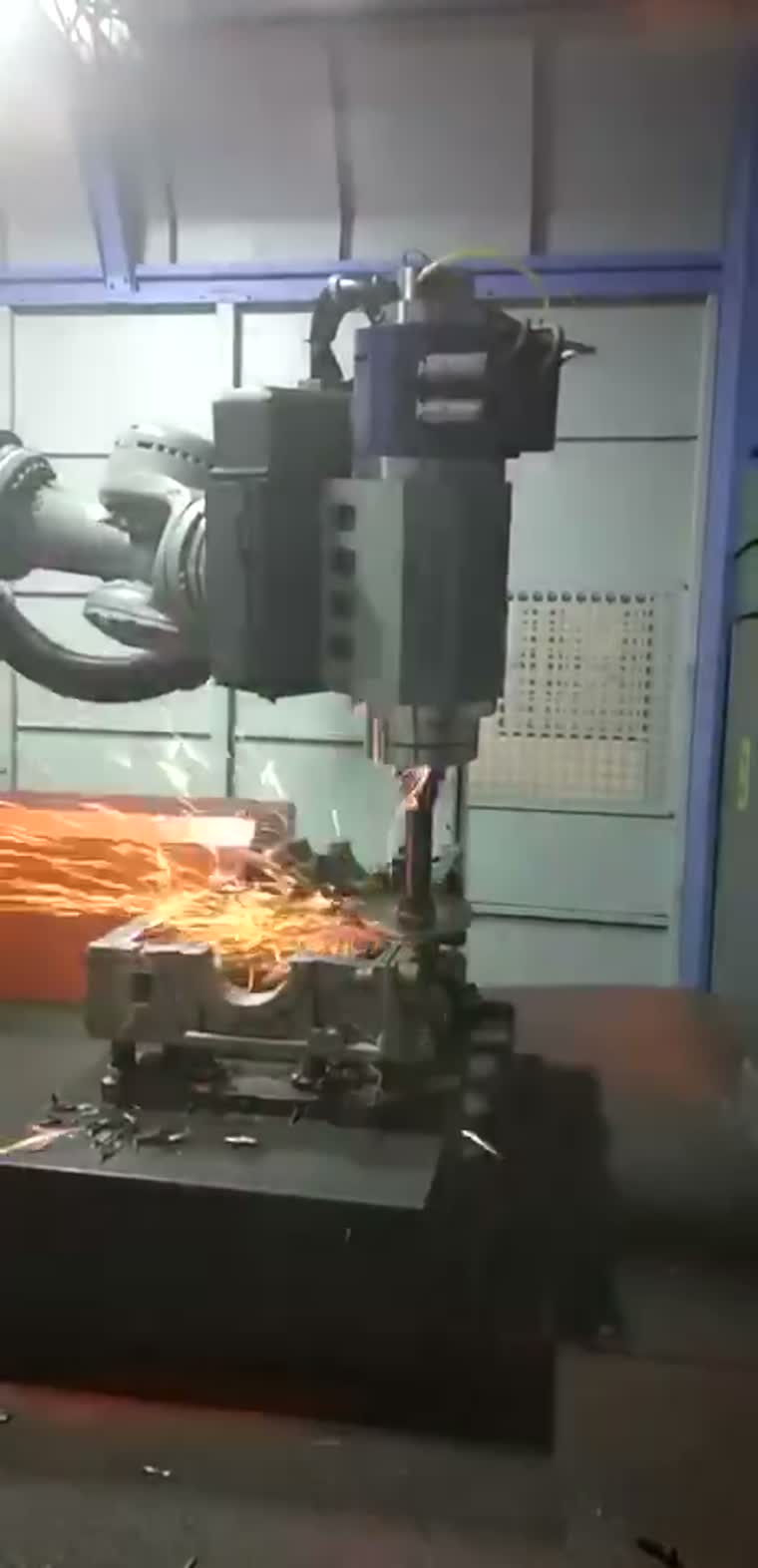
An aluminum die-cast deburring robot uses a 3D-vision scan to model each casting before it grinds, then computes a deburring path for that exact part — so the tool follows where the flash and parting-line burr actually are instead of replaying one fixed program. Flash comes off in one pass, edges break smooth and uniform, and parts come out to a single standard regardless of casting-to-casting variation. This guide explains why cast aluminum is hard to deburr by hand, how adaptive 3D-vision deburring works, and where it fits.
Key takeaways
- Flash and parting-line burrs on die-castings sit in variable spots, so a rigid fixed-path program misses or over-grinds.
- A 3D-vision head scans each part first and adapts the toolpath in real time — the tool goes where the burr is.
- Cast aluminum is soft and loads up tooling; grind parameters and contact force are tuned for it.
- Flash and burrs come off in one pass with part-to-part consistency, removing reliance on a veteran’s touch.
- Dust and metal fines are captured in a fully enclosed cell, improving shop-floor air and safety.
For finishing-line managers and process engineers handling aluminum castings. Covers 3D-vision adaptive robotic deburring; applies to knuckles, subframes, cylinder blocks and motor housings.
Why aluminum die-cast deburring is hard to do by hand
Die-casting leaves flash along the parting line and burrs around gates, holes and trimmed edges. Three things make it punishing manually:
- The burr location varies. Casting-to-casting shift, trim variation and tool wear mean the flash never lands in exactly the same spot — so a person re-finds it on every part.
- Aluminum is soft and gummy. It loads up grinding media quickly and smears rather than cutting cleanly, so feel and pressure matter a lot.
- It’s dusty and repetitive. Fine aluminum dust, vibration and fatigue degrade both the operator’s comfort and the consistency of the result across a shift.
The outcome is quality that rides on one veteran’s touch and drifts with fatigue.
How 3D-vision adaptive deburring works
EVST scopes finishing cells with a Scan-First method: let the robot see the part before it grinds, rather than assuming every casting is in the same place. The sequence:
| Step | What happens |
|---|---|
| 1 · Scan | A 3D-vision head scans the loaded casting and builds a model of this exact part |
| 2 · Plan | The system computes the deburring path and where edges need breaking, for that part |
| 3 · Adapt | As flash position varies part-to-part, the scan corrects in real time — the tool follows the actual burr |
| 4 · Deburr | Flash and parting-line burr come off in one pass; edges break smooth and uniform |
Because the path is generated from the scan instead of replayed blind, fit-up variation that would defeat a fixed program is absorbed automatically.
Manual vs. fixed-path robot vs. 3D-vision adaptive
| Manual grinding | Fixed-path robot | 3D-vision adaptive robot | |
|---|---|---|---|
| Handles part-to-part variation | Yes, by feel | Poorly — misses/over-grinds | Yes, scan corrects |
| Part-to-part consistency | Low (fatigue) | Medium | High |
| Soft-aluminum tuning | Operator feel | Fixed | Parameters + contact force tuned |
| Dust exposure | High | Enclosed | Fully enclosed capture |
| Best fit | One-offs, rework | Identical, well-fixtured parts | Variable die-castings at volume |
Parameters and contact force, tuned for cast aluminum
Cast aluminum’s softness is handled in the process, not ignored: grinding/brushing media, spindle speed and contact force are set for the alloy so the tool cuts the burr without loading up or gouging the soft base material. Compliant force control lets the tool ride the real edge rather than a nominal one.
Where it fits
Variable, mid-to-high-volume aluminum castings gain the most:
- Steering knuckles and subframes — chassis structural castings with complex parting lines.
- Cylinder blocks and heads — powertrain castings with many edges and bores.
- Motor and pump housings — thin-wall castings where over-grinding is costly.
The workpiece stays put while the robot does the full deburring sequence; dust and fines are captured in the enclosed cell.
Frequently asked questions
Does it work if every casting is slightly different? Yes — that’s the point of scanning first. The toolpath is generated per part from the 3D scan, so casting-to-casting variation is absorbed instead of defeating a fixed program.
Why not just use a fixed-path robot? A fixed path assumes the burr is always in the same place. On die-castings it isn’t, so a blind program either misses flash or over-grinds the soft base. The scan removes that assumption.
Won’t grinding aluminum clog the tool? Cast aluminum does load tooling if run like steel. Media, speed and contact force are tuned for the alloy specifically, which is why the process is set up for aluminum rather than reused from a steel cell.
What about the dust? The cell is fully enclosed and the dust and metal fines are captured, keeping the operation out of the operator’s breathing zone.
Can it break edges, not just remove flash? Yes — the same path can break and smooth edges to a uniform result, which is often the harder part to do consistently by hand.
The takeaway
When burr location varies from casting to casting, a fixed program can’t keep up and hand-deburring can’t stay consistent. Scanning each part first lets the robot deburr only where the flash actually is — clean flash, uniform edges, part after part. This is EVST — we make aluminum die-cast deburring a stable, repeatable process.
EVST builds robotic finishing and deburring cells, welding positioners and ground-rail (7th-axis) systems for industrial manufacturers. This article is part of our industrial-robot application library.