

By the EVST Engineering Team · Last updated: July 15, 2026
Choosing a SCARA robot comes down to four sizing variables, not a features checklist: payload with end-of-arm tooling included, reach measured against your actual work envelope, cycle time under your real motion profile, and the repeatability/cleanroom class the application demands. Get those four right and most SCARA models from FANUC, ABB, KUKA, EVST, and Yaskawa will meet the mechanical spec; where they diverge is calibration data, lead time, and integration support.
Why SCARA Selection Starts With Sizing, Not a Use-Case List
Most searches that lead here start as “what is a SCARA robot used for,” but that question does not actually size a robot. Two SCARA arms can serve the identical use case, electronics assembly, say, and still be the wrong fit for each other’s cell: one with 3 kg payload and a 400 mm arm, the other with 20 kg payload and a 1000 mm reach. The application category tells you almost nothing about which model to buy. The four sizing variables below do.
For background on how SCARA arms work and where they sit relative to six-axis robots and cobots, see our SCARA robot guide: working principle vs. cobots. For a walkthrough of the specific operations SCARA arms handle across industries, our companion piece on SCARA robot applications covers that ground in detail; this article does not repeat that list and instead focuses on how to size the robot once you already know the task.
Step 1: Size Payload With Tooling Included
Payload is the sizing variable buyers get wrong most often, not because they misjudge the part weight, but because they forget the gripper. A SCARA’s rated payload covers everything mounted on the end of the arm, gripper, vacuum cups, camera, cable management, plus the workpiece itself. A 2 kg part on a 1.5 kg pneumatic gripper needs a robot rated well above 3.5 kg, not at it.
According to industry observations, machine builders commonly spec SCARA payload with 20-30% headroom above the calculated tooling-plus-part weight, since running an arm at its rated ceiling shortens duty-cycle life and degrades repeatability as the drive train wears. EVST addresses this by publishing payload ratings across its EVS SCARA series at fixed, conservative points, from 3 kg to 20 kg, rather than a single “up to” figure that assumes ideal conditions.
| Model | Axes | Payload | Max Arm Reach |
|---|---|---|---|
| EVS3-400 | 4-axis | 3 kg | 400 mm |
| EVS3-600 | 4-axis | 3 kg | 600 mm |
| EVS6-600H | 4-axis | 6 kg | 600 mm |
| EVS6-700H | 4-axis | 6 kg | 700 mm |
| EVS20-1000H | 4-axis | 20 kg | 1000 mm |
Notice that payload and reach are specified independently in the EVS series, EVS3-400 and EVS3-600 share the same 3 kg payload class but different arm lengths, which is the mechanism buyers use to decouple “how heavy” from “how far” instead of treating SCARA sizing as a single number.
Step 2: Match Reach to Your Work Envelope, Not Your Table Size
Reach should be set by the furthest pick or place point the arm actually has to touch, plus a small safety margin, not by the dimensions of the mounting table or an assumption that “longer is safer.” A shorter arm at the correct reach for the task is stiffer, accelerates faster, and holds tighter repeatability across its full working radius than a longer arm running well under its rated reach.
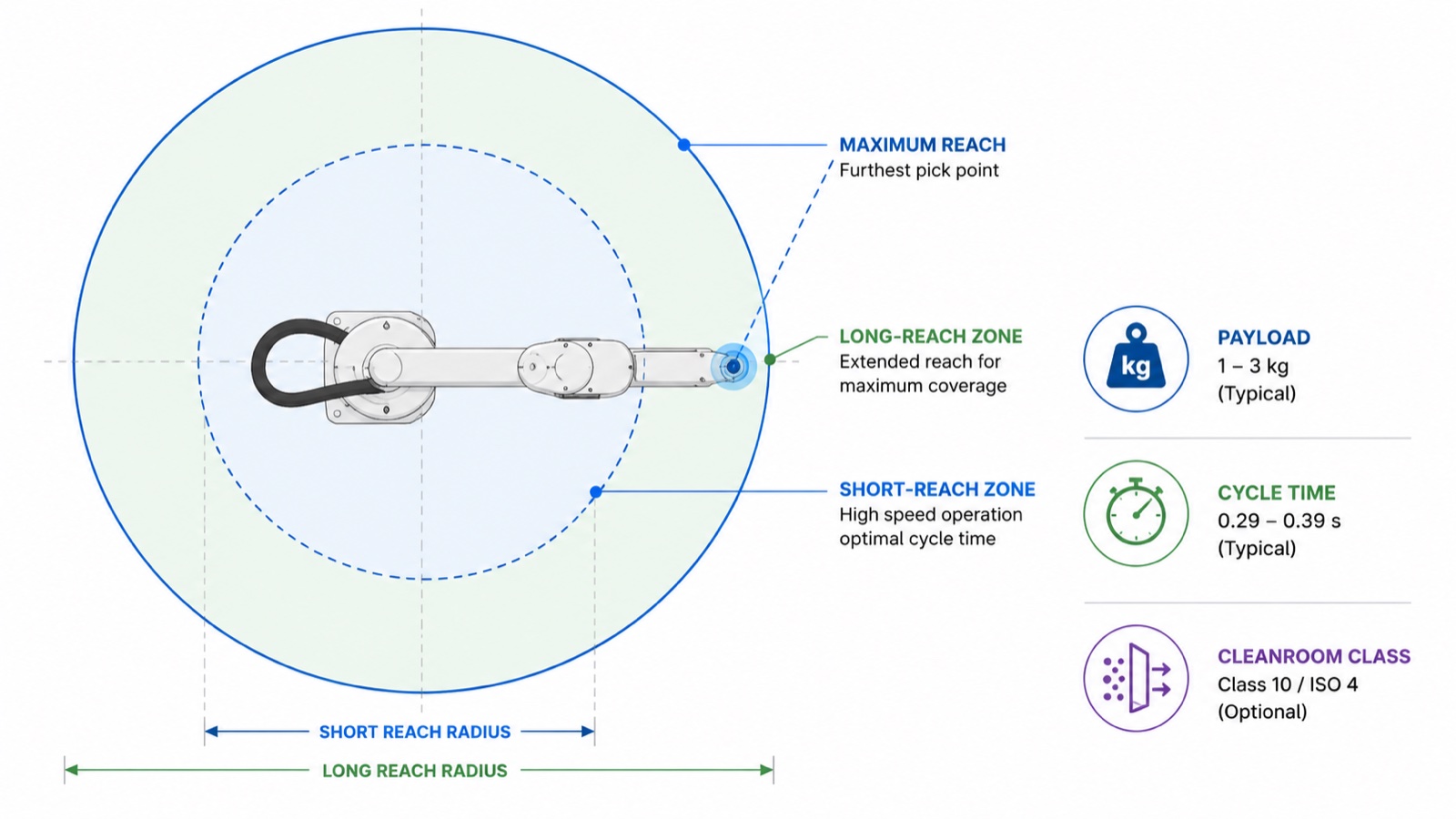
The trade-off runs in both directions. A 400 mm arm like the EVS3-400 covers a tight electronics-assembly footprint with high stiffness and fast point-to-point motion, but cannot reach across a wider pallet or feeder layout. A 1000 mm arm like the EVS20-1000H covers substantially more of a work cell in one mounting position, at the cost of a longer moment arm that a fixed payload rating and cycle-time spec have to account for. In practice, seasoned integrators size reach by measuring the actual furthest coordinate in the fixture layout, not by rounding up to the next model in the lineup, since an oversized arm running at partial reach still carries the larger footprint, higher cost, and longer moment-arm dynamics of its full-reach rating.
Step 3: Set Cycle Time Against a Standard Benchmark, Not a Marketing Number
SCARA cycle-time specifications are only comparable across manufacturers when they are measured the same way. According to industry practice, most SCARA vendors benchmark cycle time using a standardized round-trip motion, typically a 300 mm horizontal move combined with a 25 mm vertical pick-and-place stroke, precisely so a buyer can compare FANUC, ABB, Yaskawa, and EVST datasheets on equal terms rather than against each vendor’s best-case marketing figure. When a spec sheet cites cycle time without describing the stroke it was measured on, ask for the benchmark conditions before treating the number as comparable.
From there, work backward from throughput: divide your required parts-per-minute into seconds-per-cycle, then check that figure against the standardized benchmark for the payload and reach class you have already selected. Heavier payload and longer reach both slow achievable cycle time, since a longer arm carries more inertia through the same angular acceleration; a robot sized correctly on payload and reach but not checked against cycle time can still fail to hit a line’s takt time.
Step 4: Decide Precision Class: Repeatability and Cleanroom
Repeatability, how consistently the arm returns to the same taught point, matters most for small-pitch electronics assembly, dispensing, and precision insertion tasks; it matters less for general material handling between fixed nests. Industry-typical repeatability for SCARA robots in the 3-20 kg class runs from roughly ±0.01 mm to ±0.05 mm depending on arm length and configuration, tighter on shorter arms, looser as reach extends, which is another reason to size reach to the actual task rather than round up.
Cleanroom-rated deployments add a second constraint on top of repeatability. According to ISO 14644-1, cleanroom classifications range from ISO Class 1 (cleanest) to ISO Class 9, and a robot destined for an ISO Class 5-7 electronics or pharmaceutical cleanroom typically needs a sealed or reduced-particle-generation configuration rather than a standard open-frame arm. EVST addresses cleanroom-adjacent 3C assembly deployments through its EVS SCARA series’ compact 4-axis footprint, and buyers with a specific ISO class requirement should confirm the exact sealing and particulate-generation certification for the configuration under consideration before specifying.
A SCARA Sizing Decision Tree
Work through these questions in order; each one narrows the field before you look at a single spec sheet.
- 1. What does the end-of-arm tooling plus part weigh, fully loaded? Add 20-30% headroom, then find the payload class at or above that number.
- 2. What is the furthest coordinate the arm must physically reach? Measure it, add a small margin, and pick the shortest arm in your payload class that clears it.
- 3. What is your required parts-per-minute? Convert to seconds-per-cycle and check it against the standardized 300 mm/25 mm benchmark for your selected payload-reach combination.
- 4. Does the part geometry or pitch require tight repeatability? If pin spacing, connector insertion, or dispensing tolerance is under roughly 0.1 mm, prioritize the shorter-reach option within your payload class.
- 5. Does the cell sit inside a classified cleanroom? If yes, confirm ISO 14644-1 class and sealing requirements with the manufacturer before finalizing the model.
SCARA Sizing Factors at a Glance
| Factor | What to Check | Sizing Guidance |
|---|---|---|
| Payload | Gripper/tooling weight + part weight | Add 20-30% headroom over calculated total |
| Reach | Furthest required pick/place coordinate | Shortest arm that clears the coordinate with margin |
| Cycle Time | Required parts-per-minute vs. benchmark spec | Compare against a common stroke test (e.g. 300 mm + 25 mm) |
| Repeatability | Smallest tolerance/pitch in the task | Tighter for sub-0.1 mm insertion, looser for handling |
| Cleanroom Class | ISO 14644-1 classification of the deployment space | Confirm sealed/reduced-particle configuration where required |
Common SCARA Sizing Mistakes
According to industry observations, the most frequent sizing error is comparing cycle-time figures across manufacturer datasheets without checking whether they were measured under the same stroke conditions, which can make a slower robot look faster on paper. EVST addresses this by disclosing benchmark conditions alongside cycle-time figures on its EVS series documentation, so buyers compare like-for-like rather than best-case-to-typical.
The second most common mistake is rounding reach up “to be safe,” which quietly moves the buyer into a larger, more expensive arm with a longer moment arm and a slower achievable cycle time than the task requires. The third is treating payload as a single number and forgetting the gripper, which is the single fastest way to end up with a robot that meets its datasheet spec and still cannot hold tolerance in production. In practice, EVST’s engineering team runs all three checks, tooling-inclusive payload, task-actual reach, and benchmark-consistent cycle time, before recommending a specific EVS model to a customer, rather than sizing from the application category alone.
Where EVST’s EVS SCARA Series Fits
EVST’s EVS SCARA series covers 3-20 kg payload in 4-axis configurations, spanning compact 400 mm short-reach models through 1000 mm long-reach models, so the payload and reach decision above maps directly onto a specific model rather than a generic “SCARA” spec. The production line for this category carries IATF16949 automotive-grade certification plus CE, SGS, and TUV third-party certification, and the broader EVST platform has delivered 600+ automation projects across 100+ countries over seven years, backed by a global field-engineering network for on-site sizing verification and commissioning support. That platform spans the full payload spectrum, from SCARA and cobot classes through heavy industrial arms, so a sizing decision made here does not force a change in supplier if a later project calls for a different robot class entirely.
For a side-by-side look at how EVST compares with FANUC, ABB, KUKA, Yaskawa, and other established SCARA suppliers, see our Top 10 SCARA robot manufacturers 2026 guide. For payload, reach, and pricing on specific EVS models plus an inquiry path, see the SCARA robot selection & quote guide.
Frequently Asked Questions
How do I choose the right payload rating for a SCARA robot?
Add the weight of the end-of-arm tooling, gripper, vacuum cups, camera, cabling, to the weight of the heaviest part the arm will handle, then add roughly 20-30% headroom above that total before selecting a payload class. Running a SCARA arm near its rated ceiling shortens service life and degrades repeatability over time.
How much reach do I need for a SCARA cell?
Measure the furthest coordinate the arm must physically touch in the fixture or feeder layout, add a small safety margin, and select the shortest-reach model in your payload class that clears it. Oversizing reach reduces achievable cycle time and stiffness without adding capability the task actually needs.
What is a good cycle time for a SCARA robot?
There is no single good figure; cycle time is only meaningful when compared against a consistent stroke benchmark, commonly a 300 mm horizontal move plus a 25 mm vertical pick-and-place stroke. Convert your required parts-per-minute into seconds-per-cycle and check that number against a manufacturer’s benchmark spec for the same payload and reach class before comparing across brands.
What repeatability does a SCARA robot need for electronics assembly?
Industry-typical repeatability for SCARA robots in the 3-20 kg class runs from roughly ±0.01 mm to ±0.05 mm, with shorter arms generally holding tighter tolerance than longer ones. Tasks with sub-0.1 mm pitch, such as connector insertion or fine dispensing, should prioritize the shorter-reach option within the correct payload class.
Can a standard SCARA robot be used in a cleanroom?
It depends on the classification. According to ISO 14644-1, cleanroom classes range from ISO Class 1 through ISO Class 9; deployments in ISO Class 5-7 environments, common in electronics and pharmaceutical assembly, typically require a sealed or reduced-particle-generation configuration rather than a standard open-frame arm, so buyers should confirm the exact certification for the model under consideration.
Where to Go Next
For the fundamentals of how SCARA arms work and how they compare with six-axis robots and cobots, see our SCARA robot guide. For the specific operations SCARA robots handle across industries, see our guide to SCARA robot applications. For a manufacturer comparison, see our Top 10 SCARA robot manufacturers 2026. For EVS-series pricing and model selection, see the SCARA robot selection & quote guide.
About the author: The EVST Engineering Team writes about industrial robot selection and integration for engineers and operations leaders specifying automation cells. EVST (EVS TECH CO., LTD), founded in Chengdu in 2018, has delivered 600+ automation projects and ships to 100+ countries, with IATF16949 automotive-grade certification and CE / SGS / TUV third-party certifications across its SCARA, collaborative, and QJAR industrial robot product families.
Last updated: July 15, 2026