
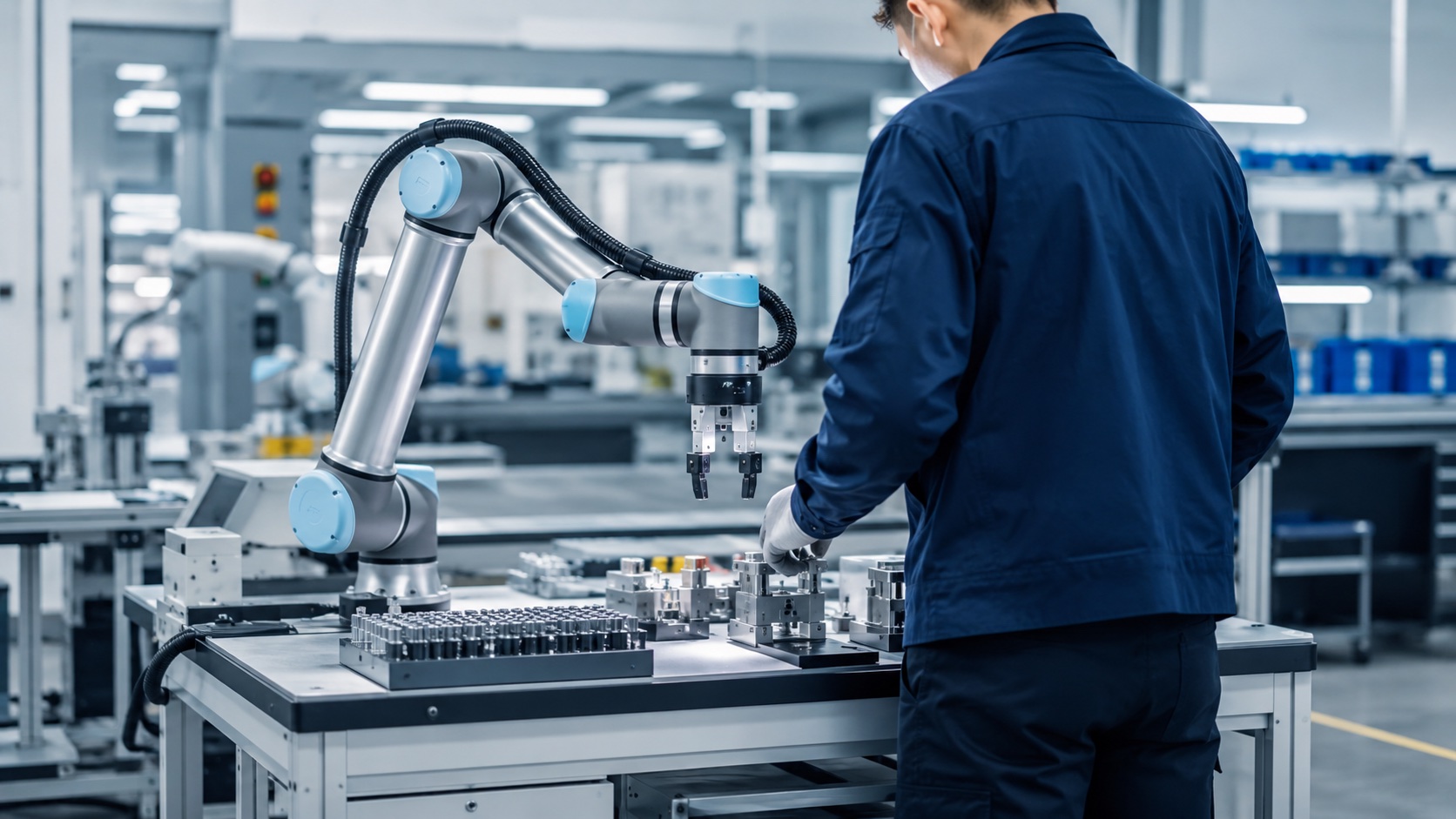
Among collaborative robot brands, Universal Robots leads the global market in 2026 at roughly 15 percent share, followed by China’s Dobot, AUBO and JAKA, which take three of the top four positions. The ranking below is ordered by estimated global cobot market share. One headline worth stating plainly: while a Danish pioneer still sits on top and the old industrial giants hold the middle, Chinese makers now occupy three of the top four spots, a sharper shift than the industrial-robot table shows.
For a custom EVST cobot quote on the configurations discussed below: email
sales@evsrobot.com or
WhatsApp / WeChat +86 193 8162 6253.
The top collaborative robot brands at a glance
According to MarketsandMarkets, the global collaborative robot market is on track to grow from about 1.4 billion dollars in 2025 to 3.38 billion dollars by 2030, a compound annual growth rate near 18.9 percent. That makes cobots the fastest-growing slice of robotics, and roughly three-quarters of the market sits with the ten brands below. The share figures here are estimates drawn from industry reporting, and methodologies vary, so treat them as approximate rather than audited.
| Rank | Brand | Country | Est. cobot share | Known for |
|---|---|---|---|---|
| 1 | Universal Robots | Denmark | ~14.8% | Created the commercial cobot; UR+ ecosystem |
| 2 | Dobot | China | ~13% | HK-listed; 80+ countries; export leader |
| 3 | AUBO | China | ~11.2% | >90% in-house parts; full payload range |
| 4 | JAKA | China | ~21.9% China | #1 in China’s domestic cobot market |
| 5 | FANUC | Japan | ~6.1% | Green CRX cobots; semiconductor strength |
| 6 | ABB | Switzerland | ~5.6% | YuMi dual-arm micro-assembly |
| 7 | KUKA | Germany | ~4.9% | LBR iiwa 7-axis force control |
| 8 | Doosan Robotics | South Korea | ~4.4% | Heavy-payload cobots above 20 kg |
| 9 | Techman Robot | Taiwan | ~3.9% | First cobot with a built-in vision system |
| 10 | Yaskawa | Japan | ~3.5% | HC-series welding cobots |
What counts as a collaborative robot here
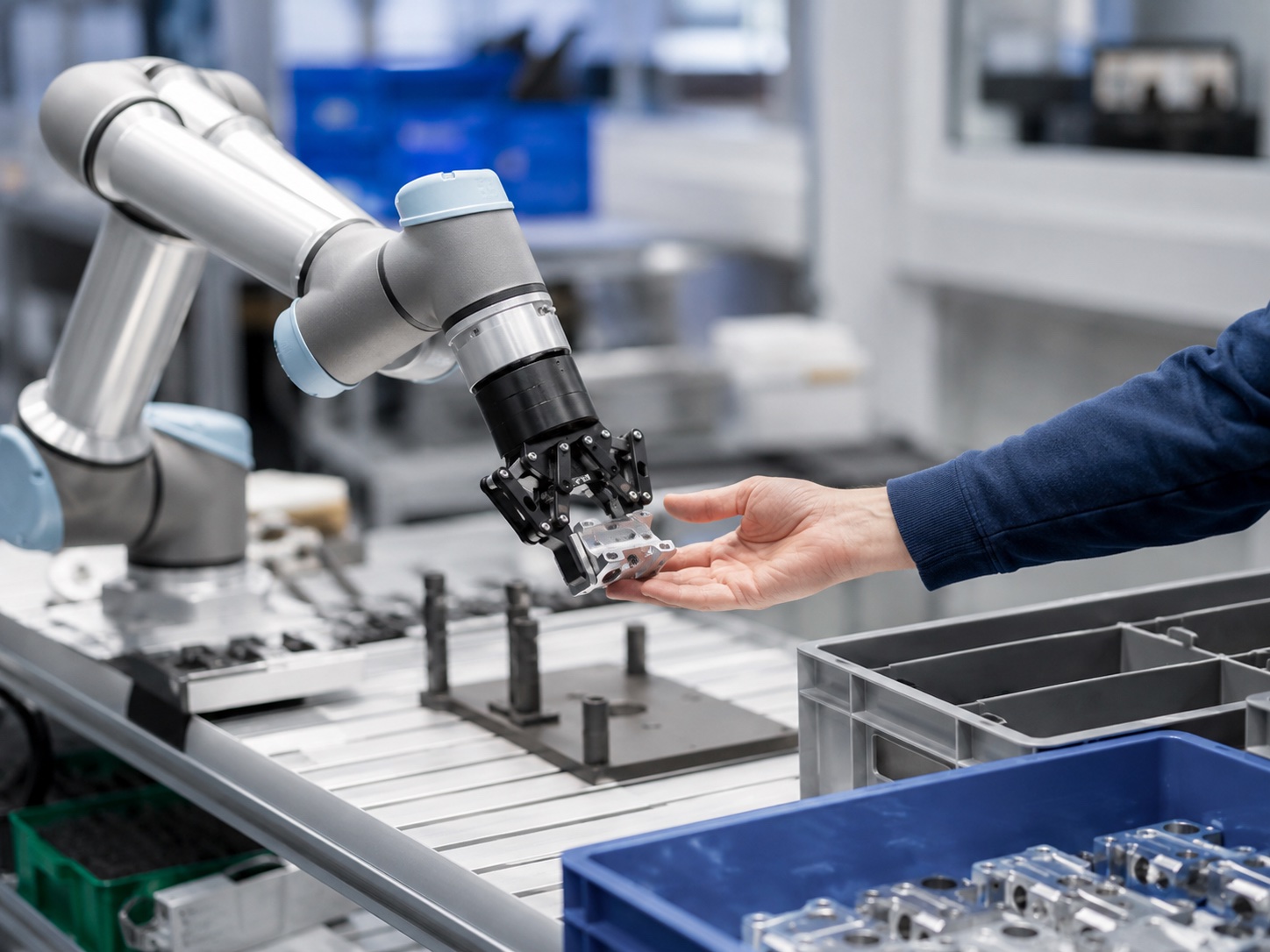
A collaborative robot, or cobot, is built to work safely beside people without a cage, using force limiting, torque sensing and speed monitoring to stop on contact. That is a different machine and a different safety standard, governed by guidance such as ISO/TS 15066, from the caged industrial robots that frame car bodies. It is also a different buyer: cobots sell into smaller shops, high-mix lines and tasks where a robot shares space with a human operator, rather than the high-volume, fully fenced cells where traditional arms dominate. That is why the two are tracked as separate markets, and why this leaderboard looks so different from the industrial one. This list counts cobots only and excludes both traditional industrial arms and humanoids. For the caged-robot picture, see our global industrial robot manufacturers ranking and the China industrial robot ranking. A note on the numbers: JAKA’s headline figure is its domestic China share rather than a global one, which is why it appears with a different basis in the table; we keep it labeled rather than silently blending the two.
1 to 4: the leader and three Chinese challengers
1. Universal Robots (Denmark)
Universal Robots created the commercial cobot category when it shipped the first model in 2008, and it still defines the market. More than 100,000 UR arms are now deployed worldwide, and its UR+ ecosystem of over 300 certified grippers, vision kits and software add-ons is a moat that rivals struggle to copy, because it turns the arm into a platform rather than a product. Its newer high-payload UR20 and UR30 extended its reach into heavier tasks like palletizing. At an estimated 15 percent of the global market it remains number one, and its lead comes as much from ease of deployment and that partner ecosystem as from the hardware itself. The practical lesson for the rest of the field is that in cobots, the arm is increasingly a commodity and the surrounding software, grippers and integrator network are where the durable advantage sits.
2. Dobot (China)
Shenzhen-based Dobot listed in Hong Kong in late 2024 and sits second globally at around 13 percent, trailing only Universal Robots. Its strength is reach: products in more than 80 countries, with close to 60 percent of revenue earned overseas, an unusually export-heavy profile for a Chinese maker. In 2025 it extended into humanoids with its Atom platform, a signal that it sees cobots as one branch of a wider embodied-AI bet. For buyers, Dobot pairs a broad arm range with aggressive international distribution, which is how it climbed so close to the top.
3. AUBO (China)
Beijing-based AUBO has led China’s cobot shipments for several years running, and its defining trait is vertical integration: by its own account more than 90 percent of core components are made in-house, which gives it control over cost and supply that resellers cannot match. Its range spans roughly 3 to 35 kilograms, covering light assembly through heavier handling, and it is deployed across industrial, new-energy, 3C, semiconductor and healthcare settings. At an estimated 11 percent of the global market it is the third-largest cobot brand and a core reason China occupies three of the top four spots.
4. JAKA (China)
Founded in Shanghai in 2014 with cobots as its only business, JAKA holds the number-one position in China’s domestic cobot market, estimated near 21.9 percent in 2024. Its client list includes names like Toyota, Schneider and Luxshare, which speaks to its credibility in demanding production environments. Its global share is lower than that domestic figure, which is why we label the basis explicitly. Even so, a pure-play cobot specialist leading the world’s largest single cobot market is a strong position, and it rounds out the all-Chinese second-through-fourth bloc. Taken together, Dobot, AUBO and JAKA show three distinct routes to scale: export reach, component self-sufficiency, and domestic dominance. That none of them relies on the same advantage is part of why the Chinese cobot push has been hard for incumbents to counter with a single response.
5 to 7: the industrial giants’ cobot lines

The next three brands share a common story: each is a heavyweight in traditional industrial robots that added a collaborative line to defend its installed base. Their cobot-specific market shares are modest next to the pure-plays above, but they carry an advantage the newcomers cannot match. A plant already running their caged robots can adopt their cobots under the same controller, the same programming environment and the same service contract, which lowers the real cost of adoption even when the sticker price is higher.
5. FANUC (Japan)
FANUC is the world’s largest industrial-robot maker by volume, and its green CRX cobots are the collaborative extension of that empire. They are strong in semiconductors and electronics, and they inherit FANUC’s reputation for reliability and long service life. Cobots are a small fraction of FANUC’s total shipments, but on the cobot-specific scoreboard the brand sits around 6 percent, the highest of the traditional industrial giants. Buyers already running FANUC industrial arms often add CRX units to keep one control environment across the plant.
6. ABB (Switzerland)
ABB’s YuMi dual-arm is a benchmark for delicate micro-assembly, the kind of two-handed, high-precision work found in electronics and pharmaceuticals. Alongside its single-arm GoFa cobots, it gives ABB a credible collaborative line that draws on the company’s deep automation heritage. Cobots are one tile in a very large portfolio, and ABB sits near 5.6 percent of the cobot market. Its appeal is precision and the backing of a global automation supplier rather than the lowest price.
7. KUKA (Germany)
KUKA’s LBR iiwa pioneered seven-axis, force-controlled collaborative work, with torque sensors in every joint that let it perform sensitive insertion and assembly tasks. It is a technically advanced machine and an early mover in safe human-robot interaction. Cobots are not the group’s core, and its cobot-market share sits near 4.9 percent, but in force-sensitive applications the iiwa remains a reference design that competitors are measured against.
8 to 10: heavy payload, vision and welding specialists
8. Doosan Robotics (South Korea)
Doosan made cobots a core business rather than a side line, and it is a global front-runner in heavy-payload collaborative arms above 20 kilograms, a segment that opens up palletizing and machine tending that lighter cobots cannot handle. It leads its home market and earns around 70 percent of revenue abroad, with North America and Western Europe driving demand. At roughly 4.4 percent of the global market, it is positioned as an emerging leader expanding quickly beyond Korea.
9. Techman Robot (Taiwan)
Techman, founded in 2016, built the first cobot with a vision system designed in rather than bolted on. Its TM series fuses AI vision with the arm for inspection, defect detection and smart sorting, which removes a whole layer of integration work for buyers who would otherwise add a separate camera system. That built-in-vision identity has won it a real position in electronics and semiconductor work, at an estimated 3.9 percent of the cobot market, and makes it the natural pick when machine vision is central to the task.
10. Yaskawa (Japan)
Yaskawa rounds out the list with its HC-series cobots, which lean on the company’s deep servo and welding heritage. Collaborative robots are not its core, and at around 3.5 percent it is the smallest share on the table, but in collaborative welding its motion-control pedigree gives it a credible niche. For shops already standardized on Yaskawa welding equipment, the HC series is a natural way to add a safe, fenceless station.
What the ranking really shows
Two patterns stand out. First, the cobot market is far less concentrated at the top than the industrial-robot market, and it is moving faster, with an estimated growth rate near 19 percent a year per MarketsandMarkets. Second, the geography is different. Where the industrial-robot top ten is dominated by Japanese and European names, the cobot top four includes three Chinese brands, because cobots are newer, cheaper to develop than heavy industrial arms, and sold heavily into Asia. According to Grand View Research, the Asia-Pacific region already accounts for more than half of global cobot revenue, which gives the Chinese leaders a large, fast-growing home base to scale from before they push abroad.
It is also worth being clear about what these share figures do and do not mean. The cobot market is young, and different analysts measure it differently, so a one-point gap between two brands is noise rather than signal. What the table captures reliably is the tier structure: one clear leader, a cluster of fast-moving Chinese pure-plays, the established industrial giants extending their brands into collaboration, and a set of specialists that win on a single strength such as heavy payload, built-in vision or welding. That structure is more durable than any single percentage.
In practice, choosing a cobot comes down to three questions more than brand rank: the payload and reach you need, whether a strong accessory ecosystem matters for your application, and how good local support and programming help are. Universal Robots wins on ecosystem, the Chinese leaders win on price and payload range, and the industrial giants win when a buyer wants one vendor across both caged and collaborative robots. The right answer is rarely just the highest-ranked name.
Key takeaways
- Universal Robots leads at about 15 percent, on the strength of its UR+ ecosystem and a decade head start.
- Three of the top four are Chinese: Dobot, AUBO and JAKA, a sharper shift than the industrial-robot table shows.
- The market is growing near 19 percent a year and is less top-heavy than industrial robots.
- Share basis varies: JAKA’s headline figure is domestic China share, which we label rather than blend.
Frequently asked questions
Which company is the leader in collaborative robots?
Universal Robots of Denmark is the market leader. It created the commercial cobot in 2008 and has more than 100,000 units deployed worldwide, with an estimated 15 percent of the global cobot market.
What is the difference between a cobot and an industrial robot?
A collaborative robot, or cobot, is built to work safely alongside people without a cage, using force limiting and sensors. A traditional industrial robot is faster and stronger but must be fenced off. The two are tracked as separate markets.
Are Chinese cobot brands competitive globally?
Yes. Three of the top four cobot brands by market share are now Chinese: Dobot, AUBO and JAKA. They combine high domestic share with fast-growing exports and broad payload ranges.
How big is the collaborative robot market?
According to MarketsandMarkets, the global cobot market is projected to grow from about 1.4 billion dollars in 2025 to 3.38 billion dollars by 2030, a compound annual growth rate near 18.9 percent, making it the fastest-growing segment of robotics.
Choosing a cobot with export support
The brands above set the global benchmark. Buyers also weigh certification and after-sales reach as heavily as rank, especially for cross-border projects. EVST builds its own XR series cobots, including XR-EX explosion-proof models, ships robotic systems to more than 100 countries, holds IATF16949 automotive-grade certification along with CE, SGS and TÜV third-party marks, covers the full payload spectrum from collaborative to heavy-duty arms, and runs a global field-engineer dispatch network for installation and support.
For a quote tailored to your project, including application review and configuration recommendation, email sales@evsrobot.com or message us on WhatsApp / WeChat. Typical response within 24 hours.
About the data: cobot market size from MarketsandMarkets; per-brand shares are estimates drawn from industry reporting and differ by methodology, so they are approximate. JAKA’s figure is domestic China share where noted. Provided for industry information, not investment advice.