
A cartoning machine, or cartoner, takes flat carton blanks, opens each one into a carton, loads the product (often with a folded leaflet), and closes the carton with tuck-in flaps or hot-melt glue. EVST builds four types: horizontal and vertical cartoners, each in an intermittent and a continuous version. Depending on the type and the carton size, they run at 40 to 120 cartons per minute.
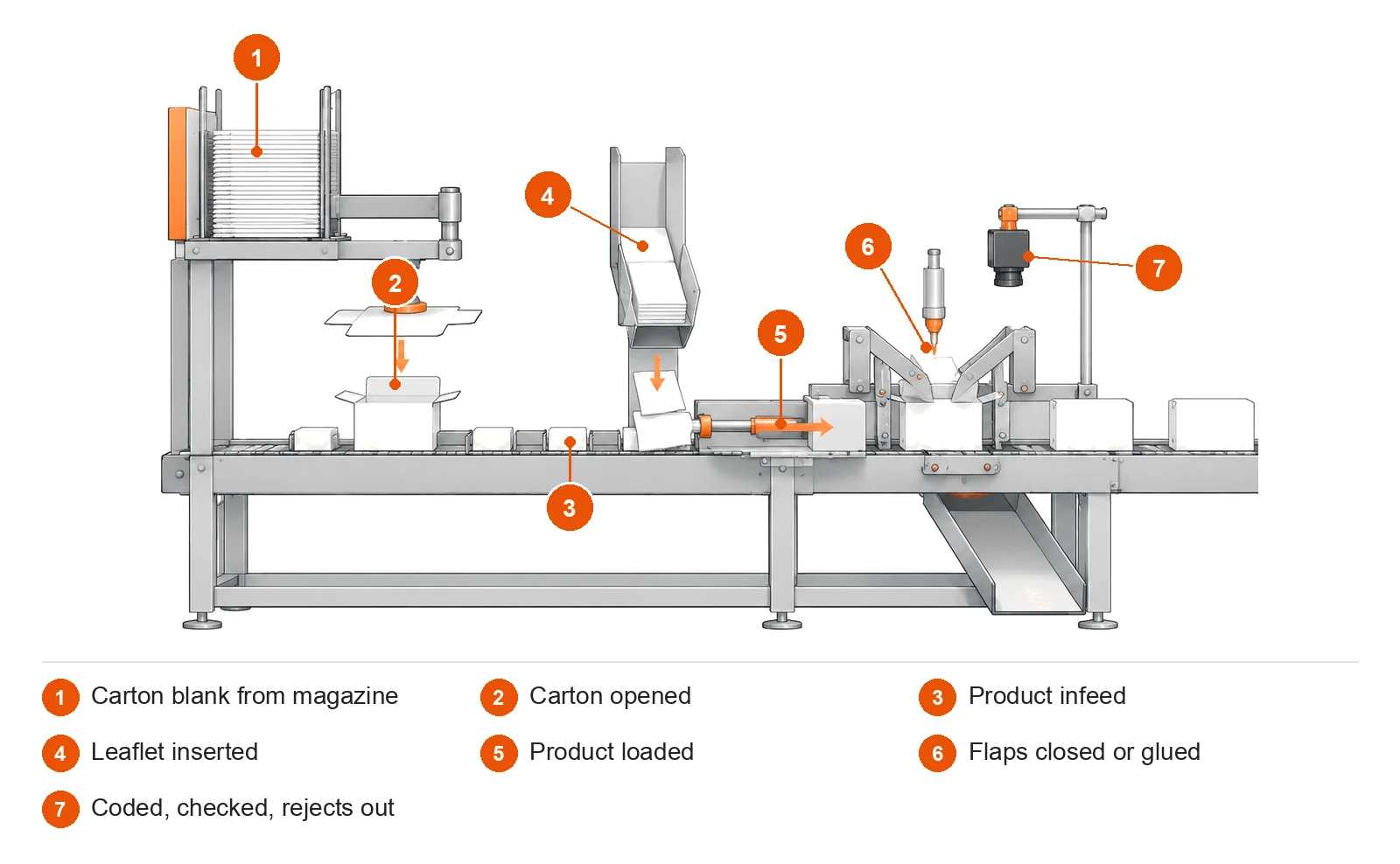
Four types of cartoning machine compared
The figures below are the machines we build. Speeds depend on carton size, and the carton sizes are length × width × height.
| Typ | Carton size (L × W × H) | Rýchlosť | Vhodné formáty produktov | podrobnosti |
|---|---|---|---|---|
| Horizontal, intermittent | 70–160 × 25–100 × 16–40 mm, or 60–220 × 25–120 × 20–70 mm (two versions) | 50 kartónov/min | Contact lenses, dental implants, other Class III medical devices | Horizontálny kartónovací stroj |
| Horizontal, continuous | 100–220 × 25–120 × 25–65 mm | 120 kartónov/min | Candy pouches, snack packs, personal-care gift sets, plug-in mosquito repellent kits | Horizontálny kartónovací stroj |
| Vertical, intermittent | 20–80 × 20–65 × 60–200 mm (60 cartons/min) or 20–40 × 20–65 × 60–200 mm (40 cartons/min) | 40–60 kartónov/min | Hair dye kits, serum and spray bottles, lipsticks, skincare bottles | Vertikálny kartónovací stroj |
| Vertical, continuous | 40–200 × 40–100 × 40–200 mm | 100 kartónov/min | Baby pacifiers | Vertikálny kartónovací stroj |
Horizontal or vertical cartoner: how to choose
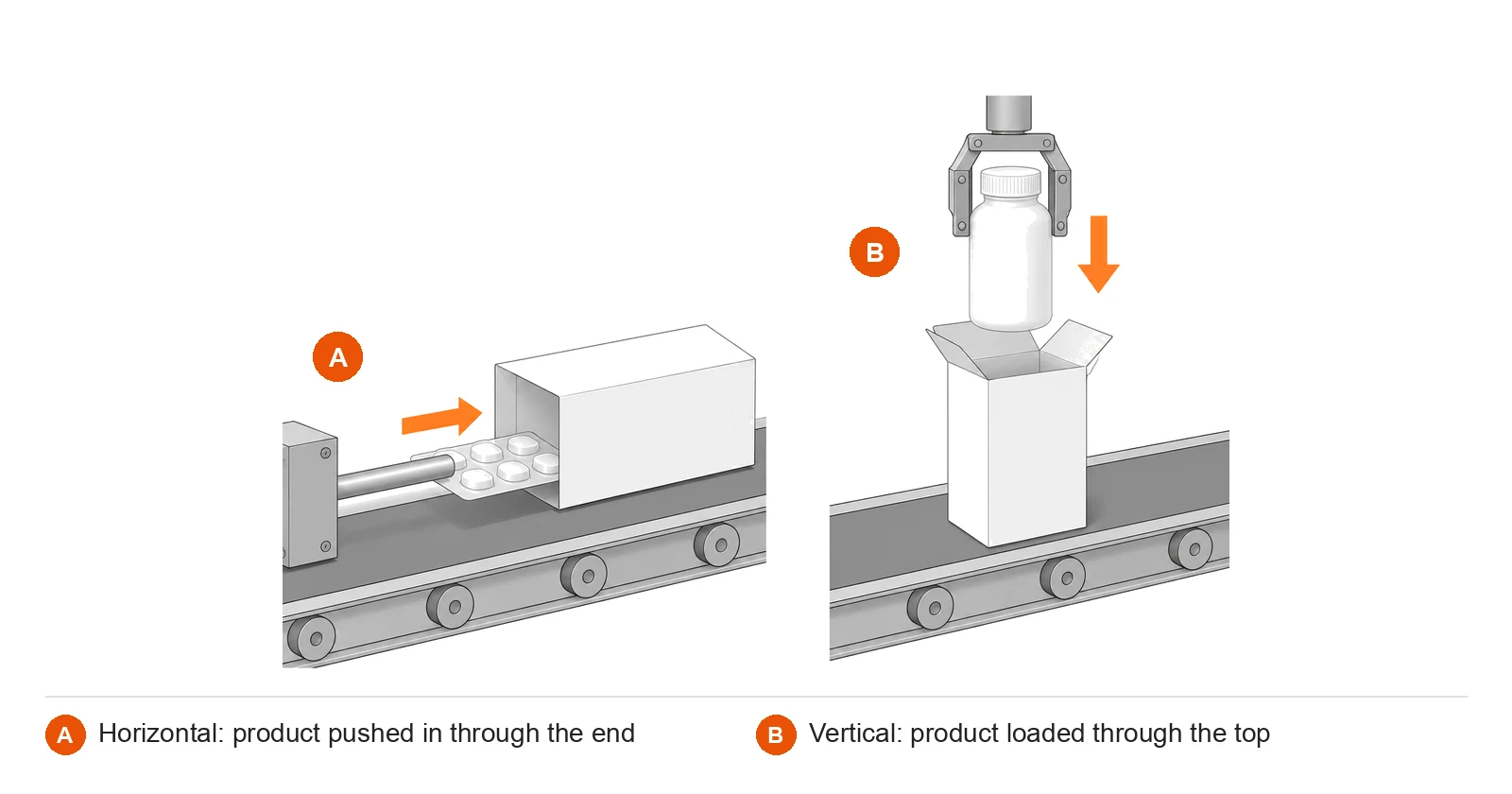
The two orientations differ in how the product gets into the carton. On a horizontal cartoner, the carton lies on its side and the product is typically pushed in through the open end. On a vertical cartoner, the carton stands upright and the product is typically loaded through the top, by gravity or by a pick-and-place unit. Pushing typically suits regular, flat or solid items at speed, while top loading is typically gentler on irregular or fragile products and keeps bottles standing. The exact process steps are configured for each product and project.
Suitable product formats follow that split:
- Horizontálne: flat or blister-packed items such as contact lenses and dental implants, sachets, candy pouches, and kits that lie flat in the carton.
- Vertikálne: products that should stay upright, such as bottles, tubes, lipsticks and pacifiers, often with a leaflet beside them.
Intermittent or continuous: speed and handling
Within each orientation, the continuous version is the faster one: 120 cartons/min horizontal and 100 cartons/min vertical, against 50 and 40–60 cartons/min for the intermittent versions. The way the product is handled also differs.
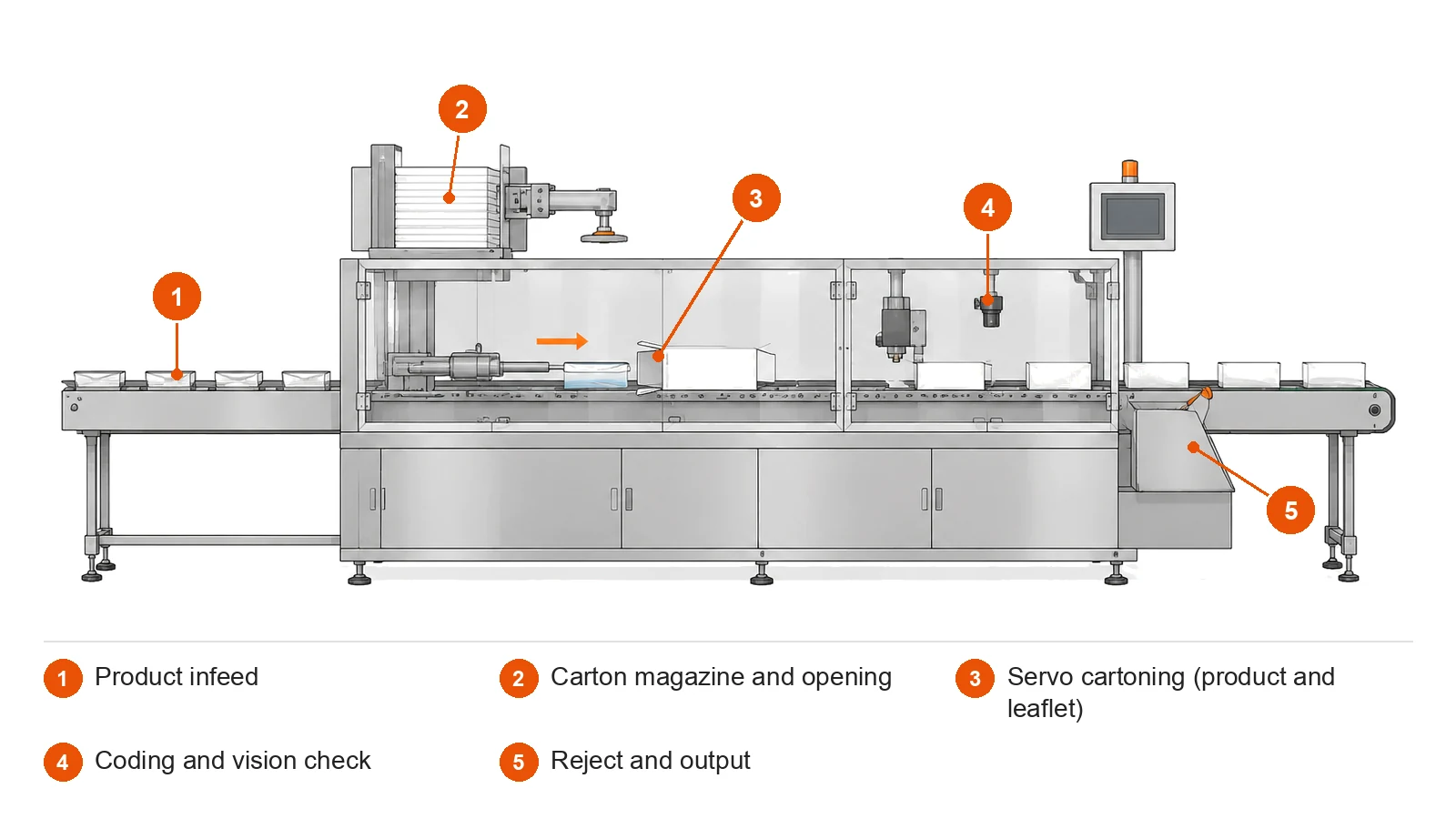
- Horizontal continuous: several pushers move product into the cartons without stopping, and an electronic cam ties the motions together so the speed is set with one key on the HMI.
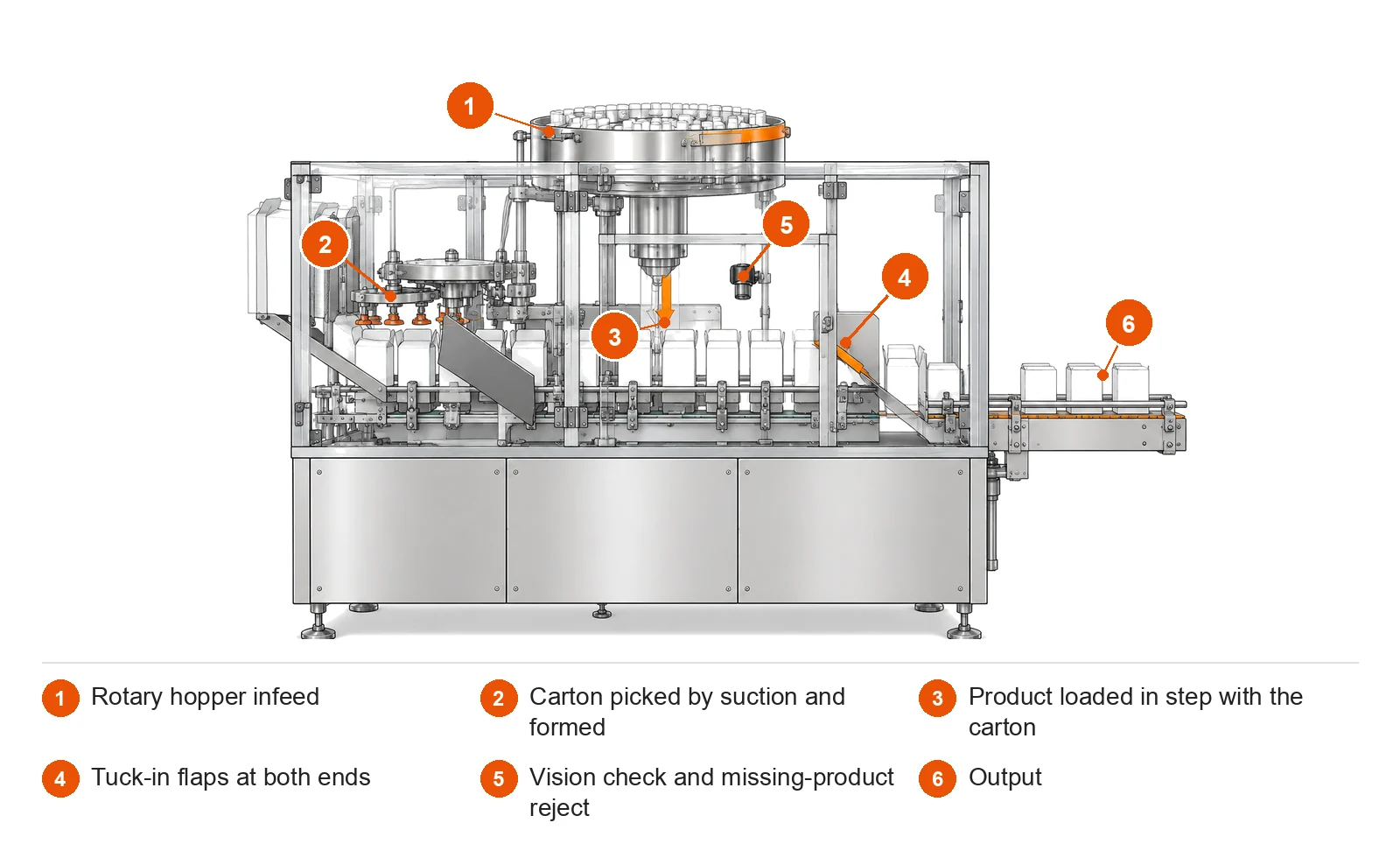
- Vertical continuous: loose product goes into a rotary hopper and travels in step with the carton stations below it, so loading never waits for the carton to stop.
- Horizontal intermittent: a servo-driven machine with a simplified mechanism and fewer wear parts, suited in particular to contact lenses and dental implants, and linked with vision inspection and 2D-code traceability.
- Vertical intermittent: product can be loaded by a robot, the cartoning module lifts and adjusts as a unit, and a change of product is a recipe change with one key.
Faster is not always the goal. On the Class III medical device lines described here, every step has a camera check, so the line runs at a modest pace and the intermittent cartoner fits it.
What a cartoner can add
Most cartoning jobs need more than “box it”. The options below are used on the cartoners and cartoning lines we build:
| voľba | Čo to robí |
|---|---|
| Leaflet folding or block leaflet feeding | Folds a leaflet or feeds a pre-folded block leaflet into each carton |
| Batch printing and inkjet coding | Prints the batch number or code on the carton |
| Záverečný | Tuck-in flaps at both ends, tab locks, or hot-melt glue |
| Missing-product and missing-carton detection | No product, no carton opened; no carton or a missing carton pauses the machine with an alarm |
| Odmietnuť stanicu | Removes cartons with a missing product or a failed check |
| Checkweighing with reject | Weighs each filled carton and rejects off-weight cartons |
| Vision inspection and code reading | Checks the printed code and label and links the carton code to the batch |
Cartoning problems that shaped the machine design
These are situations from cartoning lines we have built. Each one changed how the cartoner or its infeed was laid out; the right design for your product is worked out for each project.
- Identical cartons, different contents. Contact lenses of different powers go into cartons that look the same. Each blister is scanned and the line’s information system matches it to its carton, which is what lets the line switch from one power to the next, for example from 1.50 D to 2.00 D, without stopping.
- Blisters of different heights. Dental implant blisters are not all the same height. Each blister is lifted to a set position before it goes into the carton, and the small label is applied at a fixed locating point so it lands in the same place every time.
- Two layers in one carton. For garden nutrient bags packed two layers to a carton, a small baffle adds just enough drag to keep the bags from running loose as they are pushed in. Blocking them completely would stop the flow.
- Two products in one carton from a random infeed. When products A and B arrive in no order and must share a carton at speed, a vision system locates them, pick-and-place loads them, and the carton waits at the station until both are in. On that job this was much faster than a mechanical sorting layout.
- A liner box inside the outer carton. For cosmetics packed with an inner liner, the gap between liner and carton is small, so loading has to be precise. After loading, the carton is glued and closed.
- Straight into the shipping box. On a line for baby rice cereal, the filled cartons are packed directly into e-commerce shipping boxes.
- Odd shapes and tight floors. Octagonal candy gift boxes need their own carton handling, and in a small workshop the conveyors were raised overhead to route around the floor space.
Where the cartoner sits in a packaging line
Upstream, the cartoner is fed by whatever makes the primary pack: a filler, capper and labeler for bottles, a counting magazine for sachets, or a blister machine in pharmaceutical lines, which typically hands blisters directly to the cartoner. Downstream, lines typically add checkweighing and coding, then wrapping, shrink-wrapping or case packing. The exact process steps are configured for each product and project.
On lines we have built, the cartoner is followed by coding or labeling, vision inspection with rejection, and case erecting, packing and sealing. See the automatizovaná baliaca linka overview for the full sequence, the automatický etiketovací stroj for carton and corner labels, and piece picking or group transfer for case packing for the step after the cartoner.
What to send for a cartoning machine quote
- Product samples, and the carton blanks or dielines for every carton size
- The leaflet, if one goes in, and whether it arrives flat or pre-folded
- The number of SKUs and carton sizes the cartoner will run
- Target output in cartons per minute
- Closing method (tuck-in flaps, tab lock or glue), and what has to be printed on the carton
- What comes before and after the cartoner on your line
The main cost drivers are the cartoner type, the range of carton sizes, the options above, and the inspection and traceability the line needs. Factory testing time also grows with the number of SKUs to be run. EVST quotes per project after reviewing your samples.
Bežné otázky
What is a cartoner?
A cartoner is a cartoning machine: it opens flat carton blanks, loads the product and any leaflet, and closes the carton with tuck-in flaps or glue. EVST builds horizontal and vertical cartoners, each in intermittent and continuous versions, running at 40 to 120 cartons per minute depending on carton size.
What is the difference between a horizontal and a vertical cartoning machine?
A horizontal cartoning machine typically pushes the product into a carton lying on its side, which suits flat, blister-packed and solid items at speed. A vertical cartoning machine typically loads from the top into an upright carton, which suits bottles, tubes and fragile items. The exact process steps are configured for each product and project. EVST’s horizontal cartoners run at 50 or 120 cartons per minute and its vertical cartoners at 40 to 100, depending on version and carton size.
How many cartons per minute can a cartoning machine run?
On the cartoners we build: 50 cartons/min for the horizontal intermittent version, 120 for horizontal continuous, 40 or 60 for vertical intermittent, and 100 for vertical continuous. Actual speed depends on carton size and on the checks the line carries.
Can one cartoner handle several carton sizes?
Yes, within its carton size range. The horizontal continuous cartoner is built to handle a wide range of cartons, and on the vertical intermittent cartoner the cartoning module lifts and adjusts as a unit, with product changes stored as recipes. Which carton sizes are tested before shipment is agreed for each project.
What happens if a product or carton is missing?
On the horizontal continuous cartoner, sensors check the whole process: if no product arrives, no carton is opened, and if a carton is missing, the machine pauses and raises an alarm. On the vertical continuous cartoner, cartons with a missing product are rejected before output.
príbuzný
- Horizontálny kartónovací stroj
- Vertikálny kartónovací stroj
- Automated packaging line: filling to case packing
- Medical device packaging line
- Automatic case packing equipment acceptance
Speeds and carton sizes are machine figures and depend on the carton. The cartoner for your product is selected and confirmed for each project.