
Put a reversed water meter in the receiving carrier before choosing between a fixed stop and conveyor tracking. If it can seat in both directions, change the carrier so that only the required orientation seats, or check the dial orientation before accepting the handoff. Conveyor tracking tells the robot where a carrier is along the line. The meter and carrier still need a way to establish which way the dial faces.

Test with a meter that arrives the wrong way round
In the filmed water-meter transfer, the wrist turns by the rear fixtures. The tool then carries a round meter over the green rail and lowers above the front carrier with blue locators. Watch the turn and the approach to the carrier in the wide view and the close-up. On your own drawing, mark the required dial direction and which outside surfaces the tool may touch. Try the meter in the opposite orientation and with the variant that offers the least clearance around its connections.
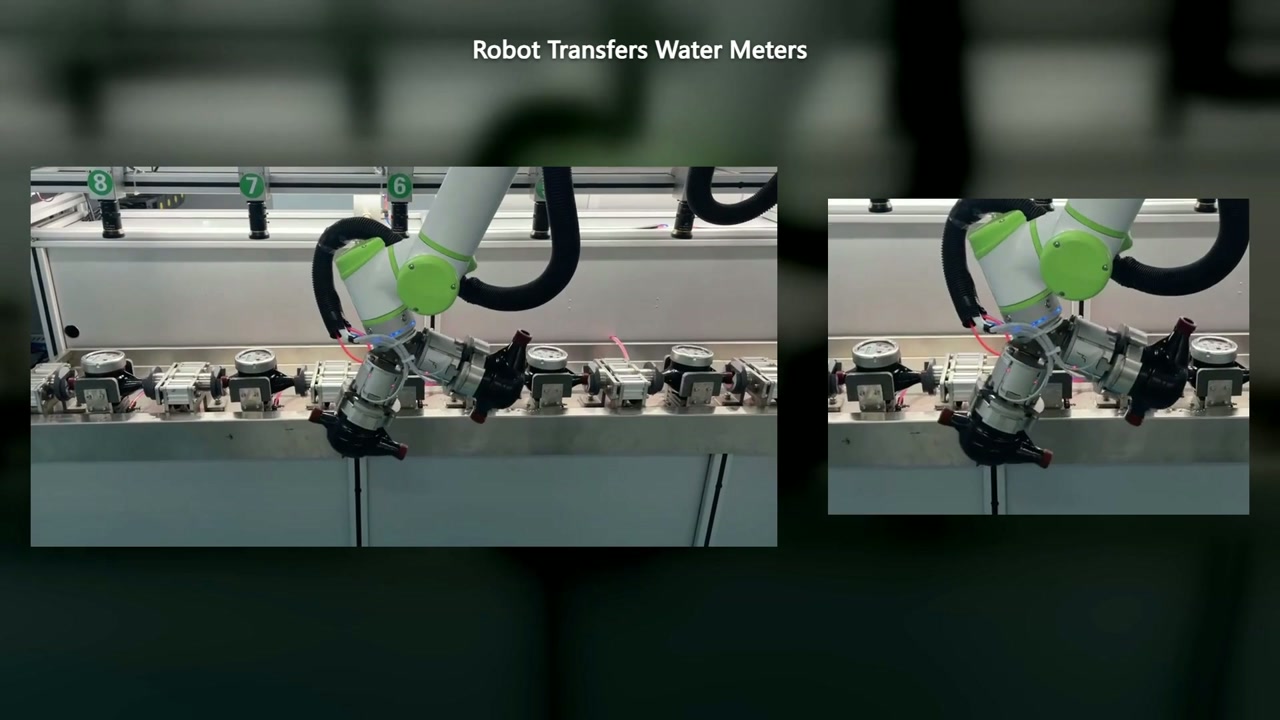
00:20 in the video. The wrist turns beside the rear fixture row.
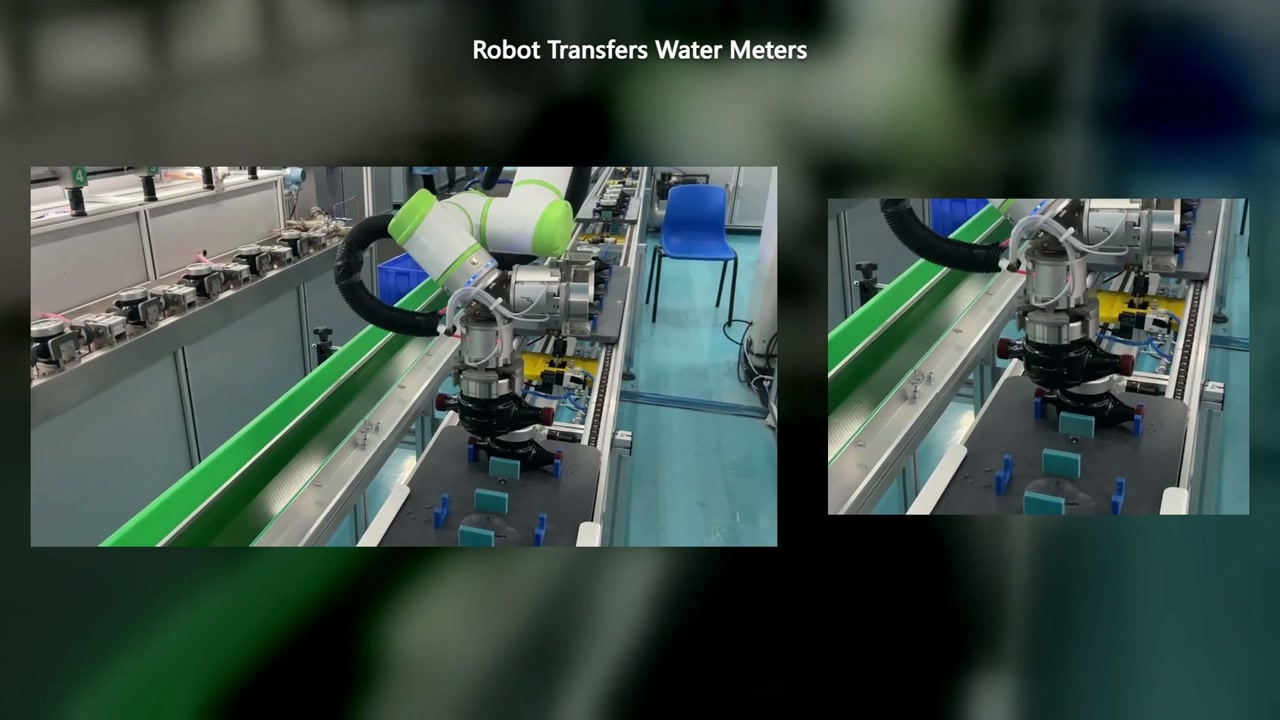
00:33 in the video. The tool lowers above the front receiving carrier.
A carrier may constrain a round body while leaving it free to turn. If the ends have distinct shapes, use a feature such as a connection or a flat on the outside body as the locating reference. If the same carrier must accept meters whose locating features differ, test a separate orientation check against each variant. Set your pass condition before the test: a reversed meter should either fail to seat or be flagged before the next operation.
Choose a transfer arrangement that can handle a rejected meter
| Layout | Wielt et wann | Verify with a wrong-way meter |
|---|---|---|
| Fixed stop | The receiving carrier can wait at a repeatable transfer point. | Confirm what holds the carrier while the meter is rejected and whether the next station can keep working from a buffer. |
| Conveyor tracking | The carrier must continue moving and its position can be measured reliably. | Confirm whether the robot can clear the rejected handoff within its reachable window and whether the empty carrier can be identified downstream. |
When asking EVST to review the handoff, include a photo of both meter orientations in the same receiving carrier. Mark the dial direction that the next operation needs and explain what happens to a carrier that passes through empty.