
We choose the washing route from the surface that must be treated, the contamination to remove and the part’s presentation. Fixed nozzles can suit a stable part and carrier arrangement. A robot-held lance is worth comparing when different faces need different approach directions or the part family changes. In either route, we integrate the liquid circuit and wet-area protection with the motion; moving a nozzle is only one part of the system.
Watch the hanging-part spray operation
The footage shows a covered robot holding a long lance and directing a fan-shaped liquid spray at a large hanging formed metal part. Its direction changes near the lower and side edges. The hanging arrangement, the lance and the surrounding wet enclosure are all relevant to the integration layout.
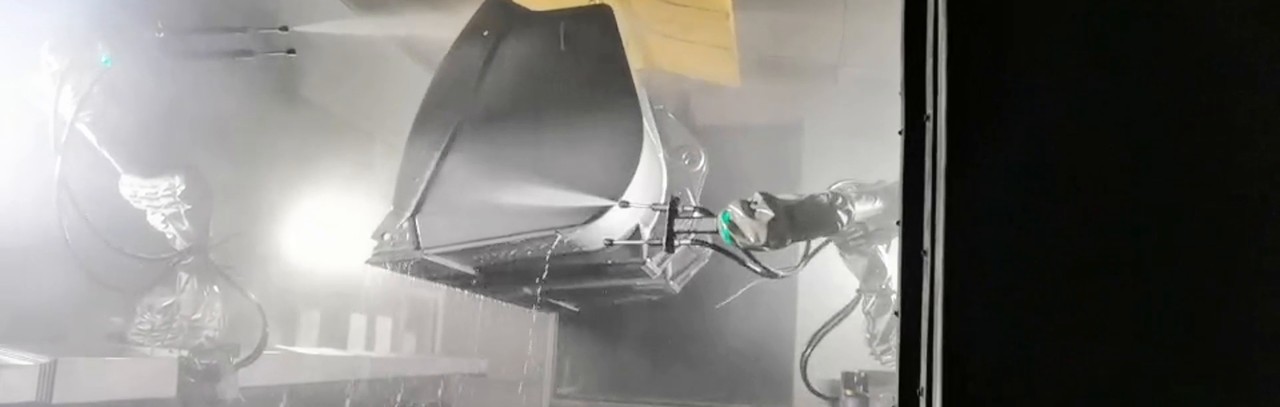
Main film 00:03 — A suspended sheet-metal part is in front of the lance, with its front surface and spray direction visible.
Compare the two ways of reaching the difficult surface
We first mark the required surfaces on the actual part in its intended hanger. A return edge, recess or hanging contact can obstruct a direct spray path. The proposal must show how liquid reaches that location, rather than adding pressure to an unchanged direction.
Nozzle type, target distance, pressure and flow interact. Bringing a nozzle closer can increase impact while narrowing its footprint. That may call for another pass or a different orientation to cover the same region. We therefore choose those variables together with the route and the available liquid supply.
| Suunnittelukysymys | Fixed nozzle arrangement | Robot-held lance |
|---|---|---|
| Stable repeat part and hanger | Lay out the nozzle directions against the repeated presentation | Define the programmed approach and the part reference |
| Hidden return edge | Add a useful spray direction or change the part presentation | Bring the lance to a usable direction with tool/hose clearance |
| Changes in part shape | Assess the nozzle, hanger or setup changes needed | Assess recipe and path changes within the reachable region |
| Käsittelyaika | Set the exposure within the selected wash arrangement | Assign processing passes and transitions to the required surfaces |
For the robotic option, we plan the full lance and hose route. Where the process permits, fluid-on sections can be tied to the processing path, with the valve state defined during transitions. The pump, valve and robot sequence need an agreed interface; a taught path by itself does not define liquid delivery.
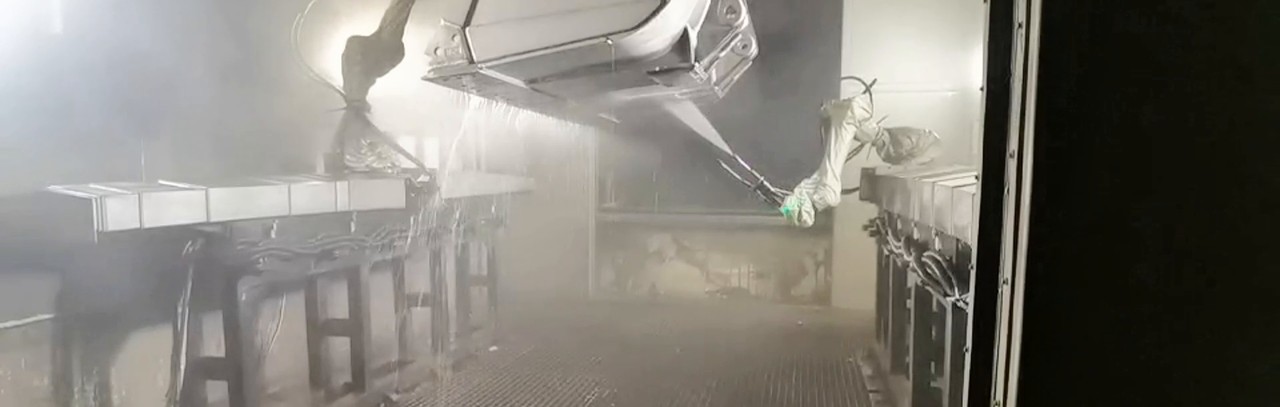
Main film 00:25 — The view shows the relationship between the lower part edge and the lance to illustrate spray direction.
Design what goes to the nozzle and what comes back
We specify the supply concept alongside the path: the selected medium, required supply condition, filtration or media treatment, collection and return arrangement, and bath maintenance where liquid is reused. Removed contamination enters the liquid circuit, so the condition of reused liquid belongs in the process plan.
That creates practical layout decisions. Provide access to filters and service points without disturbing the robot setup. Route collected liquid to the intended return or disposal arrangement. Include drainage from pockets and the hanger, and decide whether the next operation needs a separate drying stage. The appropriate medium and acceptance limits come from the actual contamination and downstream requirement.
For the next process after washing, our post-wash drainage and mist-isolation review connects residual-liquid flow, collection, waiting time and access around the cell.
Specify protection for the wet installation
A robot cover, body sealing, protected cable entry and cabinet location are separate design items. We assess them against spray exposure, temperature and the selected medium. Published cleaning-robot designs use combinations such as sealed construction, protected materials, internal cabling and monitored positive pressure. We evaluate those as equipment options rather than treating a sleeve as the whole protection specification.
If a positive-pressure package is selected, its supply, monitoring and response to a lost-protection condition belong in the control scope. The same review covers hose routing through repeated reversals, maintenance access and how the installation can be cleaned and serviced.
Choose the route with a comparable dirty-part trial
Use actual contaminated parts on the intended carrier. Keep the starting condition and agreed process variables comparable between proposals. Record where the spray arrives, then assess the specified removal result and material compatibility with the chosen inspection method. Include the difficult variant and the loaded hanger, not just an easy exposed face.
Use the trial to decide whether fixed directions are sufficient, whether a moving lance earns its additional motion, or whether the limiting issue lies in the medium or liquid circuit.
For an EVST integration discussion, send front/back part and hanger photographs, examples of the contamination, the next operation’s requirement and the product-change pattern. We can use them to develop the nozzle route, liquid-interface and protection scope before selecting the cell configuration. Discuss the hanging-part washing system.