
By the EVST Engineering Team · Last updated: July 15, 2026
A palletizing robot cell typically costs more than the robot arm alone: total capex spans the robot body, the end-of-arm tool, safety fencing and scanners, integration and commissioning, and programming. According to industry observations, most cells pay back within 12–24 months in multi-shift operations, with the robot itself usually representing only a third to half of the total budget.
Why the Robot Price Tag Isn’t the Full Story
Buyers researching palletizing robot cost often start with a single number in mind, the price of the robot arm, and are surprised when a quoted system comes in two to three times higher. That gap is not markup. A palletizing cell is a system: the robot manipulates pallets or cases, but the gripper, the safety perimeter, the controls integration, and the programming that ties them together are what actually make the line run unattended. Our complete guide to robotic palletizers covers robot types and selection criteria in depth; this article focuses narrowly on what a palletizing cell costs, how the capex breaks down, and how to work out when it pays for itself.
What Drives Palletizing Robot Cost: Five Capex Line Items
Manufacturers including FANUC, ABB, KUKA, Yaskawa, and EVST all sell palletizing-capable robots, but the robot itself is only one of five cost centers that show up on a typical system quote. Understanding each one is what lets a buyer compare quotes on an apples-to-apples basis instead of anchoring on the robot list price.
1. Robot Body
The base hardware cost scales primarily with payload class, not brand prestige. A compact 4-axis palletizing robot rated for light cartons costs meaningfully less than a heavy-payload unit built for full pallet loads or bagged bulk goods. According to industry observations, the robot body typically accounts for roughly a third to half of total system cost, with the remainder distributed across the four items below.
2. End-of-Arm Tooling (EOAT / Gripper)
Grippers for palletizing are application-specific: vacuum cups for cartons and bags, mechanical clamp grippers for crates and drums, or multi-zone tooling for mixed-SKU pallets. EOAT cost varies with the number of pick zones, product variability, and whether the tool needs quick-change capability for multiple SKUs on the same line. This line item is frequently underestimated in early budgeting because a single gripper design rarely covers every product a facility runs.
3. Safety Fencing and Scanners
Under ISO 10218-2:2025, cell-level risk assessment and safeguarding are the system integrator’s responsibility, not the robot manufacturer’s. That means perimeter fencing, light curtains or area scanners, interlocked gates, and safety-rated PLCs are priced separately from the robot and typically represent a meaningful share of total cost, particularly for cells with frequent operator access for pallet or product changeover.
4. Integration and Commissioning
This covers mechanical installation, electrical connection, PLC and HMI integration with upstream conveyors or wrapping equipment, and on-site commissioning and testing. Integration cost is where labor rates and travel distance from the integrator’s base matter most, and it is the line item most sensitive to how much of the surrounding line (conveyors, stretch wrappers, label applicators) already exists versus needs to be built.
5. Programming and Software
Pattern programming (how layers and pallets are built), palletizing software licenses, and any vision-guided pick logic for mixed loads fall under this line. Standardized single-SKU patterns program faster and cheaper than mixed-case, interlocking pallet patterns that require collision checking and layer optimization software.
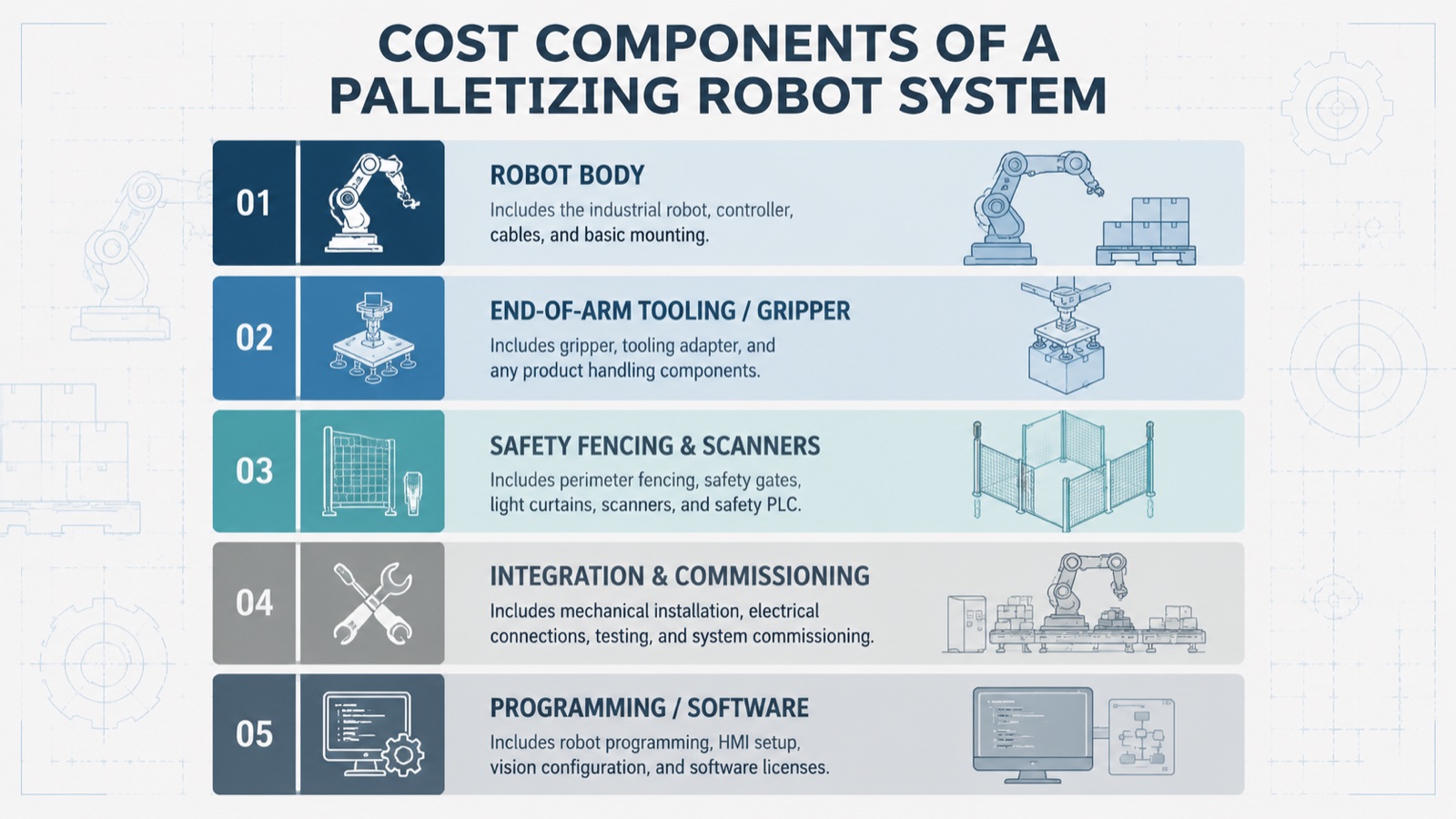
According to industry observations, integration and commissioning combined with safety guarding commonly account for as much of a palletizing cell’s total cost as the robot and gripper together, which is why comparing “robot price” alone across suppliers gives an incomplete picture. EVST quotes palletizing cells as a complete package (robot, EOAT, guarding, and commissioning) rather than pricing the robot in isolation and leaving the rest for the buyer to source separately.
Price Bands by Payload Segment
Payload class is the single biggest driver of total system cost, because it determines robot frame size, gripper capacity, and often the footprint of the safety perimeter. The ranges below reflect industry-typical budgets for a complete cell (robot, EOAT, safety guarding, integration, and programming), not a robot-only list price.
| Payload segment | Example EVST 4-axis model | Payload | Typical complete-cell budget* | Typical use case |
|---|---|---|---|---|
| Light | QJRB15-1 | 15 kg | Lower five-figure to mid five-figure USD range | Case and carton palletizing, frequent SKU changeover |
| Mid | QJRB30-1 | 30 kg | Mid to upper five-figure USD range | Standard single-line case or bag palletizing |
| Heavy | QJRB180-1 | 180 kg | Upper five-figure to low six-figure USD range | Bagged goods, multi-SKU end-of-line, bulk containers |
| Extra-heavy | QJRB800-1 | 800 kg | Six-figure USD range | Full pallet loads, drums, building-materials handling |
*According to industry observations across the payload classes above; actual pricing depends on gripper complexity, safety-zone footprint, controls scope, and site conditions. EVST does not publish fixed list prices; request a configuration-specific quote through the 4-axis palletizing robot selection guide.
Calculating Payback: The ROI Formula
The payback calculation for a palletizing robot is straightforward once the capex is known: divide total system cost by the monthly value the cell delivers, whether that value comes from labor cost avoided, throughput gained, or reduced product damage and waste.
Payback period (months) = Total system capex ÷ (Monthly labor cost avoided + Monthly value of reduced damage/waste + Monthly value of throughput gained)
For illustration, consider a mid-segment cell. A facility running two shifts of manual palletizing might, according to industry observations, avoid roughly $3,500–$5,000 per month in fully loaded labor cost by reassigning that headcount, plus another $500–$1,500 per month in reduced product damage from more consistent stacking. Against a mid-segment complete-cell budget, that combination commonly lands the payback period in the 12–24 month range cited earlier, though single-shift operations with lower labor rates or lighter throughput will see the calculation stretch closer to 24–36 months.
In practice, EVST’s field engineers find that the fastest-payback deployments share two traits: multi-shift or continuous operation (which amortizes the same capex against more throughput hours), and an existing pain point around injury risk or product damage from manual stacking, which adds savings beyond raw labor cost. According to the International Federation of Robotics, material handling and palletizing applications remain among the largest categories of industrial robot installations worldwide. That volume has helped push robot hardware pricing down over time, even as integration and safety costs have stayed comparatively fixed.
Buy vs Lease: Which Fits Your Operation
Purchasing a palletizing cell outright is the most common path for facilities with predictable, ongoing throughput, since it avoids recurring financing cost and the equipment appears as a depreciable capital asset. Leasing or equipment financing, typically arranged through regional leasing companies or bank equipment-finance programs rather than the robot supplier directly, can lower the upfront cash outlay and is more common for facilities piloting automation on a single line before committing capital to a broader rollout, or for seasonal operations where a cell is not run year-round.
The trade-off is straightforward: financing spreads cost over time but adds interest expense, which extends the effective payback period relative to a cash purchase. For most manufacturers evaluating a first palletizing robot, the decision comes down to whether the facility’s cash-flow position or its balance-sheet depreciation strategy takes priority, a question worked through with the buyer’s own finance team using the capex figures and payload segment above as inputs.
China Sourcing Cost Advantage
A meaningful share of total palletizing robot cost is the robot body and EOAT hardware itself, and sourcing from Chinese manufacturers has become a standard cost-optimization lever for buyers outside China, alongside established suppliers in Japan, Germany, and the United States. According to industry observations, Chinese-manufactured industrial robots commonly carry a lower hardware price point than comparable-spec Western or Japanese models, reflecting domestic supply-chain scale for servo motors, reducers, and controllers rather than a reduction in build quality.
EVST manufactures its QJRB palletizing robot line in China and ships to 100+ countries, with IATF16949 automotive-grade certification on its production line and CE, SGS, and TUV third-party certification on its products. Based on field deployment, EVST’s engineering team notes that the hardware cost advantage from China-based manufacturing is most pronounced at the heavy-payload end of the range, where servo and gearbox content scales up fastest, and least pronounced at the light end, where global pricing across brands is already fairly competitive.
According to industry observations, the total landed cost advantage of a China-sourced palletizing cell depends heavily on import duties, freight, and local commissioning support, not hardware price alone. On the commissioning side, EVST’s global field-engineering network means integration and startup support does not require flying a technician from China for every installation, which is one of the larger swing factors in that landed-cost comparison.
Frequently Asked Questions
How much does a palletizing robot cost in 2026?
A complete palletizing cell, including the robot, gripper, safety guarding, integration, and programming, typically ranges from the lower five figures for a light-payload 4-axis system up to six figures for a heavy-payload cell rated for full pallet loads, according to industry observations. The robot arm itself usually accounts for only a third to half of that total; EOAT, safety fencing, and integration make up the rest. EVST does not publish fixed list prices; request a configuration-specific quote for an exact figure.
What is the ROI or payback period of a palletizing robot?
According to industry observations, most palletizing robot cells pay back within 12–24 months in multi-shift operations, driven primarily by labor cost avoided and secondarily by reduced product damage and more consistent stacking. Single-shift or lower-throughput operations typically see payback stretch closer to 24–36 months. The payback formula is total system capex divided by monthly labor, waste-reduction, and throughput value combined.
Is it cheaper to buy or lease a palletizing robot?
Buying outright avoids recurring financing cost and is typically the lower total-cost option for facilities running the cell continuously or across multiple shifts. Leasing lowers the upfront outlay and suits pilot deployments or seasonal operations, but adds interest expense that extends the effective payback period compared to a cash purchase.
What is included in the total cost of a robotic palletizer, beyond the robot itself?
A complete cell budget includes the robot body, end-of-arm tooling (grippers or vacuum cups), safety fencing and scanners required under ISO 10218-2:2025 cell-level risk assessment, integration and commissioning labor, and pattern-programming or palletizing software. Buyers comparing “robot price” alone across suppliers are typically comparing incomplete quotes.
How much does a 4-axis palletizing robot cost compared to a 6-axis robot?
4-axis robots, purpose-built for palletizing motion, generally cost less than a comparable-payload 6-axis robot configured for the same task, because the simpler kinematic structure requires fewer servo axes and less complex controls. Our 4-axis palletizing robot selection guide covers when a 4-axis unit is sufficient versus when a 6-axis robot’s added wrist flexibility is worth the incremental cost.
Where to Go Next
For robot types, selection criteria, and the broader palletizing decision, see our complete guide to robotic palletizers. For industrial robot pricing beyond palletizing applications, see our industrial robot cost and pricing guide. For a configuration-specific quote on a 4-axis palletizing cell sized to your payload and throughput, see EVST’s 4-axis palletizing robot selection guide or reach the team through the contact page.
About the author: The EVST Engineering Team writes about industrial robotics and automation economics for operations and finance leaders evaluating automation capex. EVST (EVS TECH CO., LTD), founded in Chengdu in 2018, has delivered 600+ automation projects and ships to 100+ countries, with IATF16949 automotive-grade certification and CE / SGS / TUV third-party certifications across its QJAR/QJRB industrial and palletizing robot lines.
Last updated: July 15, 2026