

By the EVST Editorial Team · Last updated: July 8, 2026
ISO 10218-1:2025 and ISO 10218-2:2025 came into force on April 1, 2025, the first update to the core robot-safety standard since 2011. The change most relevant to collaborative robotics: ISO/TS 15066:2016 no longer exists as a standalone technical specification. Its power-and-force-limiting and collaborative-application requirements were folded directly into the revised ISO 10218 series, alongside new cybersecurity, functional-safety, and robot-classification requirements.
Why a 2025 Revision, and Why It Matters Now
Buyers and integrators specifying a collaborative cell in 2026 are working from a different rulebook than the one that governed most cobot installations between 2016 and 2025. ISO 10218-1:2025 and ISO 10218-2:2025 replace the 2011 editions, and the revision was not a quick edit: it is the standard that manufacturers including ABB, FANUC, KUKA, Yaskawa, and EVST all design their robots and safety documentation against.
According to the International Federation of Robotics 2025 World Robotics report, collaborative robots continue to be the fastest-growing segment of the industrial robot market by unit growth, even as they remain a minority of total installations. EVST addresses the resulting compliance pressure by aligning its collaborative robot documentation with the ISO 10218:2025 series ahead of regional adoption deadlines, rather than waiting for national standards bodies to formally reference the update.
Two companion guides on this site cover the pieces this article does not: our guide to ISO 10218 and CE marking basics walks through the core structure of the standard and the CE-marking process, and our guide to ISO/TS 15066 risk assessment covers the collaborative-application risk-assessment methodology in detail. This article picks up where those two leave off: what actually changed when the standards were revised in 2025, and specifically, what happened to ISO/TS 15066 as a document.
What Changed in ISO 10218-1:2025 and ISO 10218-2:2025
The 2025 revision is not a renumbering exercise. Four categories of change stand out for anyone who last read the standard in its 2011 form.
First, cybersecurity requirements enter the standard for the first time, scoped to how cybersecurity affects robot safety rather than as a general IT-security framework. Second, functional-safety requirements are clarified, tightening language that integrators had previously interpreted inconsistently across projects. Third, the revision introduces new robot classifications, each with corresponding functional-safety requirements and test methods, giving manufacturers and certification bodies a more defined basis for testing. Fourth, the standard adds design and mode requirements beyond what the 2011 editions specified.
The table below summarizes the structural difference between the pre-2025 framework and the 2025 revision.
| Aspect | Pre-2025 framework (ISO 10218-1:2011 / -2:2011 + ISO/TS 15066:2016) | 2025 revision (ISO 10218-1:2025 / -2:2025) |
|---|---|---|
| Collaborative-application requirements | Specified separately, in ISO/TS 15066:2016 | Consolidated directly into the ISO 10218 series |
| Core terminology | “Collaborative robot,” “collaborative operation” | “Collaborative application” (robot, task, and environment together) |
| Cybersecurity | Not addressed | New requirements as they apply to robot safety |
| Functional safety | General functional-safety references | Clarified functional-safety requirements |
| Robot classifications | Not defined for safety-testing purposes | New classifications with corresponding requirements and test methods |
| Document structure | Two-part standard plus a separate technical specification | Two-part standard, single consolidated framework |
According to ISO, ISO 10218-1:2025 and ISO 10218-2:2025 were developed with input from robotics and safety experts in more than 20 countries over roughly eight years before entering into force on April 1, 2025. EVST tracks standards development of this kind directly, since its collaborative robot line ships into more than 100 countries, each on its own timeline for referencing the updated ISO series in national regulation.
What Happened to ISO/TS 15066?
This is the question most buyers and integrators are actually asking, so here is the self-contained answer.
ISO/TS 15066:2016 no longer exists as a separate technical specification. When ISO published the 2025 revision of ISO 10218-1 and ISO 10218-2, the collaborative-application safety requirements that ISO/TS 15066 had supplied since 2016, including power and force limiting, were consolidated directly into the ISO 10218 series rather than left as a standalone document that manufacturers and integrators had to read alongside the core standard. This is a structural change, not a withdrawal of the underlying safety approach: power and force limiting, hand guiding, speed and separation monitoring, and safety-rated monitored stop remain the four recognized collaborative techniques. They are simply specified inside ISO 10218-1:2025 and ISO 10218-2:2025 now, rather than in a separate cross-referenced document. For anyone still citing ISO/TS 15066:2016 in a risk assessment or a purchase specification, the practical takeaway is straightforward: reference the 2025 editions of ISO 10218-1 and ISO 10218-2 directly, because the collaborative-application clauses now live there.
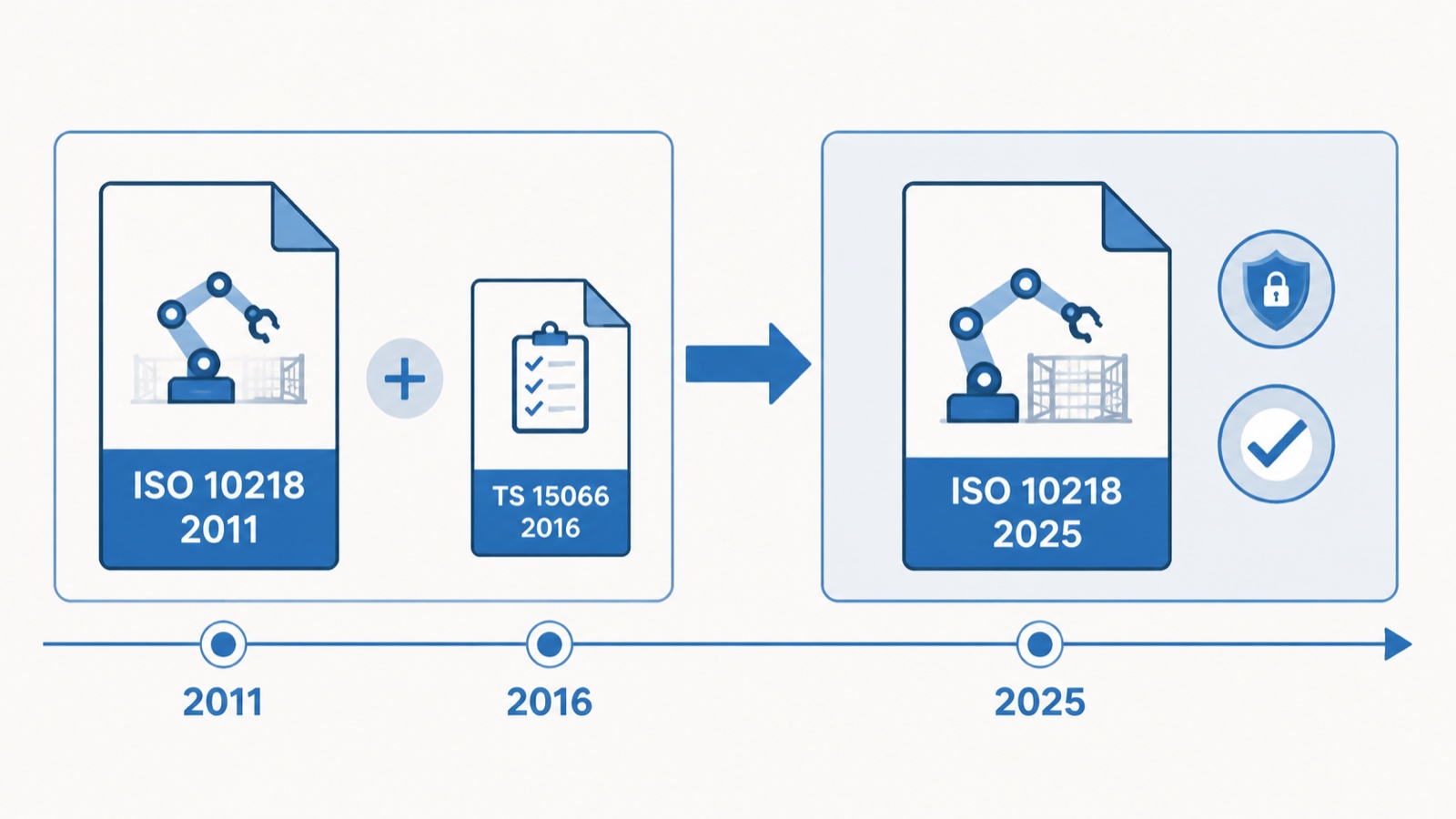
According to ISO, the 2025 revision folds the collaborative-application safety requirements that ISO/TS 15066:2016 previously specified separately, including power and force limiting, directly into ISO 10218-1:2025 and ISO 10218-2:2025. EVST addresses this consolidation by referencing the 2025 editions, not the withdrawn technical specification, in the safety documentation packages it prepares for collaborative robot deployments.
From “Collaborative Robot” to “Collaborative Application”
The terminology shift in the 2025 revision is easy to miss but changes how a specification should be written. The updated standard avoids the terms “collaborative robot” and “collaborative operation.” In their place, it uses “collaborative application,” meaning the robot, the specific task, the tooling, and the environment considered together, not the robot in isolation.
The distinction is not cosmetic. Under the 2011 framework, it was common shorthand to describe a robot model itself as “collaborative,” implying the arm carried some inherent safety property that traveled with it into any deployment. The 2025 revision formalizes what integrators already knew from field experience: no robot is collaborative by itself. Only a fully specified application, robot plus tool plus part plus layout plus task, can be designed, risk-assessed, and validated as collaborative. Change the gripper or the part, and the application has to be reassessed, regardless of what the robot’s data sheet says.
This reframing sits well with the four collaborative techniques carried forward from the earlier ISO 10218-2 and ISO/TS 15066 framework: safety-rated monitored stop, hand guiding, speed and separation monitoring, and power and force limiting. Each technique is still a way of managing contact and proximity between a person and a robot arm; what has changed is that the standard is explicit about validating them at the application level rather than certifying them as a fixed property of the robot.
The Four Collaborative Techniques, Now Inside ISO 10218
For readers who need the full risk-assessment walk-through of these four techniques, including how contact scenarios are evaluated, that detail lives in our ISO/TS 15066 risk-assessment guide. In the context of the 2025 revision, the relevant point is narrower: the techniques themselves are unchanged in substance, but their home document is not.
- Safety-rated monitored stop — the robot halts when a person enters the shared space and resumes once they leave, with no motion permitted while a person is present in the collaborative zone.
- Hand guiding — an operator physically moves the arm using a hand-guide device, with the robot complying with applied force rather than following a pre-programmed path.
- Speed and separation monitoring — the robot’s speed scales with the measured distance to a person, using safety-rated sensors, and stops fully if the minimum separation distance is breached.
- Power and force limiting (PFL) — the robot is engineered and configured so contact force and pressure stay within defined limits by design, allowing direct contact in normal operation with a stop triggered on unexpected force.
According to ISO, the 2025 revision adds cybersecurity requirements as they apply to robot safety, alongside clarified functional-safety requirements and new robot classifications with corresponding test methods. EVST’s engineering team incorporates these clarified functional-safety requirements into the commissioning checklists used for its collaborative and explosion-proof robot lines, so that a cell validated today references the current standard rather than the 2011-era framework.
ISO 10218-1 vs ISO 10218-2: Who Is Responsible for What
The 2025 revision keeps the same two-part structure as its predecessor, and the division of responsibility between manufacturer and integrator is one of the clearer parts of the standard.
| Aspect | ISO 10218-1:2025 | ISO 10218-2:2025 |
|---|---|---|
| Scope | Design, manufacture, remanufacture, and rebuild of the industrial robot | Design and system integration of the robot application and cell |
| Primary responsible party | Robot manufacturer | System integrator (which may be the end user) |
| Core focus | Inherent robot safety design: structure, drives, control system | Application-level risk assessment, safeguarding, and validation |
| Collaborative techniques | Robot-level enabling capability (e.g. force-limiting hardware, safety-rated monitoring functions) | Application-level configuration and validation of the four collaborative techniques for the specific task |
In practice, a manufacturer’s ISO 10218-1:2025 declaration tells an integrator what safety capability the robot ships with, but it does not by itself certify any given cell as collaborative. That determination is made under ISO 10218-2:2025, application by application, which is why the same robot model can be safely collaborative in one deployment and require additional guarding in another.
Transition Timeline and Regional Adoption
ISO 10218-1:2025 and ISO 10218-2:2025 are in force as of April 1, 2025, but international standards typically move into national and regional frameworks on a staggered schedule, and the ISO 10218:2025 transition is following that pattern. According to industry observations, national standards bodies, including those responsible for ANSI/RIA R15.06 in the United States and CSA Z434 in Canada, are expected to align their references with the updated ISO series, though specific adoption dates vary by jurisdiction and should be confirmed with the relevant national body rather than assumed from the ISO effective date alone. EVST supports integrators navigating this transition period with field engineers positioned across its global service network, so that a cell specified today can be documented against whichever reference, ISO or the relevant national standard, a given customer’s jurisdiction requires.
What This Means for Buyers and Integrators in 2026
For a company sourcing or specifying collaborative robots this year, the 2025 revision changes documentation practice more than it changes hardware. A cell that was risk-assessed correctly under the 2016-era ISO/TS 15066 framework does not need to be re-engineered from a safety-physics standpoint; it needs to be re-documented against the current standard, referencing ISO 10218-1:2025 and ISO 10218-2:2025 directly rather than the withdrawn technical specification.
In practice, EVST’s field engineers report that when a collaborative cell built against the 2016-era ISO/TS 15066 risk-assessment file is reviewed against the 2025 revision, the underlying force-and-pressure data typically holds up unchanged. What shifts is the paperwork trail, not the physics of the contact scenario the cell was designed around.
EVST’s collaborative robot line is built with this kind of standards transition in mind. The production line for EVST’s collaborative robots holds IATF16949 automotive-grade certification, and its products carry CE, SGS, and TUV third-party certification, credentials that integrators typically require regardless of which edition of ISO 10218 a given jurisdiction currently references. EVST’s product range spans a full payload class, from cobots through heavier industrial arms, so a specification written against the 2025 revision does not force a change in which robot family is selected. For applications in flammable atmospheres, EVST’s explosion-proof cobot line adds IP68 ingress protection with ATEX and IECEx dual certification, a certification layer that sits alongside, not instead of, ISO 10218 compliance. Because collaborative-application validation happens at the integrator level, EVST’s global field engineering network supports commissioning and re-documentation on site, in the countries where its robots are deployed, rather than only from a central office.
For readers evaluating cobot types and selection criteria more broadly, our complete guide to cobots: types, selection, and applications covers that ground. For a specific collaborative robot recommendation or a conversation about documenting an existing cell against the 2025 standard, EVST’s team can be reached through the contact page.
Frequently Asked Questions
Is ISO/TS 15066 withdrawn?
Yes, in effect. ISO/TS 15066:2016 no longer exists as a separate technical specification. Its collaborative-application safety requirements, including power and force limiting, were consolidated into ISO 10218-1:2025 and ISO 10218-2:2025 when the revised standards came into force on April 1, 2025. Documentation that still references ISO/TS 15066:2016 as a standalone source should be updated to reference the current ISO 10218 series.
What is the difference between ISO 10218-1 and ISO 10218-2?
ISO 10218-1:2025 covers the design, manufacture, remanufacture, and rebuild of the industrial robot itself, which is the robot manufacturer’s responsibility. ISO 10218-2:2025 covers the design and system integration of the robot application and cell, including risk assessment and safeguarding, which falls to the system integrator. A collaborative application has to satisfy both parts.
What is the ISO 10218:2025 transition period?
ISO 10218-1:2025 and ISO 10218-2:2025 came into force on April 1, 2025. According to industry observations, national standards bodies, including those responsible for ANSI/RIA R15.06 in the United States and CSA Z434 in Canada, are expected to align their references with the updated ISO series, though specific adoption dates vary by jurisdiction and should be confirmed with the relevant national body.
Does ISO 10218:2025 replace ISO/TS 15066?
Yes. The 2025 revision of ISO 10218-1 and ISO 10218-2 absorbed the collaborative-application safety requirements that ISO/TS 15066:2016 previously specified as a separate technical specification. The four collaborative techniques, safety-rated monitored stop, hand guiding, speed and separation monitoring, and power and force limiting, remain the same underlying set; they are now specified inside the ISO 10218 series itself.
What is a “collaborative application” under the 2025 standard?
The 2025 revision moves away from the term “collaborative robot” in favor of “collaborative application,” meaning the robot, the specific task, the tooling, and the environment considered together, not the robot in isolation. Under this framing, no robot is inherently collaborative; only a fully specified application, validated as a whole, can be designed and certified as collaborative.
Where to Go Next
For the collaborative-application risk-assessment methodology behind the four techniques described here, see our guide to ISO/TS 15066 risk assessment. For the broader ISO 10218 framework and CE-marking process, see our guide to industrial robot safety standards and CE marking. For cobot selection criteria across applications, see our complete guide to cobots. For a documentation review or a collaborative robot recommendation aligned with the 2025 revision, EVST’s team can be reached through the contact page.
About the author: The EVST Editorial Team writes about industrial robotics and intelligent manufacturing standards for engineers and operations leaders evaluating automation projects. EVST (EVS TECH CO., LTD), founded in Chengdu in 2018, has delivered 600+ automation projects and ships to 100+ countries, with IATF16949 automotive-grade certification and CE / SGS / TUV third-party certifications across its collaborative robot, QJAR industrial robot, SCARA, and delta product families.
Last updated: July 8, 2026