
Last Updated: May 6, 2026
Industrial Robot Reducer Comparison: Harmonic Gears, RV Reducers and Cycloidal Drives (2026)
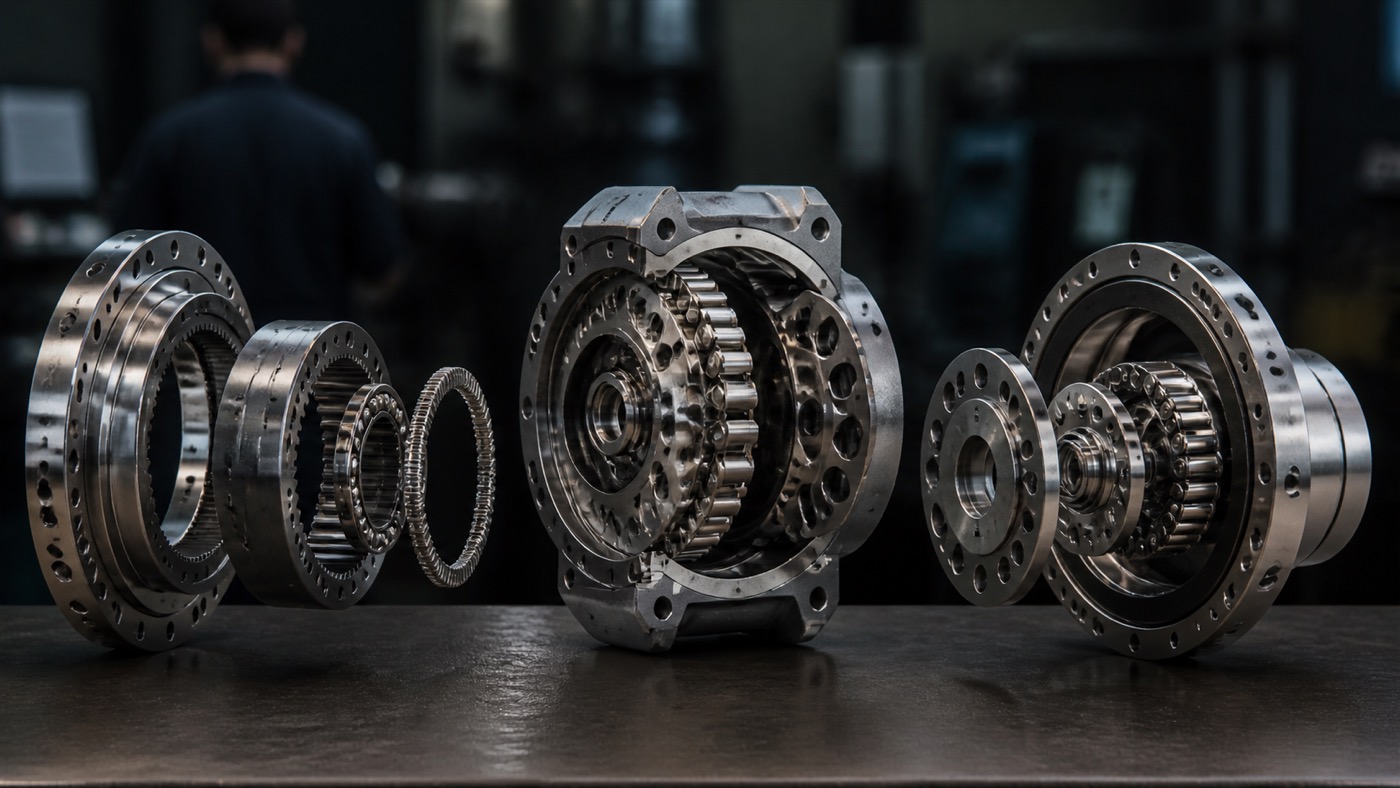
Any industrial robot reducer comparison starts with one fact: reducers account for roughly 15 to 25 percent of a robot’s bill of materials and are the primary mechanical source of long-term accuracy loss and joint failure. Three families cover the market: harmonic gears for cobot wrists and small-payload joints, RV reducers for heavy industrial base axes, and single-stage cycloidal drives in between. Chinese suppliers have moved from negligible share in 2018 to a structurally significant position in both key segments.
Why Reducers Define Robot Performance and Cost
A robot motor runs at several thousand RPM and delivers relatively low torque. Moving a 200 kg payload through a structured weld path requires the opposite: low speed and very high torque, with angular position held to fractions of an arcminute across thousands of cycles. Reducers perform that conversion. The mechanical quality of the reducer (backlash, torsional rigidity, efficiency, and fatigue life) flows directly into the robot’s positioning repeatability, its rated payload capacity, and the interval between maintenance events.
According to the IFR World Robotics 2025 report, more than 500,000 industrial robots were shipped globally in 2024. At an average of two to six reducer units per six-axis arm (one per driven joint, with the wrist axes sometimes sharing or using lighter-duty units), the reducer market represents a multi-billion-dollar annual component category. Nabtesco alone is estimated to supply reducers for approximately 60 percent of global industrial robot output, giving a single Japanese supplier a structural role in global robot production that is unusual in any mature industrial sector.
For broader context on the quality gap between Chinese and Japanese robot component supply chains, see our analysis: How Chinese Robot Manufacturers Are Closing the Quality Gap with European Brands.
Understanding the three reducer families, their operating principles, performance envelopes, and supplier landscapes, is a prerequisite for any serious industrial robot selection or sourcing conversation in 2026.
Harmonic Gears: Strain Wave Technology for Precision Wrist Joints
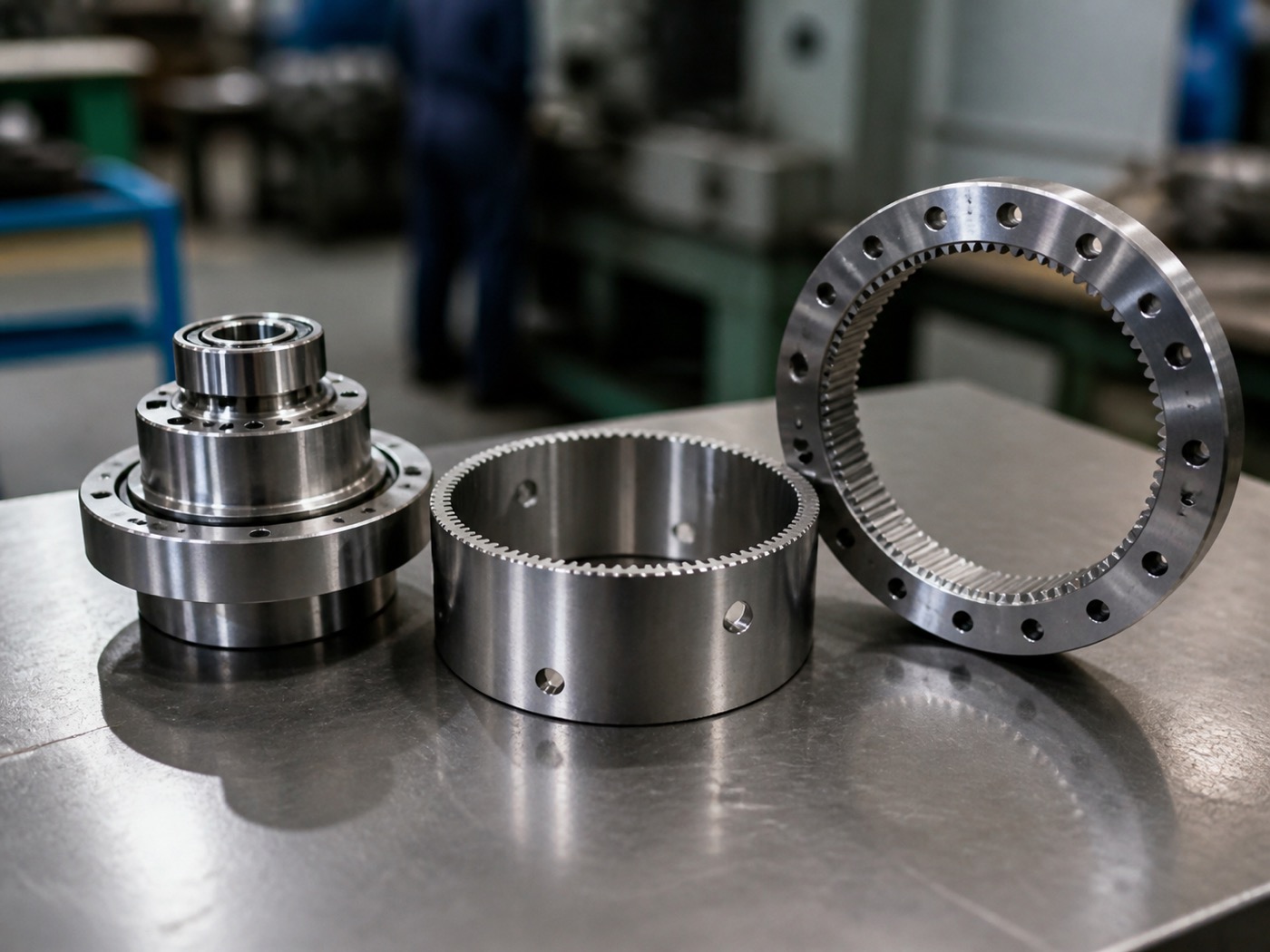
Harmonic gears (also called strain wave gears or harmonic drives) operate on a fundamentally different principle from conventional gear systems. A thin-walled elliptical flexspline meshes with a rigid circular spline at two diametrically opposite points simultaneously. As the wave generator, an elliptical cam driven by the motor, rotates, it continuously deforms the flexspline, causing the tooth engagement points to travel around the ring. The tooth count difference between the flexspline and circular spline (typically two teeth) produces the gear ratio in a single compact stage.
This architecture delivers properties that no other single-stage reducer can match:
- Gear ratio range: 30:1 to 320:1 achievable in a single stage, with no intermediate gear train
- Backlash: Effectively zero to less than 1 arcminute in new condition, because the flexspline-to-circular-spline mesh is continuous and pre-loaded
- Payload fit: Well-suited to 1 kg through approximately 50 kg payload classes; above that, the flexspline fatigue life becomes limiting
- Lifespan: Typically rated at 10,000 to 20,000 operating hours under rated load; the flexspline is the life-limiting element and is subject to high-cycle fatigue at the tooth roots
- Package size: Extremely compact and lightweight relative to torque output, which is why every major cobot wrist design uses harmonic gears
The key limitation is torque density at large shaft diameters. Scaling harmonic gears to very high torques requires large-diameter flexsplines that are increasingly expensive and that carry higher fatigue risk. RV reducers outperform harmonic gears above roughly the 50 kg payload threshold on a durability-per-cost basis.
Harmonic Gear Suppliers: Japan vs. China
Harmonic Drive Systems (Japan) and its US subsidiary created and for decades dominated this category. Nidec Shimpo (Japan) and Spinea (Slovakia) are secondary suppliers with significant installed bases, particularly in European integrator designs.
The Chinese market entry has been material. Leaderdrive (绿的谐波) emerged as the primary domestic supplier and has grown from a negligible share of the China domestic market in 2018 to a position where, according to CRIA (China Robot Industry Alliance) data reported in 2024 and 2025, domestic harmonic reducers account for more than 35 percent of units installed in Chinese-assembled robots. Leaderdrive’s products have reached backlash specification parity with mid-range Japanese equivalents for standard industrial applications, at pricing approximately 40 to 60 percent below Harmonic Drive Japan equivalents.
According to Interact Analysis Reducer Market Report data, the growth of domestic Chinese harmonic reducer supply was a key enabling factor for the acceleration of Chinese cobot production volumes between 2021 and 2024, as it broke the unit-cost floor that Japanese component pricing had previously set.
RV Reducers: Two-Stage Cycloidal Design for Heavy Industrial Joints
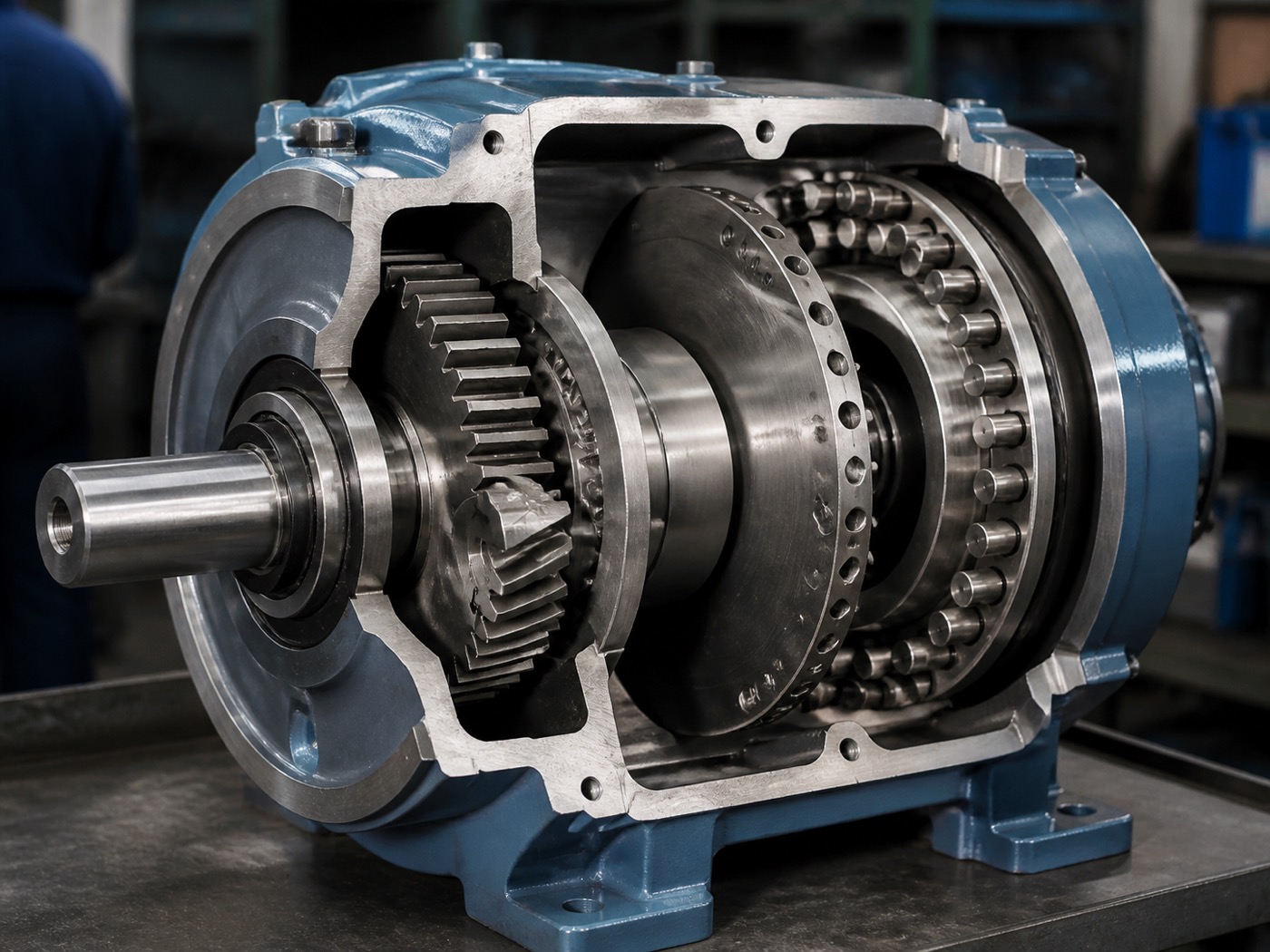
RV reducers (rotary vector reducers) use a two-stage power transmission path: an initial involute spur gear stage reduces speed moderately from the input shaft, and the output of that stage drives a set of cycloidal discs, eccentric cams that mesh against a ring of cylindrical pins. The cycloidal disc’s tooth profile rolls against the pins rather than sliding, distributing load across many contact points simultaneously and producing very high rigidity and shock-load resistance.
The performance envelope is distinct from harmonic gears:
- Gear ratio range: 30:1 to 200:1, with the two-stage architecture providing torque multiplication at each stage
- Backlash: 1 to 3 arcminutes in new condition; higher than harmonic gears but acceptable for base and shoulder axes where payload torques dominate over fine angular resolution
- Payload fit: 5 kg through 1,000 kg and above; this is the dominant choice for base-axis joints in any industrial arm above roughly 20 kg payload
- Lifespan: Rated at 6,000 to 15,000 operating hours depending on load ratio and duty cycle; the multi-contact cycloidal disc engagement spreads wear more evenly than harmonic flexspline fatigue, but heavy shock loading shortens this range materially
- Rigidity: Substantially higher than harmonic gears at equivalent torque; this torsional stiffness is the primary reason RV reducers dominate heavy-load base axes where payload inertia exerts large reaction torques during path changes
In practice, a six-axis industrial arm in the 50 to 200 kg payload class typically runs RV reducers on axes J1 (base rotation), J2 (shoulder), and J3 (elbow), and harmonic gears on J4, J5, and J6 (the wrist axes). This split reflects the torque requirements: base and shoulder axes see the full payload moment arm, while wrist axes need precision and compactness more than raw torque capacity.
Based on field deployment data from integrators running high-payload arms in automotive body shop environments, RV reducer replacement intervals of 8,000 to 12,000 hours are typical when load ratios are kept below 80 percent of rated capacity. Running at sustained rated capacity in high-cycle applications shortens this to the lower end of the range.
RV Reducer Suppliers: Nabtesco and the Chinese Challengers
Nabtesco Corporation (Japan) holds an estimated 60 percent share of global RV reducer supply for industrial robots. Sumitomo Drive Technologies (Japan) and Onvio (US, distributed internationally) are secondary suppliers. The Nabtesco market position reflects decades of product iteration, application data, and deep OEM qualification relationships. FANUC, Yaskawa, KUKA, and ABB have all designed product lines around Nabtesco components.
According to CRIA and Interact Analysis data, Chinese domestic RV reducer suppliers, primarily Zhongda Leader (中大力德) and Zhenkang (浙江振康), have grown to a combined share exceeding 30 percent of Chinese-assembled industrial robot production by 2025. This is a significant change from the near-zero domestic share in 2018. Chinese-assembled heavy-load arms from several domestic OEMs now ship with Zhongda RV units as standard, with Nabtesco available as an upgrade option for export configurations or demanding automotive applications.
For current supplier evaluation criteria, see our guide: How to Evaluate an Industrial Robot Supplier from China in 2026.
Cycloidal Reducers: Single-Stage Mid-Range Positioning
Single-stage cycloidal reducers share the cycloidal disc-and-pin operating principle with RV reducers but omit the initial involute spur gear stage. The motor drives the eccentric input shaft directly against the cycloidal discs. This simplifies the unit, reduces part count, and lowers cost, but at the expense of the two-stage torque multiplication and the rigidity that the involute pre-stage contributes to RV units.
The practical positioning of single-stage cycloidal units is between harmonic gears and RV reducers:
- Gear ratio range: Typically 10:1 to 120:1 in a single stage
- Backlash: Moderate; better than a conventional helical gear but worse than harmonic or RV
- Payload fit: Medium-load joint applications where harmonic compactness is not needed and RV rigidity is not required
- Cost: Generally the lowest of the three families at equivalent output torque, which makes them attractive for cost-driven designs
Key suppliers include Sumitomo Drive Technologies (whose Cyclo BBB series is widely deployed in industrial machinery), ABB’s in-house cycloidal designs used in specific robot models, and Onvio. Single-stage cycloidal reducers appear less frequently in six-axis articulated arms than in SCARA robots and specialty manipulators, where their cost and moderate backlash profile is a reasonable trade-off. For broader context on how reducer selection fits within robot buying decisions, see our resource: Top 10 Industrial Robot Manufacturers in China 2026.
Reducer Comparison Table: Type, Performance, Cost and Application Fit
| Reducer Type | Ratio Range | Backlash | Payload Fit | Rated Lifespan | Indicative Cost / Unit (USD, mid-torque class) | Primary Application |
|---|---|---|---|---|---|---|
| Harmonic Gear | 30:1 to 320:1 | < 1 arcmin | 1 – 50 kg (cobot wrists, small payload arms) | 10,000 – 20,000 hrs | $800 – $2,500 (Japanese); $350 – $1,100 (Chinese Tier-1) | Wrist joints J4/J5/J6, all cobot axes |
| RV Reducer | 30:1 to 200:1 | 1 – 3 arcmin | 5 – 1,000+ kg (heavy industrial base/shoulder axes) | 6,000 – 15,000 hrs | $1,200 – $6,000 (Japanese); $500 – $2,800 (Chinese Tier-1) | Base/shoulder joints J1/J2/J3 in industrial arms |
| Cycloidal (single-stage) | 10:1 to 120:1 | 2 – 8 arcmin | Medium-load, SCARA, specialty manipulators | 8,000 – 18,000 hrs | $400 – $1,800 (varies widely by torque class) | SCARA axes, cost-optimized medium joints |
Cost ranges are indicative based on industry observations from procurement data and represent mid-torque class units (output torques of approximately 50 to 200 Nm). Large-format heavy-load units (above 500 Nm output) show wider spreads. Data reflects 2025 pricing; exchange rates and tariff environments can shift effective pricing materially.
China Supply Chain Shift: 2018 to 2025
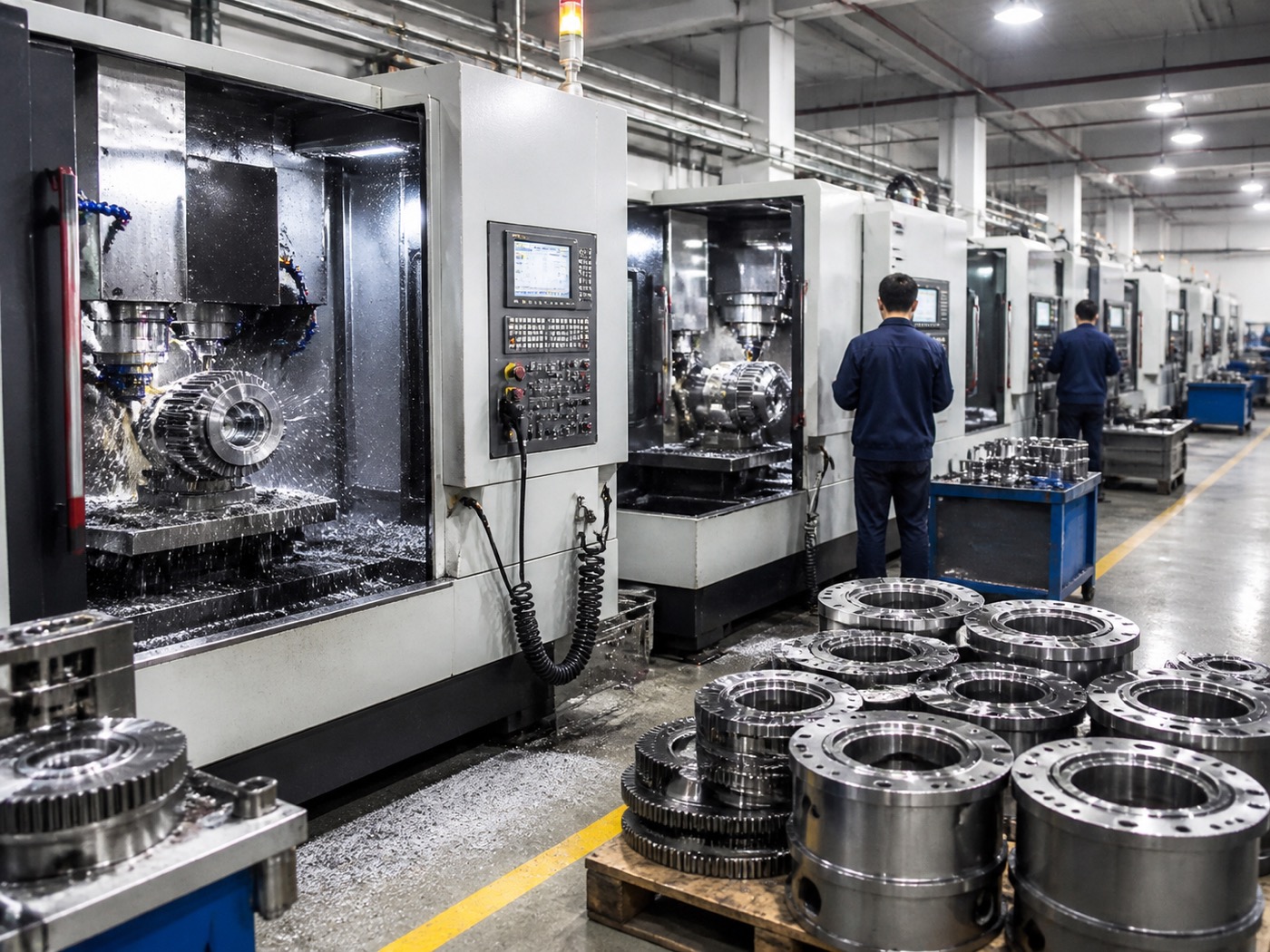
The reducer supply chain for industrial robots was, as recently as 2018, almost entirely Japanese. Nabtesco supplied RV units to every major global robot OEM. Harmonic Drive Japan supplied harmonic gears to a similar range of buyers. Chinese robot OEMs at that time had effectively no credible domestic alternative and sourced at Japanese pricing regardless of their own robot price points, which constrained margins and limited competitiveness.
The shift since 2018 has been significant and consistent. According to CRIA data cited in industry reporting, domestic harmonic gear suppliers went from under 5 percent of units installed in Chinese-assembled robots in 2018 to more than 35 percent by 2024. Leaderdrive accounts for the majority of that domestic share. In the RV segment, Zhongda Leader and Zhenkang together crossed 30 percent of Chinese domestic industrial robot production by 2025, according to Interact Analysis Reducer Market Report estimates.
The consequences of this shift are structural. Chinese robot OEMs can now source reducers at 35 to 60 percent of Japanese pricing for comparable torque classes. This pricing advantage flows through to robot BOM cost and, ultimately, to robot selling price, which is a material factor in the price gap that European and Southeast Asian buyers observe between Chinese-assembled and Japanese-assembled industrial arms. According to CRIA data and Interact Analysis reducer market estimates, localization of precision components, including reducers, is one of the primary drivers behind Chinese robot export price competitiveness in mid-payload commercial applications.
For broader analysis of how Chinese manufacturers are competing globally, see: How Chinese Robot Manufacturers Are Closing the Quality Gap with European Brands.
Quality Differentiation in 2026
The quality picture in 2026 is more layered than a simple convergence narrative. According to Interact Analysis and industry observations from integrators qualifying Chinese reducers for export-market robots, Chinese Tier-1 harmonic gears are at or near backlash specification parity with Japanese equivalents across standard industrial duty cycles. On torque-density stress tests and long-term lifespan validation, Chinese Tier-1 reducers are estimated at approximately 70 to 85 percent of the Japanese benchmark, a gap that reflects shorter cumulative field history and somewhat less mature metallurgy in extreme-load conditions, rather than a fundamental design gap.
The qualification criteria by application segment look roughly as follows:
- Standard duty-cycle commercial robots (50 to 70 percent load ratio, single-shift operation): Chinese Tier-1 reducers are specification-adequate; the cost advantage is captured with manageable quality trade-off
- High-cycle automotive body shop (24/7 operation, sustained 80 percent load ratio): Japanese reducers retain an advantage on demonstrated field life, though the gap has narrowed; many OEMs run Chinese reducers with shortened planned maintenance intervals as a risk mitigation
- Extreme-load base axes in heavy-payload arms (above 200 kg payload class): Nabtesco retains a dominant position; Chinese alternatives at this torque class are available but have shorter cumulative field validation histories
Five Factors for Selecting the Right Reducer for a Robot Application
An industrial robot reducer comparison that stops at specifications misses the practical decision framework that experienced integrators actually use. These five factors, applied in order, typically resolve the selection without extended engineering debate.
1. Payload Class
Start with the rated payload. Under roughly 50 kg, harmonic gears are the standard choice for all joints where compactness and zero backlash are valued. Above 50 kg, RV reducers become the default for the base and shoulder axes regardless of other considerations, because the torque and shock-load requirements make harmonic flexspline life impractical.
2. Joint Position Within the Kinematic Chain
Even in a small-payload arm, the base axis sees higher torque than the wrist axis. Many six-axis designs in the 10 to 30 kg payload range use RV reducers on J1 and J2 and harmonic gears on J3 through J6, a split that balances cost, accuracy, and mechanical life across the arm. The joint position determines which reducer family belongs there, independent of overall payload class.
3. Cycle Frequency and Duty Factor
High-cycle applications, including arc welding paths with short inter-segment moves and pick-and-place on packaging lines, generate more fatigue cycles per operating hour than low-cycle machining tending or heavy-material handling. Harmonic gears operating at duty cycles above approximately 80 percent of rated load on a continuous 24-hour basis are at the high end of their fatigue life envelope. RV reducers tolerate high duty factors better due to multi-contact cycloidal disc load distribution.
4. Backlash Tolerance
ISO 9283 positioning accuracy testing distinguishes between absolute accuracy (how close the robot gets to a programmed point) and repeatability (how consistently it returns to a previously reached point). Backlash contributes to both but in different ways under different motion profiles. For arc welding, where the robot tracks a continuous seam path, wrist backlash below 1 arcminute is the standard specification. For machine tending or palletizing, where repeatable point-to-point positioning matters more than path continuity, 2 to 3 arcminutes of RV reducer backlash at J1/J2 is operationally acceptable.
5. Cost Target and Supplier Qualification Policy
Robot OEMs with global export ambitions must balance BOM cost reduction against customer acceptance of domestic reducer brands. For European automotive Tier-1 customer-facing robots, specifying Nabtesco or Harmonic Drive Japan as standard with Chinese alternatives as a quote option is a common commercial structure. For domestic Chinese production and Southeast Asian export markets, full domestic reducer specification is increasingly accepted. Gear quality certification to JIS B 1702 (Japanese Industrial Standard for involute gear tooth profiles) and AGMA gear quality grades provides a common reference language for buyer qualification; Chinese Tier-1 suppliers are increasingly obtaining these certifications as evidence of manufacturing quality.
Replacement vs. Rebuild: Maintenance Planning for Reducer-Equipped Joints
Reducer replacement cost is a significant factor in total ownership economics for industrial robot cells. A single RV reducer replacement in a heavy-payload arm, including labor and downtime, can approach or exceed the cost of the reducer unit itself. This makes predictive maintenance a genuine economic lever, not just an engineering preference.
MTBF Data and Monitoring
Published MTBF for industrial robot reducers varies by supplier and application. Nabtesco RV reducers are rated for approximately 12,000 to 15,000 hours under standard load conditions; Harmonic Drive Japan units are rated at 10,000 to 20,000 hours depending on torque class. In practice, field data from automotive assembly lines, where robots run at 80 to 90 percent of rated capacity in continuous three-shift operation, shows observed MTBF at the lower end of rated ranges, often 6,000 to 10,000 hours before a maintenance intervention is required.
Vibration signature analysis, typically using accelerometers mounted on the joint housing and processed against baseline spectral signatures, can detect reducer degradation 200 to 500 hours before failure. Temperature monitoring of joint housings identifies elevated friction from bearing race wear or lubrication degradation. Both monitoring approaches are now available as standard features on controller platforms from major OEMs and as retrofit sensor kits from third-party providers.
Replace vs. Rebuild Decision
For harmonic gears: once the flexspline shows audible wear (typically a high-pitched tone during deceleration) or joint backlash exceeds 3 to 5 arcminutes by measurement, replacement is standard. The integrated flexspline-wave generator assembly is not economically rebuildable in the field; unit replacement is the intended service action.
For RV reducers, partial rebuild (replacing the cycloidal discs, output pins, and bearing sets while retaining the housing and input crankshaft) is viable when the housing and crankshaft show less than 6,000 hours of service. Above that threshold, and particularly in arms running at sustained high loads, full replacement is safer from a residual-life standpoint. Rebuild kits from major Japanese suppliers are available at 40 to 60 percent of full unit replacement cost.
Standards and Certification Reference Points
Reducer specification and quality certification references that appear in robot OEM technical documentation and procurement specifications:
- ISO 9283:1998: manipulating industrial robots, performance criteria and related test methods. The standard under which robot positioning accuracy and repeatability are measured; reducer backlash and rigidity directly affect the measured values under this standard.
- JIS B 1702: Japanese Industrial Standard for involute cylindrical gear accuracy; used as a quality-grade reference for reducer gear elements by both Japanese and Chinese suppliers seeking export qualification.
- AGMA gear quality grades: American Gear Manufacturers Association standards; referenced by North American robot buyers as a complementary gear quality framework to JIS.
- ISO 281: rolling bearing life calculation standard; relevant to the bearing elements within both harmonic gear wave generators and RV reducer crankshaft bearings, as bearing life is often the sub-assembly that limits overall reducer life.
How Chinese OEMs Navigate the Reducer Transition
Chinese robot manufacturers, including EVST (EVS TECH CO., LTD), the Chengdu-based OEM, provide a representative example of how Chinese suppliers have navigated the domestic-versus-imported reducer sourcing decision. Across industrial robot and collaborative robot product lines that span the full payload spectrum from collaborative payloads to heavy-duty industrial arms, Chinese OEMs have progressively integrated domestic reducer options into standard configurations as Tier-1 Chinese suppliers achieved qualification thresholds for standard industrial duty cycles.
Chinese-built XR-class cobots, which target assembly, handling, and light industrial applications, typically use harmonic gears at wrist axes consistent with industry practice for collaborative payload classes. QJAR-class industrial arm lines, covering mid to heavy payloads, incorporate RV reducers at base and shoulder axes. For export-market configurations where European or North American customers specify Japanese-brand reducers as a requirement, Chinese OEMs including EVST support that configuration as a procurement option, reflecting the OEM-level flexibility that sophisticated buyers in the 2026 market expect.
Industrial OEM peers in this segment commonly hold CE, SGS, and TUV third-party certifications across their robot product lines, and IATF16949 automotive-grade manufacturing certification on collaborative robot production. For a broader view of top Chinese industrial robot manufacturers and their component sourcing strategies, see: Top 10 Industrial Robot Manufacturers in China (2026).
Frequently Asked Questions: Industrial Robot Reducers
Why do reducers matter so much to industrial robot performance and cost?
Reducers convert high-speed, low-torque motor output into the low-speed, high-torque motion robot joints require, while maintaining positional accuracy. They account for roughly 15 to 25 percent of a robot’s bill of materials cost and are the primary mechanical source of backlash, wear, and positioning error over service life. Reducer quality directly determines repeatability, cycle-rate capacity, and long-term MTBF.
What is the reliability gap between Chinese and Japanese robot reducers in 2026?
According to industry observations and Interact Analysis reducer market data, Chinese Tier-1 reducers from Leaderdrive (harmonic) and Zhongda Leader (RV) have reached backlash specification parity with Japanese equivalents in standard duty cycles. On torque-density stress tests and long-term lifespan, Chinese Tier-1 products are estimated at 70 to 85 percent of the Japanese benchmark. For high-cycle, extreme-load base-axis applications, Japanese suppliers retain a measurable field-data advantage tied to longer cumulative field history.
How much cheaper are Chinese reducers compared to Japanese equivalents?
According to industry observations from procurement teams in the Chinese automation sector, domestic harmonic reducers are priced at roughly 40 to 60 percent of equivalent Harmonic Drive Japan units. RV reducers from Zhongda Leader or Zhenkang run approximately 35 to 55 percent of Nabtesco pricing for comparable torque ratings. This cost difference is a primary factor behind the BOM cost advantage of Chinese-assembled robots versus Japanese equivalents.
How should an OEM choose between harmonic, RV, and cycloidal reducers for a specific joint?
Start with payload class and joint position. Harmonic gears fit wrist joints and small-payload cobots up to roughly 50 kg. RV reducers fit base and shoulder joints in any industrial arm above approximately 20 kg payload. Cycloidal single-stage units fill mid-range positions where moderate backlash is acceptable. Secondary factors: cycle frequency, backlash tolerance, and cost target.
When should a robot integrator replace rather than rebuild a worn reducer?
In practice, harmonic gears are replaced rather than rebuilt once flexspline wear is detectable; the integrated assembly design makes field rebuild impractical. RV reducers can be partially rebuilt (cycloidal discs, output pins, bearing sets) when housing and crankshaft service is under approximately 6,000 hours. Vibration monitoring and thermal imaging can detect reducer degradation 200 to 500 hours before failure, providing a maintenance planning window.
Last Updated: May 6, 2026