
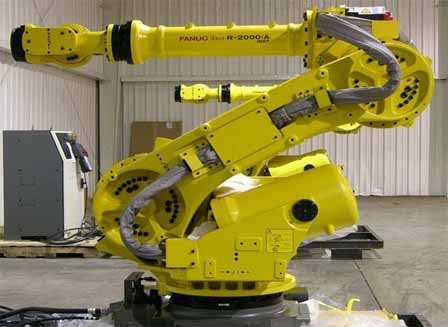
What Is an Industrial Robot?
An industrial robot is a programmable, automatically controlled, multipurpose manipulator with three or more axes, used in manufacturing to weld, handle, assemble, palletize, and paint parts in place of repetitive manual labor. Unlike fixed automation, the same robot arm can be reprogrammed for a new task without changing the hardware, which is why industrial robots are the backbone of modern factories. The seven models below are among the most widely deployed types, but choosing the right one depends on payload, reach, and your process — see our overview of the top industrial robot manufacturers and our robotic arm cost guide before you buy.
Source: Pinterest
Industrial robots are automated machines that are used in manufacturing industries in the place of human beings. They are faster, more precise and can run for days, qualities that are behind their gradual rise in the manufacturing world. Industrial robots can be classified into 7 main categories discussed below.
Articulated Robots
Source: Pinterest
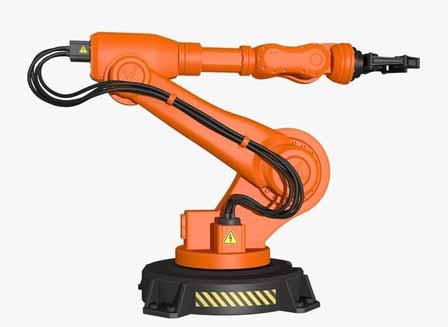
Articulated robots are the most commonly used robots in manufacturing and they are characterized by rotary joints called axes. They range from simple 2-axis joints to sophisticated ones with more than 10-axis that are powered by motors. The most common articulated robots you would typically find in a factory is a 6-axis robot.
Thanks to their axes, articulated robots are the most flexible and are therefore used in roles that require intense multitasking work. You will find them in welding, parts transfer, assembly, pick and place, packaging and palletizing tasks.
Cylindrical Robots
Source: industrial-electronics.com
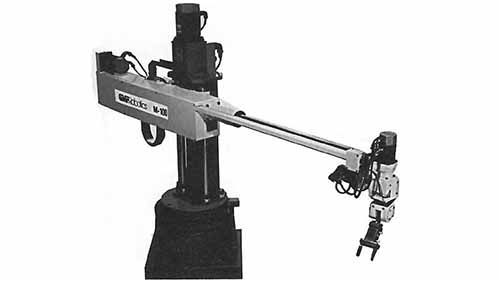
These are robots that have a single rotary joint at their base and another prismatic joint that connects the links. This rotary joint utilises rotational motion along the joint axis as the prismatic joint uses linear motion. What gives them the name cylindrical however is the shape of their envelope that is shaped like a cylinder. Some of the rules that are best suited for cylindrical robots include robotic coating and machine tending.
Cartesian Robots
Source: Pinterest
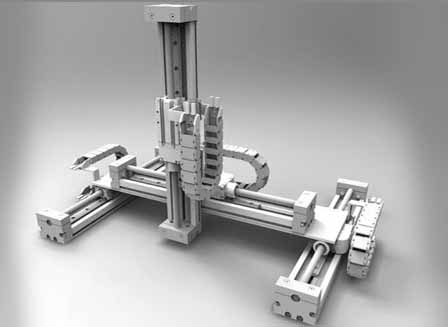
As the name implies, cartesian robots operate along a linear track system. Also known as Gantry robots, they have a cube-shaped envelope that has three perpendicular axes of X, Y and Z. It is these axes that determine each directional movement of the robot during operations. Cartesian robots are best suited for pick and place roles because they can cover very huge distances, depending on the length of the linear tack. Most of the line tracks are usually overhead which also makes these types of robots the best for making use of space.
SCARA Robots
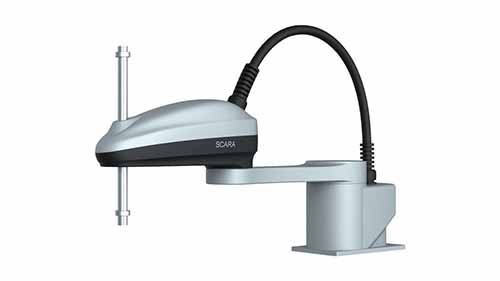
SCARA Robots are among the most advanced industrial robots. They are best known for their speeds which is the reason why they are given sophisticated roles like assembling intricate parts of cars and other automotive contraptions. They have a cylindrical envelope and can also operate along an X,Y,Z plane coupled with a rotary motion. Other roles that SCARA robots can conotably handle include machine loading, palletizing, and automated packaging.
Collaborative Robots
Source: Pinterest
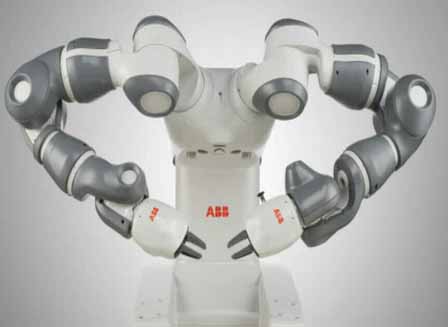
Collaborative robots were the answer when the need to include human labour alongside robots arose. They are designed with the best safety features that makes them ideal to work alongside humans without any danger of accidents taking place. They are rounded without any point and are equipped with state of the art sensors that are able to determine distances when humans are in proximity.
Delta Robots
Source: Pinterest
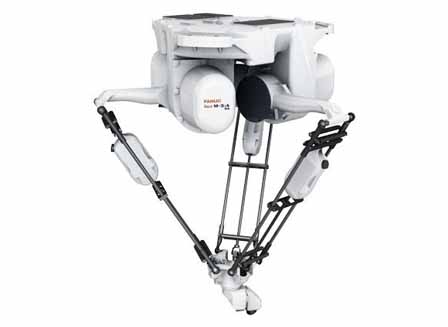
Also called Parallel robots, these are automated industrial machines that feature parallele joint arms that extend from a common base facing downwards. It has a dome-shaped envelope. Their extremely lightweight arms makes them the ideal robot for tasks that require high seeds with equal precision. They are the type of robots you will find in an electronic manufacturing factory, food processing plants or a pharmaceutical maker. Their roles include pick and place and parts transfer.
Polar Robots
Polar robots were the first industrial robots to be invented; most of the improved robots that came after them were roughly based on the Polar robot blueprints. They have a spherical work envelope and polar coordinate formation of the robot axe. They are not widely used anymore but in places where they have been adapted for modern roles you will find them handling tasks like die casting, injection molding and material handling.
Conclusion
Industrial Robots continue to revolutionize the manufacturing process around the world. They are faster and produce high quality materials. However, the disruption the continued cause in the job market cannot be ignored.
As more manufacturers are switching from human labor to automated machines, it is only a matter of time before thighs get hairy down the line. If manufacturing is what you have been eyeing for a while now, then getting to know all these types of robots and how they work will be a good start for your journey.
How to Choose an Industrial Robot
Match the robot to the job in four steps. First, fix the payload — the heaviest part plus the gripper or tool. Second, check the reach and work envelope against your station layout. Third, pick the axis count: 4-axis SCARA and palletizers for fast planar work, 6-axis arms for welding, assembly, and any task needing full 3D orientation. Fourth, weigh repeatability, duty cycle, and total cost, including integration and tooling. When in doubt, start from your application and work back to the specification rather than the other way around.
Frequently Asked Questions
What is an industrial robot?
An industrial robot is a programmable, automatically controlled manipulator with three or more axes, built to perform manufacturing tasks such as welding, material handling, assembly, and palletizing. Its defining trait is reprogrammability: one arm can be redeployed to a new task in software.
What are the main types of industrial robots?
The most common types are articulated (6-axis) arms, SCARA robots, Cartesian/gantry robots, delta (parallel) robots, and collaborative robots (cobots). Each type trades off speed, reach, payload, and flexibility for a different class of task.
How many axes does an industrial robot have?
Most industrial robots have between 4 and 6 axes. A 4-axis SCARA is fast for flat pick-and-place and assembly, while a 6-axis articulated arm can reach almost any position and orientation in 3D, which is why it dominates welding and complex handling.
How much does an industrial robot cost?
An industrial robot arm typically starts in the low tens of thousands of US dollars, with the deployed cell costing more once tooling, safety, and integration are added. See our robotic arm cost guide for a full breakdown by payload and application.
How do I choose the right industrial robot?
Start from the application, then size payload, reach, and axis count, and finally weigh repeatability, duty cycle, and total cost of ownership. To compare suppliers, see our guide to the top industrial robot manufacturers.