
By Уреднички тим EVST-а · Прегледао/ла Уреднички тим EVST-а · Последње ажурирање 8. октобра 2026. · Уредничка политика · Политика исправки · Услови
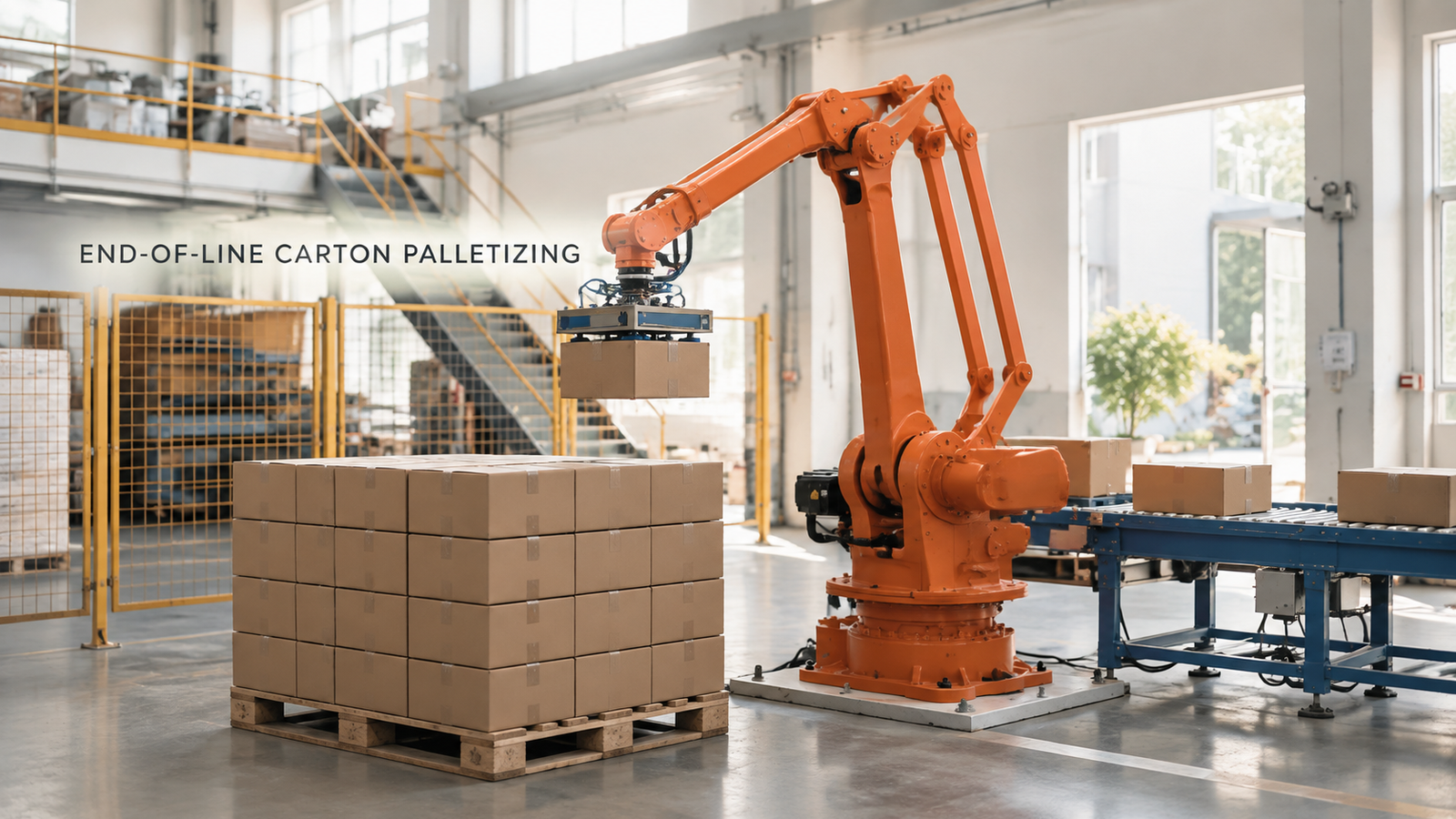
An end-of-line palletizing cell stays stable when three things are settled together: a grip that holds the carton firmly without marking or crushing it, a stacking pattern that makes a load that survives handling, and a pick position at the conveyor end that is the same for every carton. Weaken one and the other two have to compensate. In the cell described here, an orange four-axis palletizing robot lifts packed cartons off the end of a roller conveyor and builds them into layers on a pallet.
Planning to palletize your own cartons? Send us your carton size, weight, pallet size and daily output, а ми ћемо вам одговорити са концептом ћелије и проценом времена циклуса.
Why the end of the line is where the pressure builds
Cartons leave a packing line at a steady rate, and someone has to turn that flow into pallets. By hand it is repetitive lifting, and the quality of the stack depends on how tired people are and how many hands are available in a busy season. The visible result is uneven stacks: leaning columns, overhanging corners, loads that need restacking before they can be wrapped.
A robot removes the fatigue but not the need for a plan. A person squares a crooked carton or shifts a hold without thinking. A robot repeats what it was taught, so the cell must deliver the carton where the robot expects it, hold it without damage, and place it in a pattern chosen on purpose. That is why the three points below are one chain, not three separate checks.
How the cell works, step by step
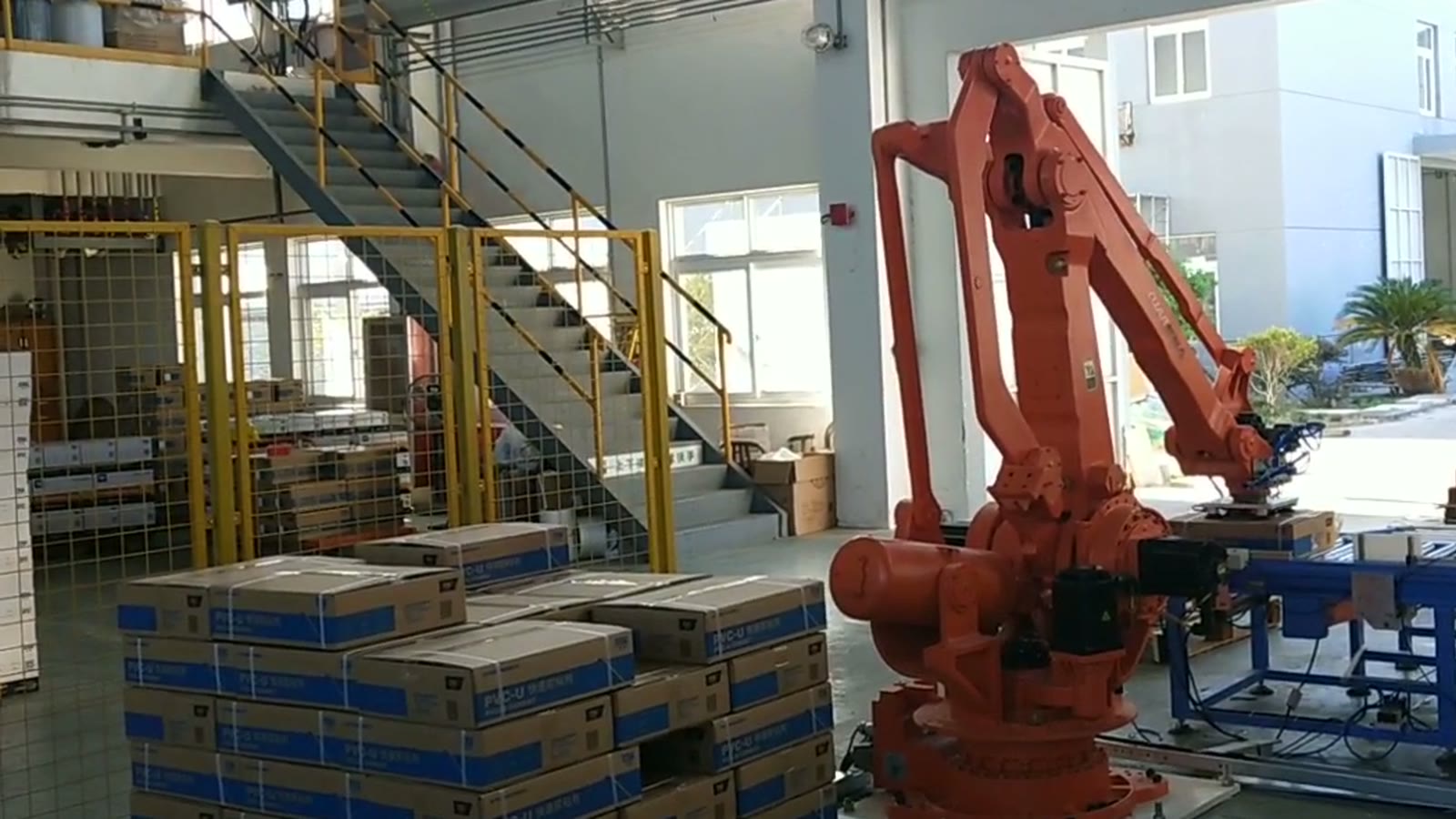
The robot, with a parallelogram-style upper arm, stands between two stations. Cartons arrive on a blue roller conveyor to its right; the pallet being built is on its left.
- A carton travels along the roller conveyor to the pick position at its end.
- The robot reaches out and brings its gripper down onto the top of the carton.
- The carton is lifted clear of the rollers.
- The arm rises and swings round, carrying the carton over the pallet.
- The carton is lowered onto the stack and lined up with the cartons already placed.
- The gripper releases and the arm pulls back for the next carton.
- Repeating this, the pallet fills row by row and layer on layer.
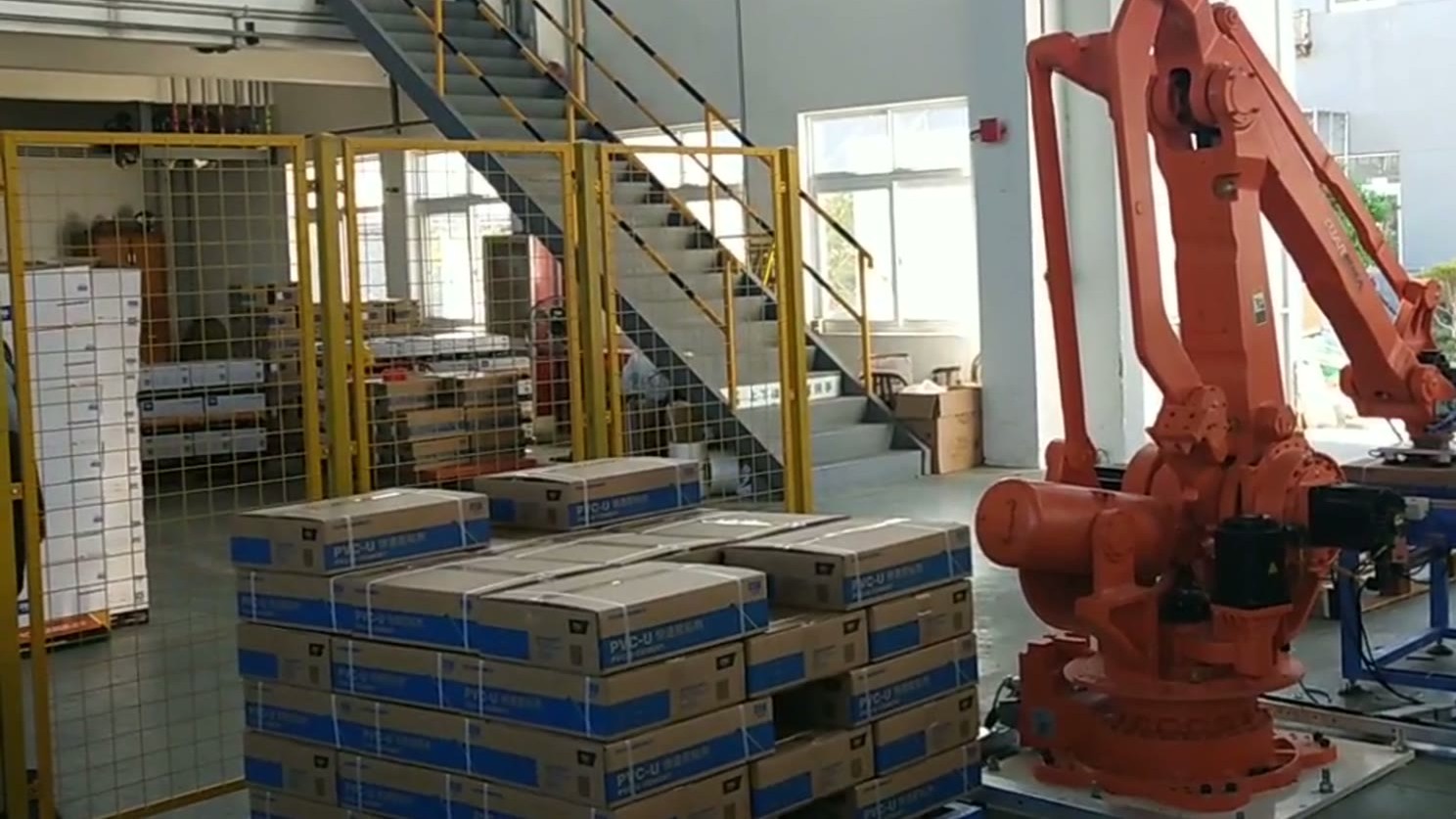
The robot picks from above, so the carton’s top face is what the gripper works with, and whatever the gripper does at the pick has to survive the swing to the pallet.
Grip: holding without crushing
The carton is the product’s packaging, and a flattened corner shows up at the customer. The gripper must hold firmly enough to survive acceleration and the turn, yet gently enough to leave the box intact. Those demands pull against each other, and the balance depends on the carton: its material, how full it is, how rigid its walls are.
This is why we ask for carton size and weight first. They set the holding force needed and how it is spread over the contact area. A light, stiff box and a heavy, soft-sided one are different jobs even when their outer dimensions match. The right gripper for a given carton is a quotation-stage decision, best tested on real cartons.
Grip also reaches forward. After release, the gripper has to retract without dragging the carton or its neighbours. A gripper that needs more room beside the carton than the pattern allows forces gaps into the stack, and gaps cost stability.
Pattern: a load that stays together
A stack is stable when the load is carried evenly and the cartons lock against each other. General principles:
- Alternating the carton direction from one layer to the next bridges the joints below, so the stack does not split into free-standing columns.
- Keeping each layer inside the pallet footprint protects cartons in handling and transport.
- The pattern must fit both carton and pallet; a carton length that is not a neat fraction of the pallet leaves space that should be planned, not discovered.
- Stack height is limited by what the bottom cartons can carry, by the robot’s reach and by what downstream handling accepts.
In this cell each carton is set down against those already placed and lined up with them before the gripper lets go. That alignment turns a pattern on paper into a straight stack, and it only works if the carton sat in the same position in the gripper at every pick, which leads to the third point.
Pick position: one spot at the conveyor end
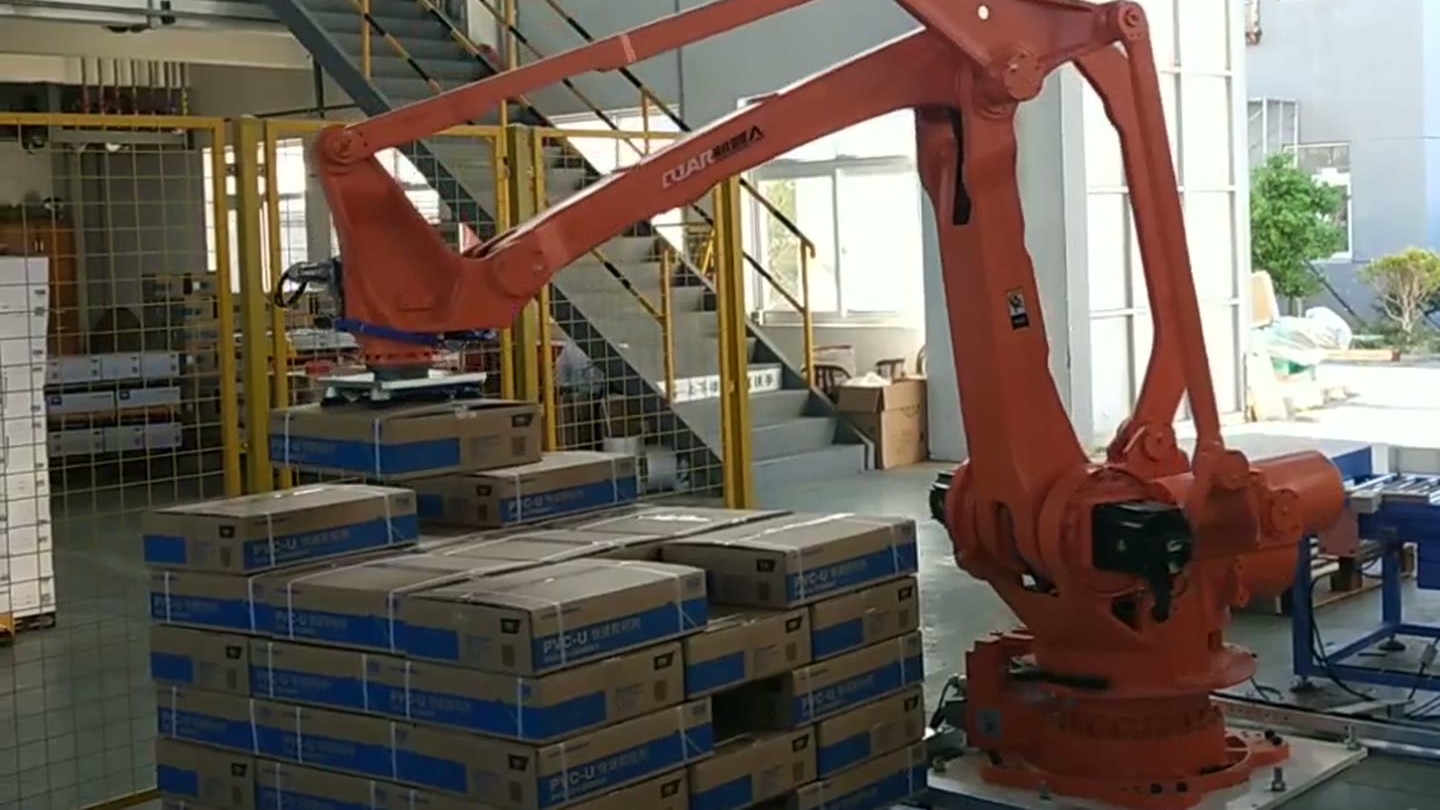
A carton that stops short, or lands crooked on the rollers, is picked off-centre. The error then carries through the cycle: the carton hangs differently in the gripper and is placed offset on the stack. Small pick errors become visible stack errors after a few layers.
In general, a cell can fix the pick position with a physical stop at the conveyor end, side guides that centre the carton, or a sensor that confirms it is in place before the robot moves. Which fits depends on the carton and the conveyor, and the simplest mechanical answer is usually the most dependable. The robot should never have to guess where the carton is. Upstream matters too: if cartons arrive tightly packed or at a varying pace, conveyor length and the buffer before the pick position belong to the cell design.
Four-axis palletizer or cobot palletizer?
Both are used for cartons; the job decides.
| Four-axis palletizing robot | Collaborative palletizer | |
|---|---|---|
| снага | Higher payload, faster cycles for continuous output | Easier to site in a shared area, quick to relocate |
| Reach and speed | Large envelope, built for repetitive pick and place | Usually smaller envelope and lower speed |
| Безбедност | Normally works inside a guarded area | Designed to work beside people; the risk assessment still decides guarding |
| Fits best | Steady, high-volume lines, fixed carton sizes | Lower volume, mixed jobs, tight floor space |
Confirm payload, speed and the safety assessment against your own data before deciding.
When the chain holds, and when it needs more design
It fits consistent carton sizes arriving at a predictable point and going onto one pallet type with a repeating pattern. Look closer when sizes vary widely, cartons are soft or deform under their own weight, several products mix on one pallet, or wrapping and forklift handling add requirements. These do not rule automation out; they decide how much extra design the cell needs.
Questions we hear
Can one cell handle more than one carton size? Often, if the sizes are known in advance and the pattern and pick position are planned for each. The more they differ, the more gripper and pick position must be considered together.
Шта треба да почнете? Carton size and weight, pallet size, the stack height you want and daily output. A photo of the current line helps.
For a cell concept and cycle-time estimate, контактирајте нас овде or write to sales@evsrobot.com.
This article describes the process shown in the video and general design practice; it makes no claim about this cell’s speed, load rating, stacking pattern or layer count.