
Estimate a cookware tending cycle from repeated handoff events, then separate work that must happen in sequence from work that can genuinely overlap. Adding every robot movement to the machine’s operating time overstates the cycle when work runs in parallel. Taking only the longest task understates it when unloading, loading or confirmation blocks the machine.
Draw the event line before choosing a formula
Choose a repeatable boundary, such as one machine-start confirmation to the next machine-start confirmation. Use the same boundary for every observation. A published machine-tending template, for example, measures between explicit cycle-start and cycle-end functions; its convention illustrates why an elapsed time needs a defined scope.
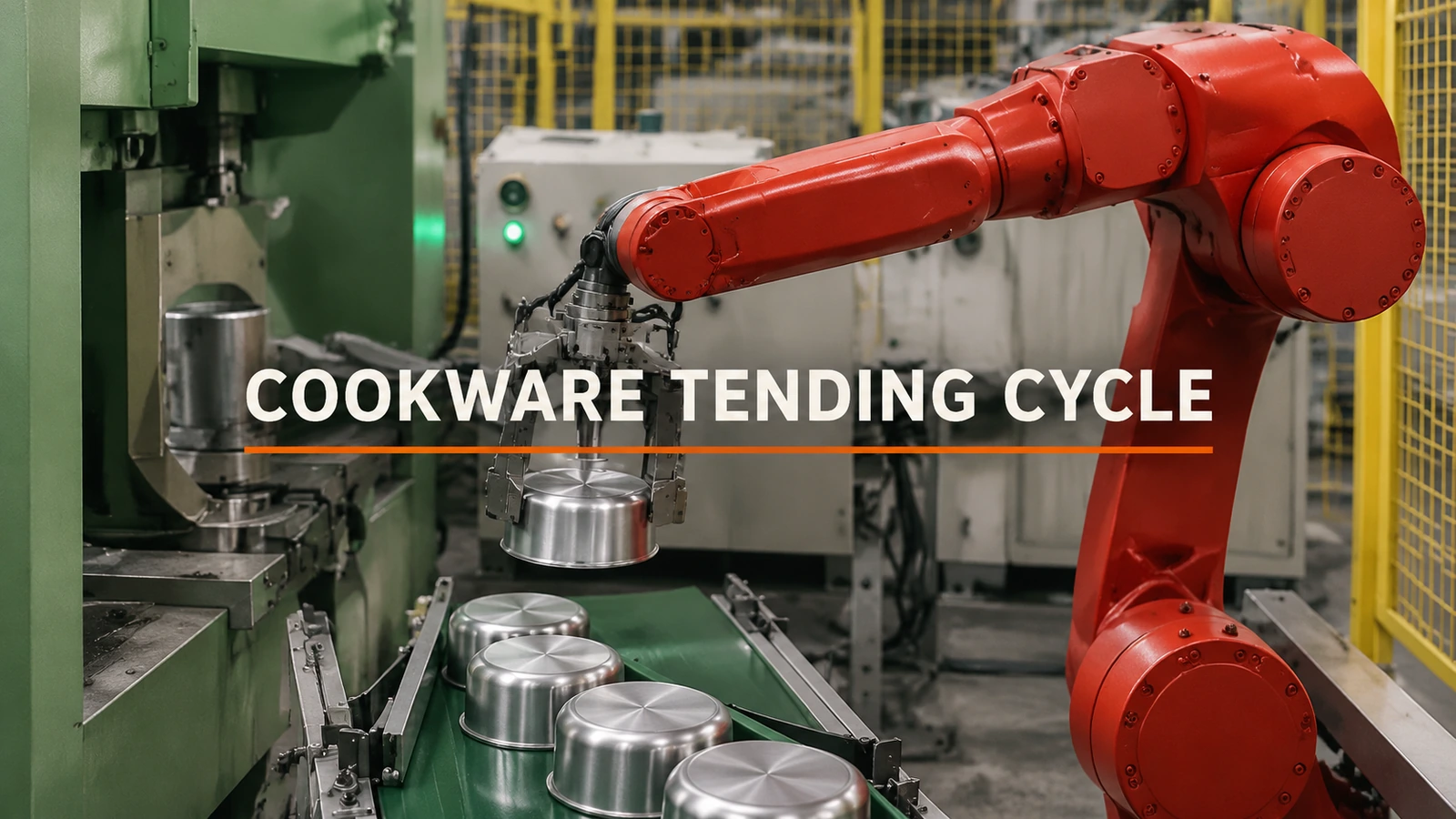
The footage here shows a robot transferring cookware between a row of parts, a rear equipment interface and a nearby station. Those transfers identify activities to investigate. A production estimate needs the corresponding readiness and completion events from the proposed equipment sequence.
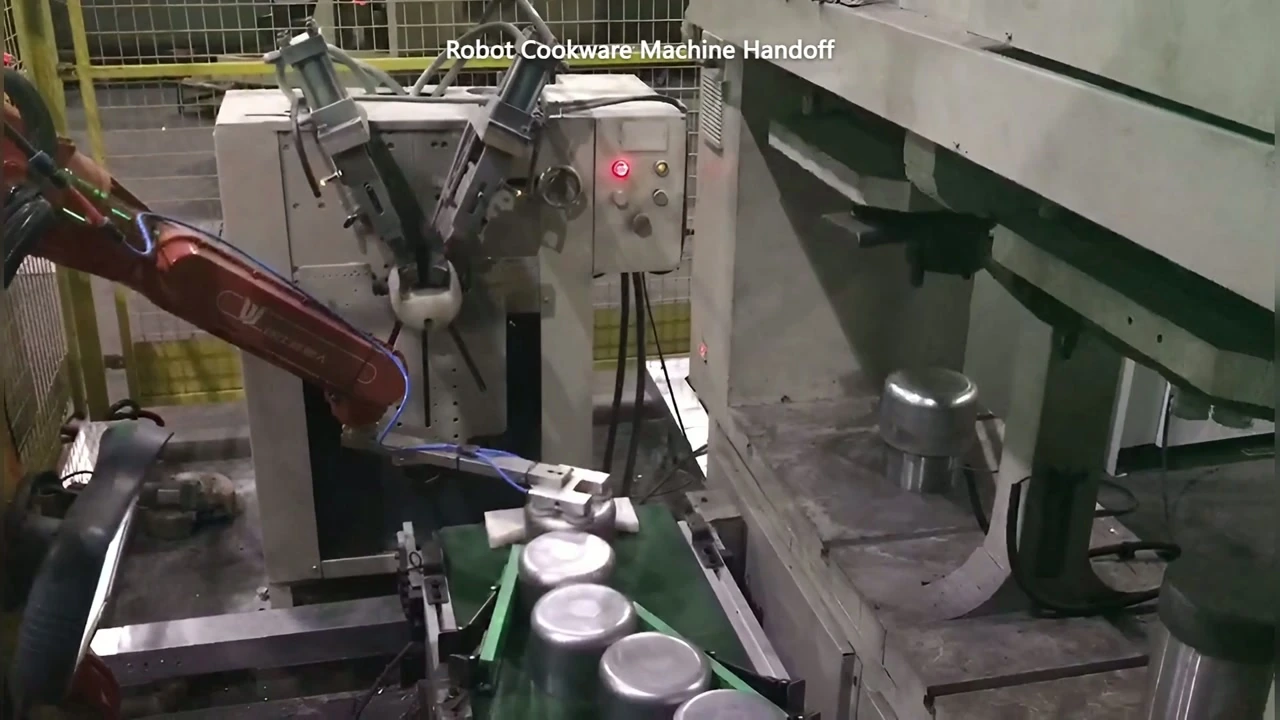
00:08 — Robot tool between the cookware presentation and the equipment-side interface.
Record when the machine becomes available, when the robot is allowed to enter, when the part has been removed, when the next part is placed, and when the machine is permitted to restart. Include gripping and release confirmations in the task they constrain rather than treating them as free time.
A limited overlap model
For a proposed arrangement with a single repeated machine operation, define:
| Μεταβλητός | Νόημα | Συνθήκη χρονισμού |
|---|---|---|
| H | Serial handoff work between machine operations | These steps cannot overlap the machine operation |
| M | Machine-occupied operating interval | Begins after the handoff permits restart |
| R | Robot work outside that machine during the operating interval | Can run concurrently only if resources and access are independent |
After H is complete, M and R start together, and the next H begins only after both have finished. H overlaps neither task. If there is a start delay, work spanning cycle boundaries or another shared-station dependency, use the actual event timeline rather than this simplified expression. Under those assumptions, the repeating interval is T = H + max(M, R). If the external robot work cannot overlap the machine operation, use T = H + M + R instead. These are planning models for the stated sequence, not measured values from the filmed station.
The distinction is practical. Preparing a part elsewhere may fit inside machine time, while removing a finished part from the occupied interface cannot simply be placed in the same parallel block. If another operation shares the gripper, entry space or receiving position, draw that resource conflict before using the formula.
Keep the production allowance in a separate account
The repeating interval is not a complete shift forecast. Replenishment, inspections, changeovers and interruptions can consume time outside the repeated pattern. Record those activities separately and decide how they affect the production window. Do not hide them inside an unexplained efficiency percentage.
If the machine repeatedly waits after it is ready, investigate the event delaying restart. If the robot mostly waits during machine operation, making its free-space travel faster may not change the repeated interval. The event record tells the team which delay is worth addressing.
Καταχώρηση EVST a continuous handoff recording, the available machine-ready signals and the intended production window. These are useful starting inputs for discussing a sequence estimate and identifying the missing measurements.