
Moving a clamp to clear the welding gun is a fixture change, not just a path correction. Before approving it, compare how representative parts sit, how they respond when clamped and what happens when released without welding. Then check the real gun route. This order helps distinguish a holding problem from a change that appears only after welding.
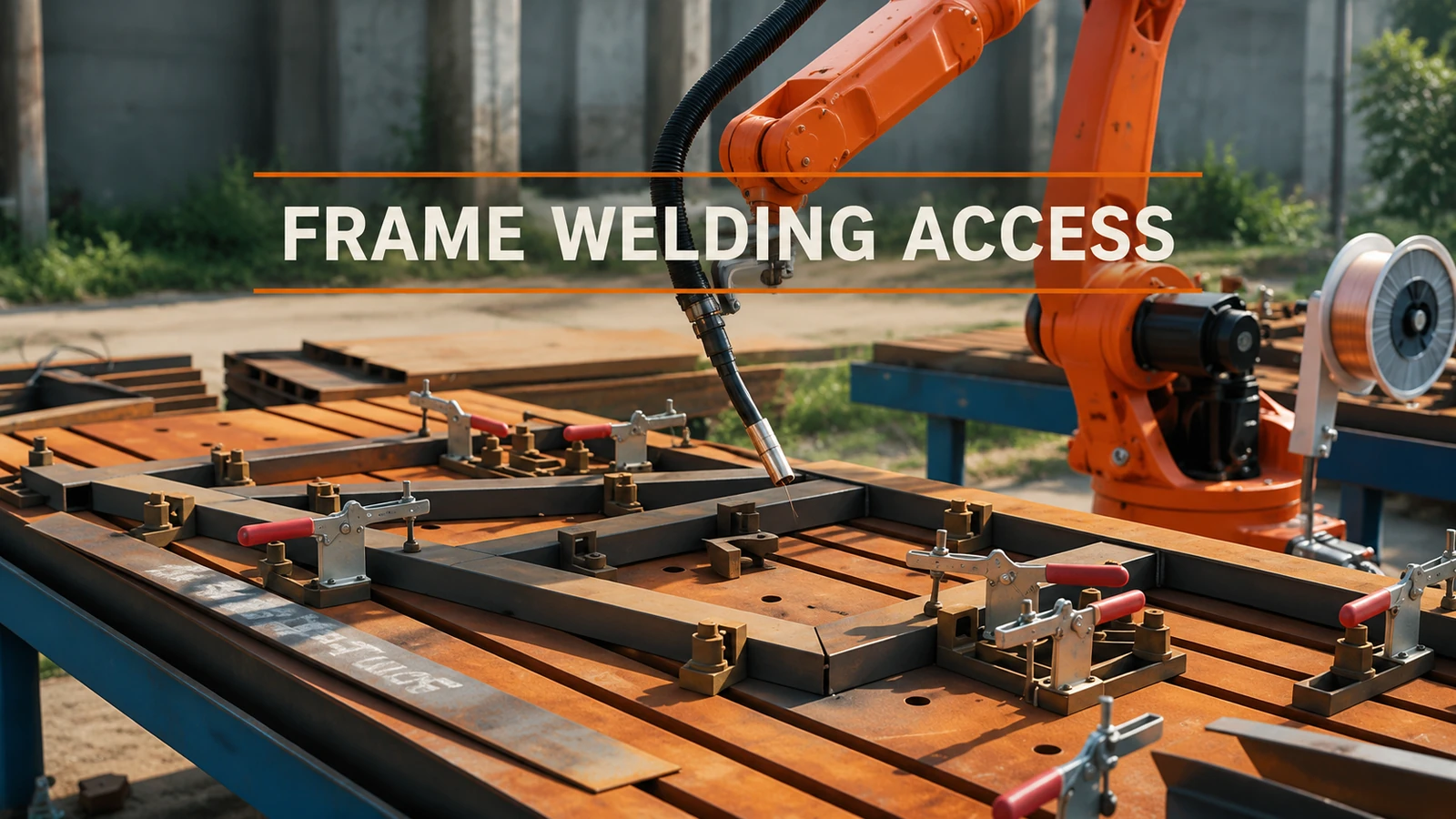
The application here shows an orange robot arc welding a rectangular component on a long table, with red clamps around the work. For a proposed clamp revision on this kind of fixture, the useful approval question is whether the new arrangement preserves the part’s reference while opening the required working space.
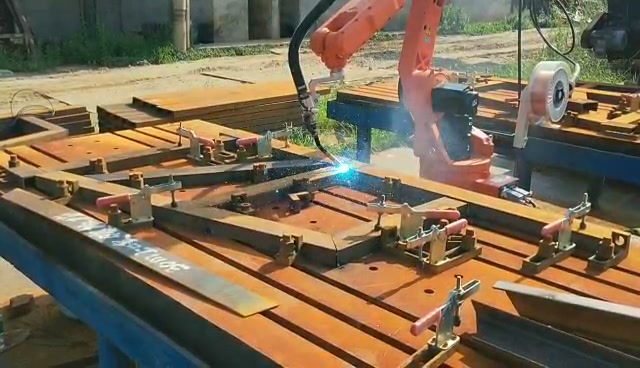
EN main film 00:24 — gun at a joint on the clamped rectangular component.
Record what the relocated clamp must still do
On a photograph or fixture drawing, mark the original pad position, the proposed one and the supports underneath. Identify the locating contacts that establish the part’s position separately from the clamp that holds it against them.
The new pad should press toward an appropriate support or locator rather than bend an unsupported span. Moving it away from the gun may also move it away from that support. Increasing force to close a visible gap can conceal a seating problem instead of resolving it.
Keep a record of the intended incoming-part condition and the joint or installation features that must retain their position. Use those same references before and after the change. Otherwise, a different measurement setup can be mistaken for a fixture improvement.
Compare the cold states before making an arc
With the proposed arrangement, use a controlled, non-welding trial to record the sequence below. Apply the product’s agreed criteria; do not invent a universal gap or movement limit.
| ပြည်နယ် | What to observe against the same references | What a concern directs you to examine |
|---|---|---|
| Part seated, clamps open | Contact with the intended supports and locators; where the joint lies | Incoming-part condition, seating route or obstructed contact |
| Clamps closed | Whether the reference is retained; changes in the joint, support contact or part shape | Pad location, support beneath it and the applied holding action |
| Clamps released, still unwelded | Whether the part returns or retains a changed shape; whether it can be removed normally | Clamping-related movement and the loading/release sequence |
Repeat this comparison with representative incoming parts, including the variations the fixture is expected to accept. A particularly straight master part can miss a problem that appears when the next batch is loaded.
If movement or bending already occurs in this cold trial, start with contact, support and clamping. Changing the weld sequence cannot explain a movement that happened before any arc. Record the observation before adjusting another variable.
Check the gun route with the actual holding states
Once seating and holding are acceptable, check approach, movement along the joint and withdrawal using the complete proposed gun envelope. Include the move between separate joints. A route that clears the open fixture may not clear the closed clamps.
If the proposal opens a clamp during the sequence, record what continues to locate and retain the assembly in that state. Treat it as a distinct arrangement to check, rather than temporarily hiding the clamp in a model. The controlled path check should use the corresponding physical clamp states.
Keep the welding trial separate from cold acceptance
After the cold checks, run the relevant welding trial and inspect the required features after release, using the same references. If the cold sequence was acceptable but the welded assembly differs, review the fit-up, holding sequence and welding conditions together. The comparison tells the team where the change first appears; it does not make a single cause certain.
An actionable change record links the clamp revision to its cold-state observations, checked gun route and subsequent welded sample. For an EVST discussion, send before-and-after clamp photographs, the support locations and the feature that must stay in position. That is a more useful starting point than an unqualified request to “make room for the gun.”