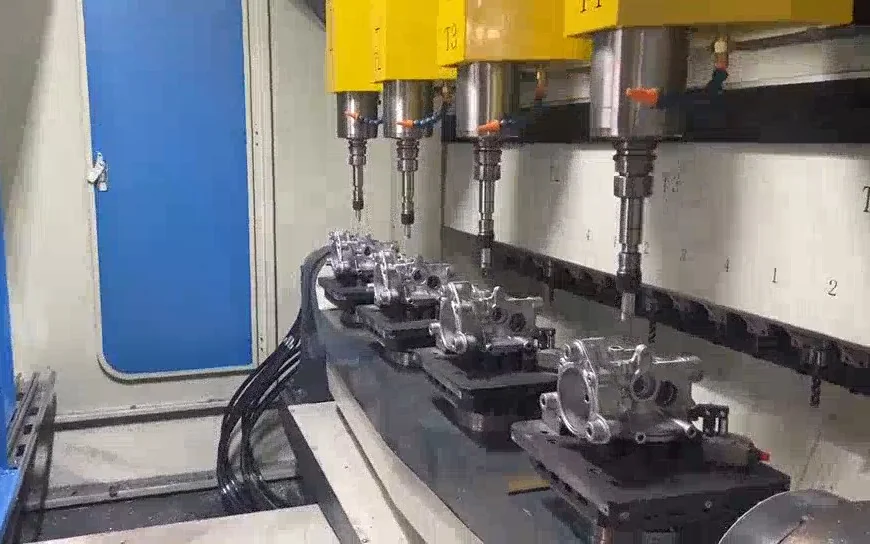
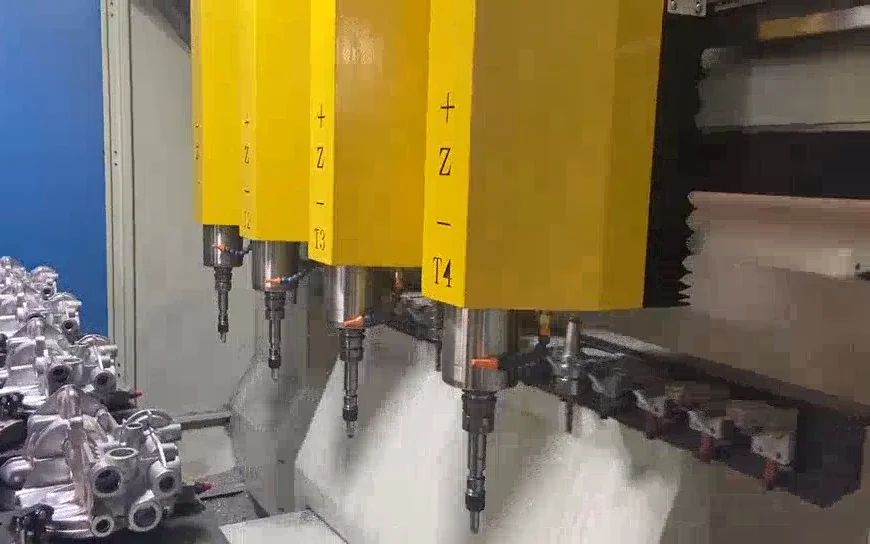
An automated deburring machine is a special-purpose CNC machine built to take off the flash, gate remnants, parting lines and other burrs that casting or molding leaves on a part. The part is clamped in a dedicated fixture and the spindles move on programmed machine axes inside a closed cabin. On multi-station models, every station cuts at the same time, so one cycle finishes several parts. That suits work where the same part family comes back in volume and the fixtures can be designed around it.
A dedicated deburring machine is usually the better fit when:
A robot cell is usually the better fit when:
The two are not exclusive. In lines we have built, a robot destacks the castings and feeds the machines (see linking the machine to a robot). For robot-based deburring of large castings, scan-generated paths and post-weld grinding, see the tế bào loại bỏ bavia bằng robot.
The deburring machines we have built fall into three families. The family follows the part: large die-cast housings, small die castings, or cosmetic parts. Within a family, the frame, the number of stations and the axes are then chosen for each project based on your parts and output targets.
| Cấu hình | Motion and stations | Các bộ phận điển hình | Nó loại bỏ cái gì | Tải |
|---|---|---|---|---|
| Single-station six-axis machine, three frame sizes | Six axes, one part per setup | Car and small-engine blocks, transmission housings, other die castings of different sizes | Flash, heat-check fins, gate remnants, parting lines | By hand or by robot |
| A/B rotary-table dual-station machine | Two stations on a rotary table on the larger frame | Larger aluminum die castings | Burrs; grinding | One side loads while the other side is processed; suited to robot loading |
| Dual-station machine with an external axis | Larger frame plus an external axis | Larger aluminum die castings | Burrs; two parts processed in one clamping | Mỗi dự án |
| 5-axis four-station machine for die castings | Five axes, four stations cutting at once | Small automotive and motorcycle die castings, hardware | Flash, heat-check fins, gate remnants, parting lines | Fixture bar loaded by hand through the front doors |
| 5-axis six-station machine, 3D contours | Five axes, six stations cutting at once | Phone housings, e-cigarette housings, automotive plastic parts, power-bank housings | Gate marks, tool marks, burrs | Mỗi dự án |
| 5-axis four-station machine, 2D contours | Five axes, four stations cutting at once | Camera housings, set-top-box housings, e-cigarette housings, door handles | Gate marks, tool marks, burrs | Mỗi dự án |
For large die-cast housings, such as engine blocks for cars and small engines and transmission housings, the single-station machine works one clamped part at a time with six axes of tool motion. It is built in three frame sizes, so the frame is matched to the size of the casting. It removes the four burr types die casting leaves behind: flash, heat-check fins, gate remnants and parting lines.
On the larger frame, an A/B rotary table gives the machine two stations. While the part on one side is being deburred, the finished part on the other side is taken off and a new casting clamped, so loading happens inside the cycle rather than after it. That is what lets a robot tend the machine inside a production line. A second version adds an external axis to the large frame and processes two parts in a single clamping.
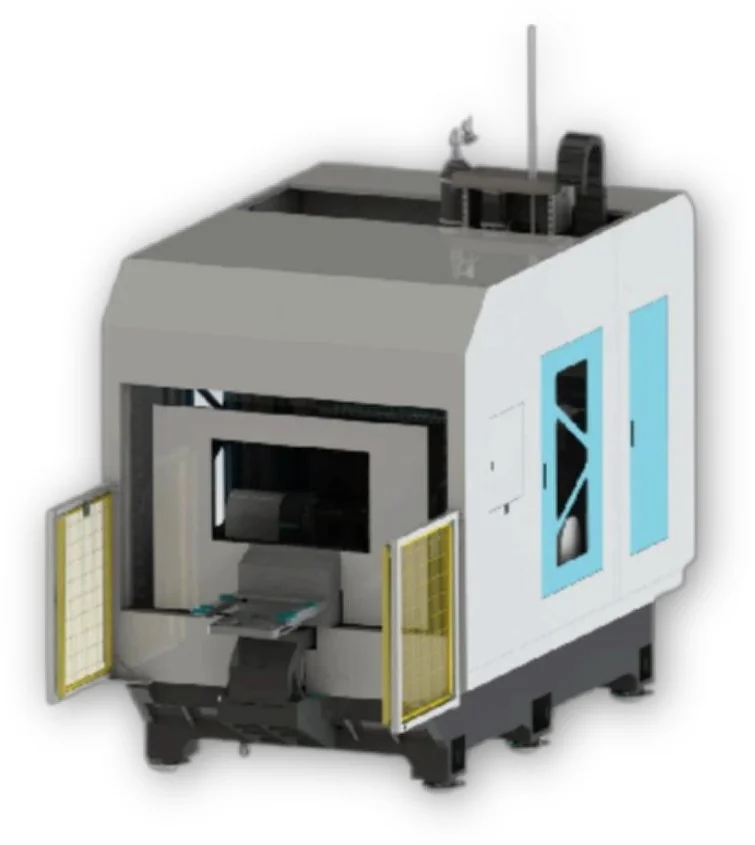
For small automotive and motorcycle die castings and hardware parts, a five-axis machine with four stations finishes four parts in each cycle, taking off flash, heat-check fins, gate remnants and parting lines. When the product changes, the machine can be switched over to the new part type.
On cosmetic parts in aluminum, plastics and other materials, gate marks, tool marks and burrs are appearance defects on the finished housing. Two five-axis machines cover this work, split by the shape of the surface:
On the four-station cosmetic machine, the contour is followed under CNC control, and a circulating water system filters and settles the grinding dust. Both machines can be switched between product types. For polishing fixtures and finish control on phone housings, see đánh bóng ốp lưng điện thoại.
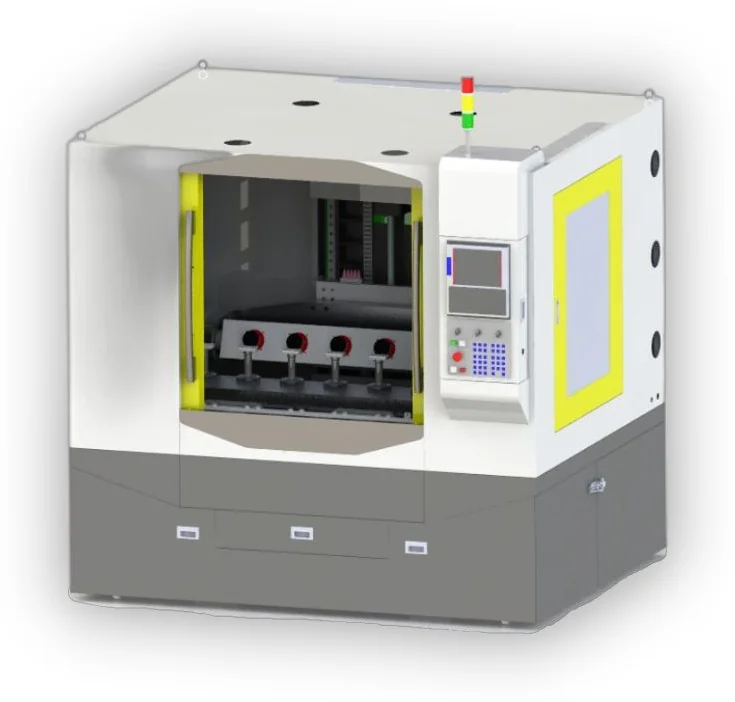
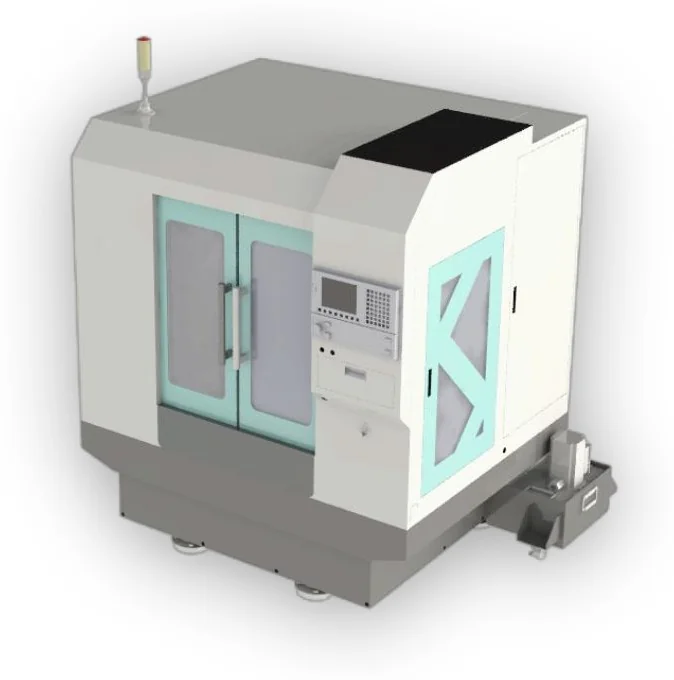
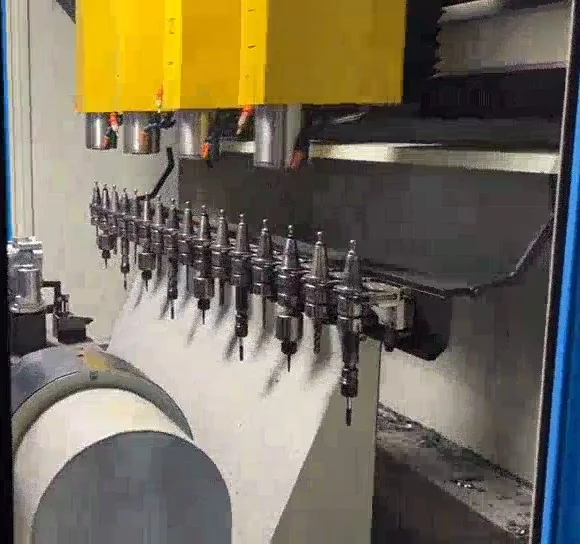
The footage and stills on this page come from a five-axis four-station machine deburring aluminum die castings.
In the machines built to date, the station count follows the part type: four stations for small die castings, six stations for cosmetic parts with 3D contours, and four stations for cosmetic parts with 2D contours. All stations cut at once, so each cycle finishes as many parts as there are stations loaded.
For your part, four things decide the configuration:
EVST confirms the station count, the fixtures and the cycle on your actual parts for each project.
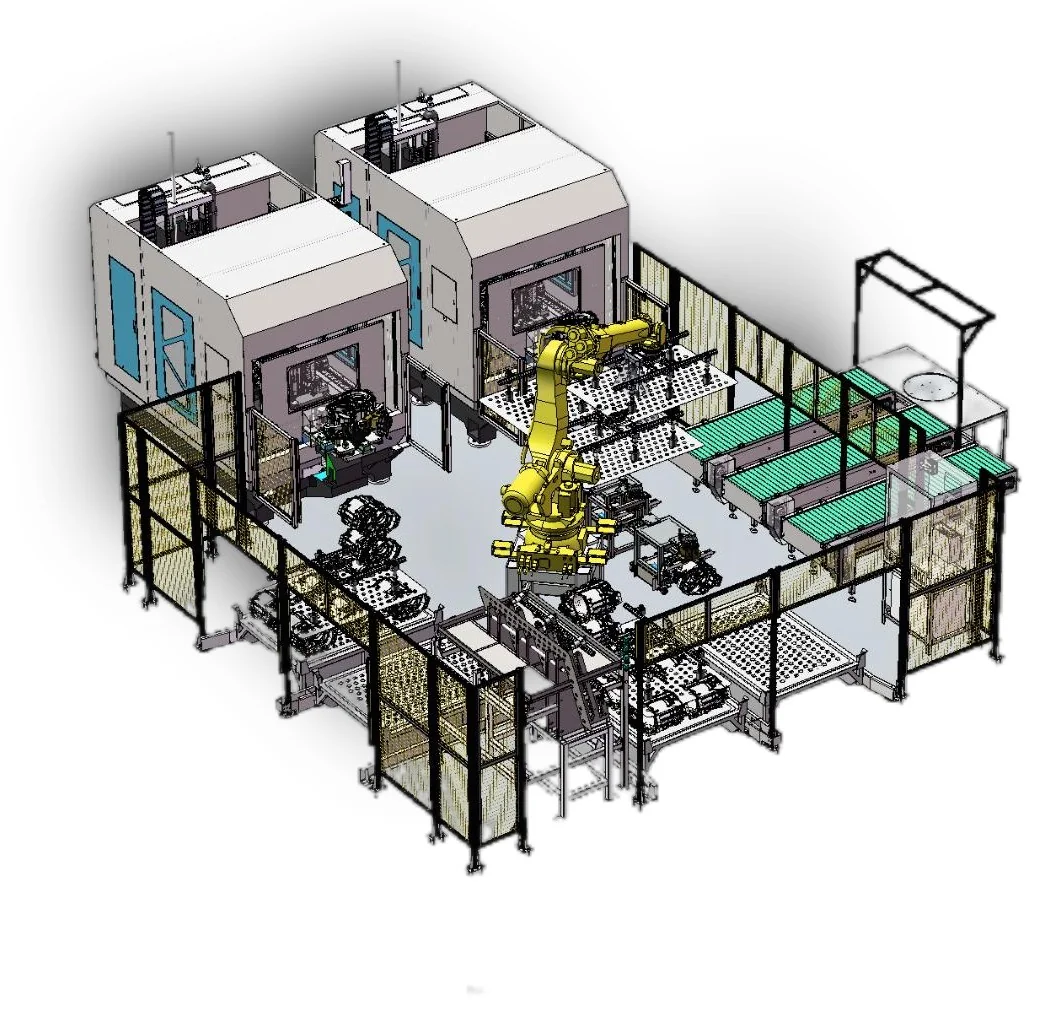
A deburring machine does not have to be loaded by hand. For unmanned loading, the systems we have built pair one robot with two machines. The robot takes castings off the incoming pallet, with 3D vision finding each one before the pick, feeds both machines in turn, and stacks finished parts on the outgoing pallet. With an A/B rotary-table machine, the robot loads one side while the other side is still cutting. How many machines one robot can serve is worked out from the cycle times of your parts.
Đọc liên quan: one operator running several machines with a robot và balancing a dual-station motor-housing grinding cell.
A quote for an automated deburring machine starts from your parts. Send what you have of the following:
Sample parts help confirm the fixture design and tool approach before the configuration is fixed.
| Mục | Giá trị |
|---|---|
| cấu hình | Six-axis single-station (three frame sizes); A/B rotary-table dual-station; dual-station with external axis; 5-axis four-station; 5-axis six-station |
| Parts processed per cycle | 1 (single-station); 2 with the external-axis version; 4 or 6 on multi-station machines |
| Vật liệu | Aluminum high- and low-pressure die castings; aluminum, plastics and other materials for cosmetic parts |
| Hoạt động | Flash, heat-check fins, gate remnants, parting lines; gate marks, tool marks, burrs |
| Kiểm soát | CNC |
| Spindles (5-axis four-station die-casting machine) | Four spindles moving together; tools changed from an in-cabin rack |
| Fixture (5-axis four-station die-casting machine) | Fixture bar rotates to present further faces of the castings in one clamping |
| Hệ thống nước | Circulating water with dust filtration and settling (four-station cosmetic machine) |
| Tải | By hand; A/B rotary table for loading during the cycle; robot loading with 3D-vision pallet picking |
| Kích thước và trọng lượng tối đa của bộ phận | Theo yêu cầu |
| Spindle power and speed, axis travel | Theo yêu cầu |
| Thời gian chu kỳ | Assessed per project on your parts |
Configurations listed are those built to date; the machine for your parts is selected for each project based on your parts and output targets.
An automated deburring machine is a special-purpose CNC machine that removes burrs, flash, gate remnants and parting lines from cast, molded or machined parts. The parts are held in dedicated fixtures and the spindles move on programmed machine axes in an enclosed cabin. EVST builds single-station six-axis, A/B rotary-table dual-station, and 5-axis four- and six-station configurations.
Choose a multi-station deburring machine when the same small castings run in volume and several can be clamped at once; a five-axis four-station machine finishes four per cycle. Choose a robotic deburring cell for large castings, a wide part mix, frequent changeovers, or castings whose burr positions vary enough to need a scan of each part. Large housings can go either way: a six-axis single-station machine or a robot cell, decided on access and part mix. See the tế bào loại bỏ bavia bằng robot for the robot route.
In the machines built to date, small die castings run on four stations, 3C cosmetic parts with 3D contours on six, and those with 2D contours on four. Every station cuts at once, so more stations means more parts per cycle, provided each part and its fixture fit one station. The final count is confirmed on your parts.
Both are five-axis multi-station machines for appearance parts made of aluminum, plastics or other materials. The 3D-contour machine has six stations and is used on phone housings, e-cigarette housings, automotive plastic parts and power-bank housings. The 2D-contour machine has four stations and is used on camera housings, set-top-box housings, e-cigarette housings and door handles.
Yes. Each multi-station machine can be changed over to another product type by swapping the fixtures and the program for the new part. How many part numbers can share one machine, and how often it can change over, is assessed on your part list.
Yes, on the 5-axis four-station machine for die castings. The fixture bar holding the castings rotates to turn further faces toward the spindles, and the spindles change tools from the rack in the cabin, so several faces are finished without unclamping. Which faces can be reached in one clamping is checked against your part drawings.
Yes. With an A/B rotary-table machine, a robot loads one side while the other side cuts. In lines we have built, one robot destacks castings with 3D vision, feeds two machines and stacks the finished parts.
On aluminum die castings it removes four kinds: flash, the thin fins of metal where die halves and cores meet; heat-check fins, raised lines copied from a cracked die surface; gate remnants; and parting lines. On cosmetic parts it removes gate marks, tool marks and burrs.
The price depends on the configuration (single-station, dual-station or multi-station), the frame size, the number of stations, the fixtures for each part number, and whether a robot and pallet handling are included. EVST quotes per project after reviewing your parts; liên hệ với chúng tôi with drawings and your annual volume. Lead time and warranty are confirmed in the quotation.
Configurations on this page are those built to date; the machine for your parts is selected and confirmed for each project.