
An automatic labeling machine is a labeler built into a production line. Containers arrive on the conveyor, the machine puts the label in the same position on every one, and the labeled product moves on to inspection, coding or case packing without anyone handling it. That is different from a handheld label maker or a desktop label printer, which only produce labels for someone to apply by hand.
The EVST labeler is built for high-speed, accurate labeling of round bottles, square containers and cartons, including labels that have to wrap all the way around the container. It can work on its own with a simple floor layout, or run as one station in an sjálfvirk umbúðalína.
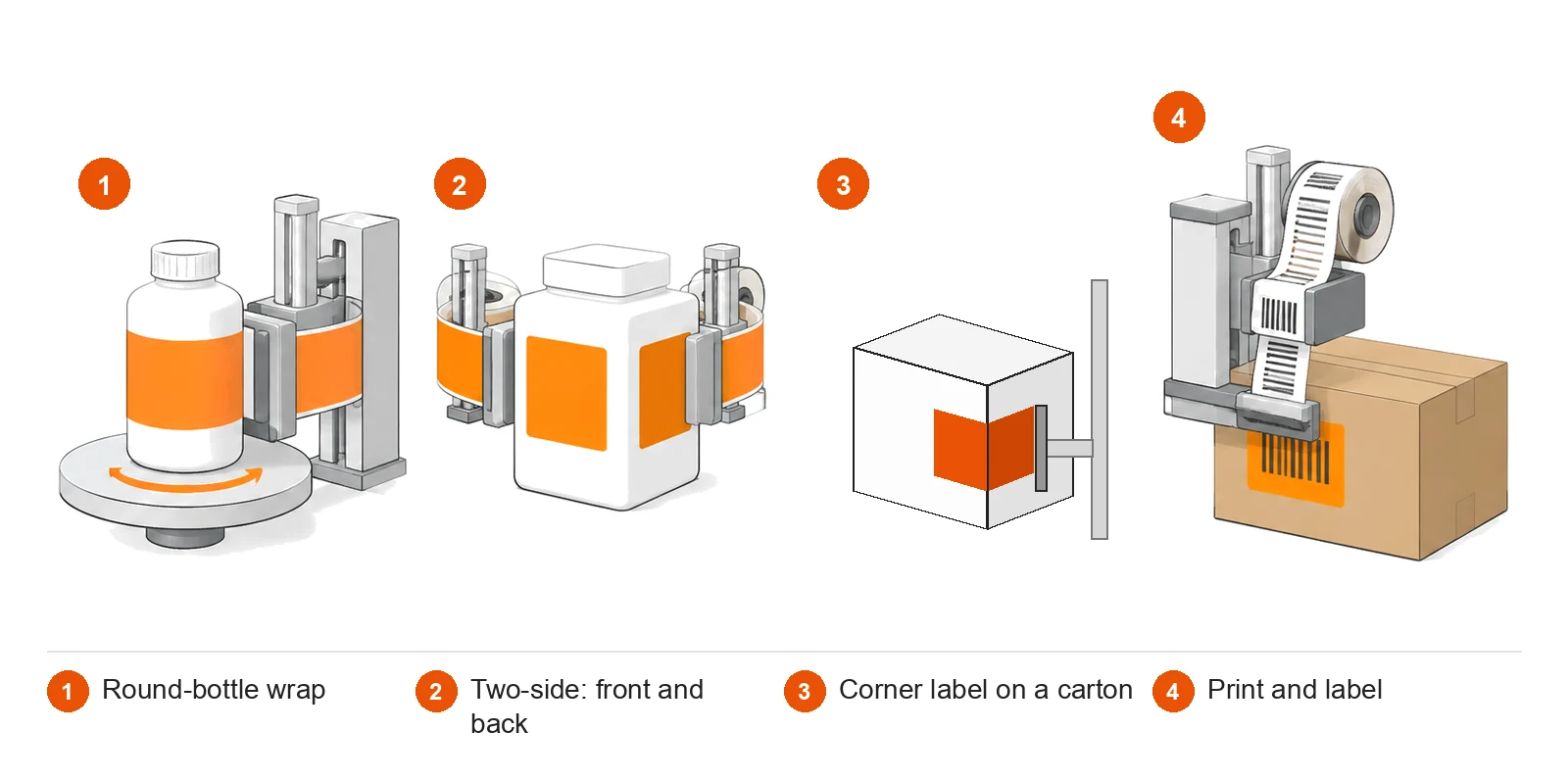
Four labeling configurations are available. Which one you need follows the container shape and where the label has to go.
| Labeling configuration | Notað á | Labeling rate | Stærð merki |
|---|---|---|---|
| Round-bottle wrap | Hringlaga flöskur | 12,000 stk/klst | Height 30–90 mm, length 40–140 mm |
| Two-side (front and back) | Square and flat bottles, pails and jerrycans | 2,000 stk/klst | Height 20–160 mm, length 20–150 mm |
| Corner | Cartons and boxes, label across two faces | 7,200 stk/klst | Height 50–280 mm, length 40–140 mm |
| Print and label | Cartons and containers that need printed data | 7,200 stk/klst | Up to 240 × 100 mm (length × width) |
Labeling rates are the stated values for each configuration. The rate on your containers depends on container size and label length, and is confirmed on your samples.
For round bottles the label is wrapped around the body as the bottle passes the label head. This is the fastest configuration, at 12,000 pcs/h, for labels 30–90 mm high and 40–140 mm long. Agrochemical bottles are a typical example.
Square containers usually carry a front label and a back label, so the two-side configuration applies both in one pass, at 2,000 pcs/h for labels up to 160 mm high and 150 mm long. On square chemical pails, the labeling station can apply labels of different sizes at the same time, on one face, on two faces or on a curved surface.
Corner labeling runs one label across two faces of a carton. It runs at 7,200 pcs/h for labels 50–280 mm high. On the sachet cartoning lines we have built, a corner label with printed data is applied to each carton right after the cartoner and before case packing.
When each label carries data that changes, such as a batch number or a traceability code, the print-and-label configuration prints the label and applies it in one station, at 7,200 pcs/h, with labels up to 240 × 100 mm. For 200 kg chemical drums and IBC totes, where wider labels are printed one by one, EVST uses a separate print-and-apply labeler.
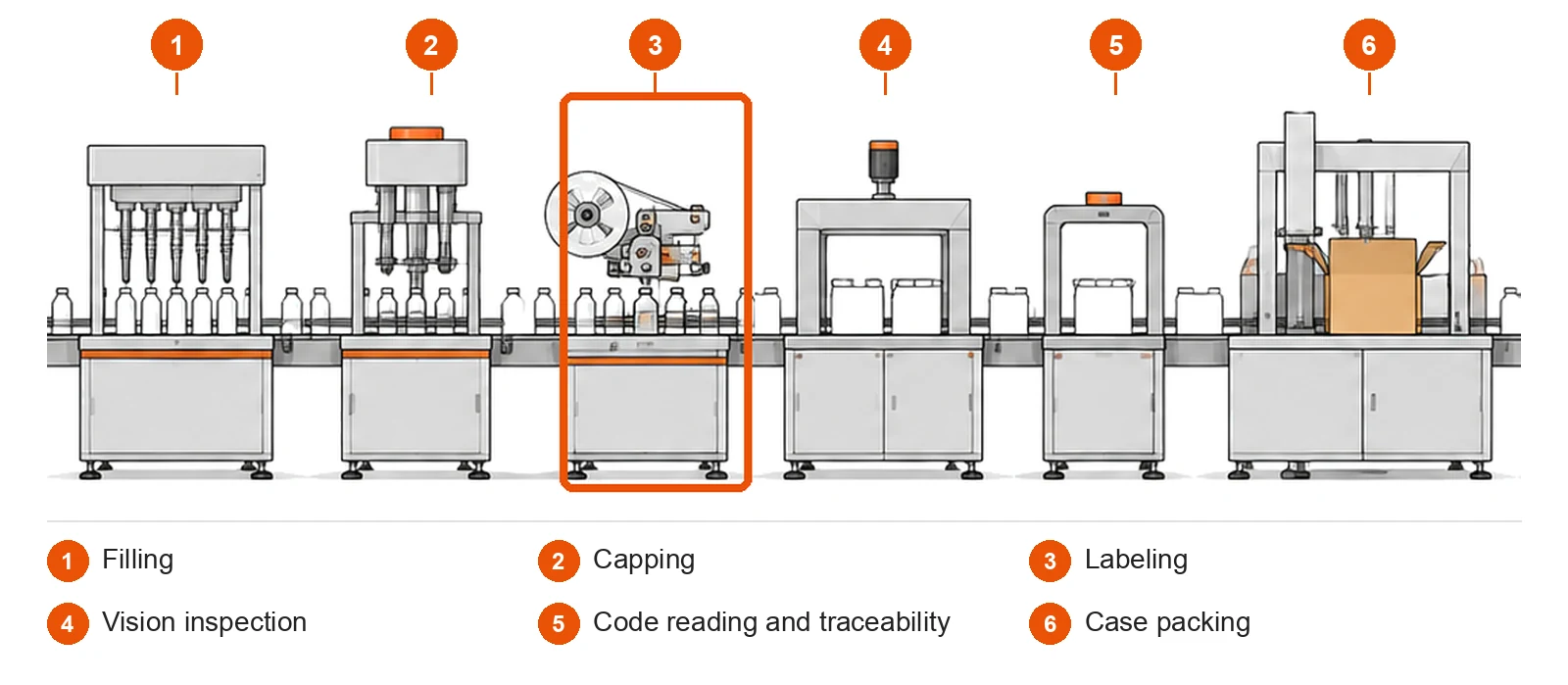
On the liquid filling lines we have built, the labeler sits after the capping machine and before vision inspection and QR code traceability. A typical sequence is:
The exact process steps are configured for each product and project. See the vökvafyllingarlína for complete configurations from 100 ml to 30 L. After labeling, boxed products continue to a öskjuvél.
A labeling quote starts from your containers and labels. Send what you have of the following:
Sample containers and labels help confirm the label head setup before the configuration is fixed.
| Liður | gildi |
|---|---|
| Labeling configurations | Round-bottle wrap; two-side (front and back); corner; print and label |
| Labeling rate | Round-bottle wrap 12,000 pcs/h; two-side 2,000 pcs/h; corner 7,200 pcs/h; print and label 7,200 pcs/h |
| Label size, round-bottle wrap | Height 30–90 mm, length 40–140 mm |
| Label size, two-side | Height 20–160 mm, length 20–150 mm |
| Label size, corner | Height 50–280 mm, length 40–140 mm |
| Label size, print and label | Up to 240 × 100 mm (length × width) |
| Ílát | Round bottles, square and flat bottles, pails and jerrycans, cartons and boxes |
| Notkun | Stand-alone, or linked into a filling and packaging line |
| Eftirlit | Production counter, production data prompts, parameter protection |
Configurations listed are those built to date; the machine for your containers is selected for each project based on your labels and output targets.
No. A label printer or handheld label maker only produces labels, and someone applies them by hand. An automatic labeling machine sits on the production conveyor and applies labels to every container at a fixed position at line speed. The print-and-label configuration adds printing, so variable data such as batch numbers is printed and applied in one station.
Round bottles use the round-bottle wrap configuration, which wraps the label around the body at up to 12,000 pcs/h for labels 30–90 mm high. Square and flat bottles, pails and jerrycans use the two-side configuration, which applies a front and a back label in one pass at 2,000 pcs/h for labels up to 160 mm high. Cartons use corner labeling, with one label across two faces.
The labeling rate depends on the configuration: 12,000 pcs/h for round-bottle wrap, 7,200 pcs/h for corner labeling and for print and label, and 2,000 pcs/h for two-side labeling. The rate on your own containers depends on container size and label length and is confirmed on samples.
Yes. On the liquid filling lines we have built, the labeler sits after capping and before vision inspection, QR code traceability and case packing. It can also run alone. See the vökvafyllingarlína for complete line configurations.
The price depends on the labeling configuration, the number of label stations, whether labels are printed on the line, the container range, and the conveyor and inspection that come with it. EVST quotes per project after reviewing your containers and labels; hafa samband við okkur with photos and your target output. Lead time and warranty are confirmed in the quotation.
Labeling rates and label sizes on this page are the values for each labeling configuration; the rate and setup for your containers are confirmed for each project.

